Get me outta here!

Henny Kupferstein

Official Webpage

Menu

Skip to content
  • Home
  • Services
  • Resources
  • Books, Research, and Publications
  • Autism and Perfect Pitch
  • Contact
  • Book A Consult
  • My Art

Author Archives

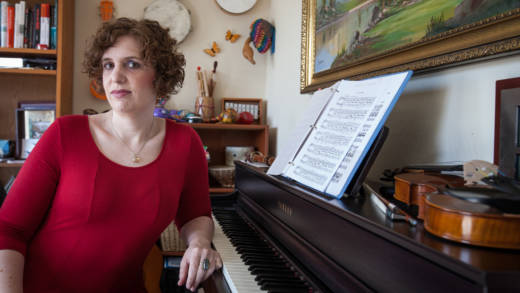
Henny Kupferstein, Ph.D.http://www.hennyk.comAutistic Autism Researcher, Psychology
Henny Kupferstein, Ph.D.'s avatar

Will we ever get honest research about autistic students stuck in school jail?

September 14, 2024 by Henny Kupferstein, Ph.D.

Every now and then, one of these dissertation flubbers make me wonder if these doctorates are actually practicing what they preached. This dissertation was published in 2019, and the references used date back mostly 20 years ago, when supporting arguments that ABA is best for autistic students in education. A quick peek into the author’s professional account is her having been a BCBA in 2004, or at least 15 years before she got her doctorate in education. Will we ever get honest research about autistic students stuck in school jail?

The author, Stephanie G. Augustin, presented her doctoral thesis titled “A Phenomenological Analysis of Autistic Children Receiving Applied Behavior Analytic Treatment: A Culturally and Linguistically Diverse Parents’ Perspective” to Northeastern University’s Graduate School of Education in 2019. Her research focuses on the experiences of culturally and linguistically diverse parents whose autistic children undergo ABA treatment, exploring the intersection of cultural factors and the application of ABA therapy in education.

Augustine completely ignores a critical issue in the ABA debate: trauma. How can you endorse ABA without acknowledging the potential trauma it can inflict, especially in marginalized communities? The focus on “cultural sensitivity” feels like a convenient distraction from the real harm ABA can cause—coercive, retraumatizing interventions that prioritize compliance over emotional well-being.

Positive Behavior Supports (PBS) might sound good on paper, but it risks encouraging educators to treat behaviors as problems to be fixed rather than symptoms of deeper issues like trauma. Where’s the mention of the damage ABA has done to those with trauma histories? The author’s narrow recommendation to apply ABA “culturally” is irresponsible and misses the mark completely.

This paper essentially pushes a blanket endorsement of ABA, even if it tries to soften the blow with talk of cultural sensitivity. It sets a dangerous precedent for educators to apply ABA without critically considering individual needs, trauma, or the broader context. The author had a responsibility to present a balanced view, but this paper is nothing more than a one-sided defense of an outdated, harmful practice.

APA Citation:

Augustin, S. G. (2019). A Phenomenological Analysis of Autistic Children Receiving Applied Behavior Analytic Treatment: A Culturally and Linguistically Diverse Parents’ Perspective (Doctoral dissertation, Northeastern University).

Extracted reference to Trauma:


Critics of Ecological Systems Theory 

Bronfenbrenner’s ecological model is a developmental theory that looks at every aspect  of the individual’s external environment, called “systems” at every level from individual to  societal. This theory was useful as a paradigm for understanding the context of human  development in the framework of examining the relationships between individual and relational  contexts. However, the theory posits that one’s experiences are impacted by events that occur at  any level of the system, making it difficult to pin down any specific event or series of events that shapes individual behavior and development. The theory has a great concern for people, their  interpretations of life events, and the transactional relationships that occur in relation to others (Siporin, 1980). Siporin (1980) critiqued Bronfenbrenner’s ecological theory based on the  premise that one’s ability to “evolve” or access what they want and need can be determined by  access to resources and the individual’s beliefs about his/her ability to obtain the goal. He gives  the example of a successful engineer needing not only to have the academic capacity, but also  the willingness, resources, commitment, time, and learned competence (Siporin, 1980) to achieve  his/her goal. While the theory is often used to explain how people overcome trauma or negative life events, there is a great deal of information on how ecological systems theory frames societal  problems such as crime, mental health issues, and disease (Siporin, 1980).  

There are also claims that this theory leaves out critical components, crucial to a thorough  developmental theory, mainly the concept of resilience and the individualistic or the  “entrepreneurial” person (Christenson, 2016). In a review of Bronfenbrenner’s ecological theory,  Christenson makes some proposed “enhancements” based on the premise that the theory distorts  one’s understanding of how individuals deal with trauma and pain throughout the course of their  development (2016). While the model describes the kinds of impact that negative experiences in  various systems can have on human development, it does not take into consideration the concept  of “resiliency” (Christenson 2016). Resiliency is the ability for an individual to persevere, move  forward, and overcome despite barriers, trauma’s, and negative experiences (Di Fabio &  Saklofske, 2018).  

Christenson (2016) also brings into question the lack of entrepreneurship or individuality  discussed in the ecological model, which stresses relationships between people and contexts. He  compares the model to various other developmental theories such as Freudian psychodynamic  theory, Erikson’s psychosocial theory, Piaget’s cognitive developmental theory, and Vygotsky’s  cognitive-mediation theory. He critiques that the theory would be more comprehensive if it  included the person as an individual and took into consideration how the individual acts as  his/her own agent in decision making, perception creating, and the willingness to participate with  others in meaningful ways that are satisfying and risk-taking. Darling (2007) supports the notion  that a significant part of ecological systems theory is an understanding of the individual as a  reactive, response-evoking entity in the “center of the circle.” This means that the systems cannot exist without the solicitation and active participation of the individual. Individuals cannot  function in isolation, thus requires access to people, resources, and competencies in order to  obtain opportunities (Siporin, 1980). 

Uncategorized Leave a comment

#banABA is scored as a negative sentiment by behaviorists evaluating our tweets

June 13, 2024 by Henny Kupferstein, Ph.D.

Surprise! If your tweets were scored as out of compliance with behaviorism metrics, you are now assigned to the negative category and put into the corner without skittles.

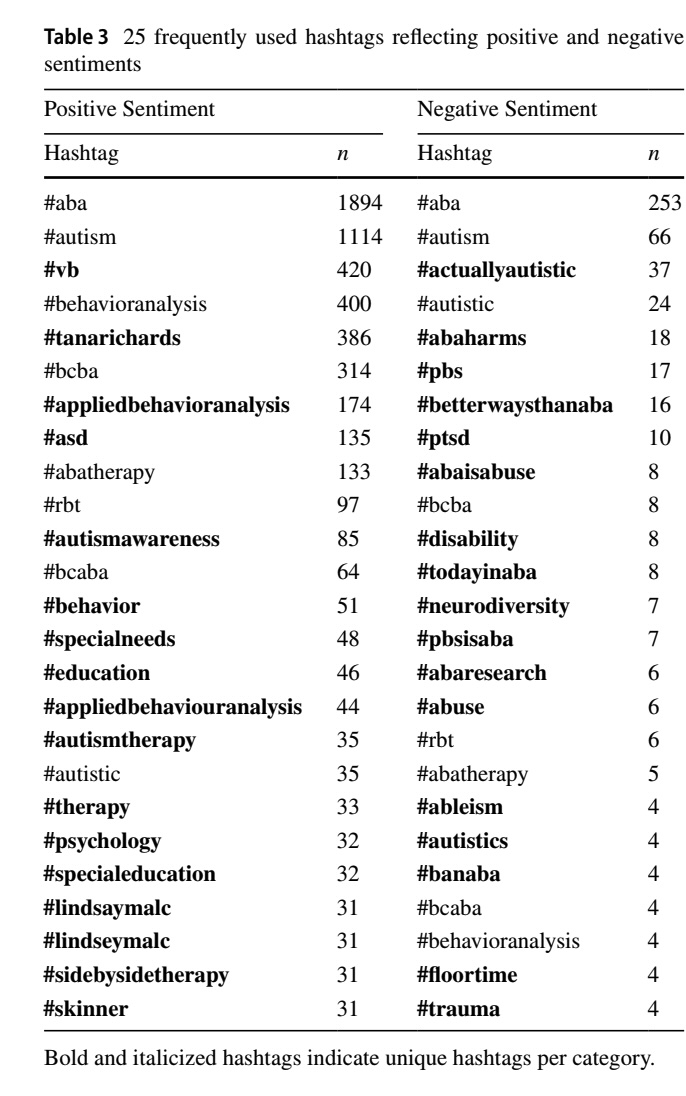
In a recent publication dated April 1, 2024, five behaviorism faculty members from Western University in Ontario, Canada, analyzed around 11,000 tweets about Applied Behavior Analysis (ABA). They categorized these tweets into neutral, positive, or negative sentiments and concluded that a small but vocal minority expresses negative sentiments toward ABA. However, the sentiment analysis conducted by manually coding tweets is inherently subjective and biased, with a lack of detailed validation measures that severely undermine the credibility of their findings. The hashtag #banABA scored a 4 on the negative sentiment weight table. The study does not make possible the auxiliary information necessary to comprehend what “4”  means in the context of their review. 

Behaviorists Label #banABA Tweets as Negative Sentiment

Despite the study’s ambition to provide insights into public perceptions of ABA, a closer examination reveals significant methodological flaws, biased interpretations, and a disturbing disregard for the lived experiences of the autistic community. The study operationalizes human sentiment through an internal scoring system used for both patient populations and strangers on the internet. Tweets that didn’t align with their sentiment ratings were classified as negative and dismissed, reflecting a troubling tendency to ignore critical voices rather than engage with them constructively.

The study emphasizes the distress behaviorists feel when their work is equated with harm but fails to address the root causes of these perceptions. Focusing on the professional discomfort of behaviorists rather than the reported experiences of harm from autistic individuals reveals a prioritization of professional reputation over patient welfare. Moreover, the authors’ equating of tweets with verbal socialization demonstrates a fundamental misunderstanding of how autistic individuals and the general public use written communication on social media. This diminishes the validity of their analysis and reflects a lack of understanding of digital communication dynamics.

The authors conclude with strategies for behaviorists to counter negative sentiments on social media, including how to tweet and use hashtags effectively. This approach trivializes the concerns raised by critics of ABA, reducing a complex, multifaceted issue to a mere public relations problem. Instead of addressing substantive criticisms of ABA practices, the authors focus on managing perceptions, indicating a profound disconnect from the ethical implications of their work. This misguided recommendation exploits the scientific method to silence critical voices on the internet rather than foster an open and honest dialogue.

Hashtags scored: aba, #autism, #vb, #actuallyautistic, #behavioranalysis, #autistic, #tanarichards, #abaharms, #bcba, #pbs, #appliedbehavioranalysis, #betterwaysthanaba, #asd, #ptsd, #abatherapy, #abaisabuse, #rbt, #autismawareness, #disability, #bcaba, #todayinaba, #behavior, #neurodiversity, #specialneeds, #education, #appliedbehaviouranalysis, #abuse, #autismtherapy, #therapy, #ableism, #psychology, #specialeducation, #banaba, #lindsaymalc, #lindseymalc, #sidebysidetherapy, #foortime, #skinner, #trauma, #pbsisaba, #abaresearch

Uncategorized Leave a comment

Autistics Opposed to AB-1822 competency to stand trial.

January 12, 2024 by Henny Kupferstein, Ph.D.

A new bill was introduced yesterday by Assemblymember Damon Connolly [D] “AB-1822 Criminal defendant: mental competency to stand trial.” (see his Facebook Assemblymember Damon Connolly)

If passed, the law would force courts to continue the prosecution of sex offenders who have been deemed incompetent to stand trial. Currently, the law requires the court to order the transfer to a mental health facility. As these facilities have a long history of not improving or changing competency (autism cannot be cured), cases are currently being dismissed. 

I spoke to Connolly’s staffer Michael [michael.dyar@asm.ca.gov (916) 319-2012]. They are not considering any amendments. Autistic people should not be forced into ‘curing’ their competency in a state facility that isn’t inclusive of DD/ID needs. 

I want to make sure regional centers are represented (Daniel Savino <DSavino@arcanet.org>), as they would have to fund the behavioral supports for people who are referred by the courts. Lastly, I have an initiative to be introduced this session, which would mandate public schools to include DD/ID students in sex ed classes. 

  • Read proposal as HTML
  • Read proposal as PDF

So long as DD/ID SPED students are excluded from mainstream health education, we should not be forcing them into perpetual criminalization of their sexual behaviors that are judged as illegal.  

Action Items

  • Call Connolly’s office (916) 319-2012 and demand that they amend the bill language. DD/ID people should not be remanded to a facility under the court order to correct their competence to stand trial. The ammendmant should exclude DD/ID people from the court ordered monitoring of competency ‘treatment’
  • Contact the Assembly Health Committee (916) 319-2097 and speak to Patty.Rodgers@asm.ca.gov, to assure us that developmentally disabled people excluded from sex ed not be criminalized.
  • Contact the Assembly Committee on Rules (916) 319-2800​​ and ask that this bills is double-referred to health committee. Email mike.erke@asm.ca.gov
  • Write to me, henny@hennyk.com for help with registering your opposition.

Uncategorized Leave a comment

CalHHS Behavioral Health Task Force: Street Medicine

December 15, 2023 by Henny Kupferstein, Ph.D.

Homelessness is a pressing issue in many countries around the world. While governments and non-profit organizations work to provide shelter and basic necessities, access to healthcare remains a challenge for many homeless individuals. This is where street medicine comes in.

Street medicine is a unique approach to healthcare that involves bringing medical care to people living on the streets. It originated in the United States in the 1990s and has since spread to other countries around the world. The goal of street medicine is to provide basic healthcare services to homeless individuals who may not have access to traditional healthcare.

Street medicine practitioners typically work in teams that include doctors, nurses, social workers, and outreach workers. They go out into the community to meet with homeless individuals, providing medical care and connecting them with other resources they may need, such as housing and food assistance.

One of the key benefits of street medicine is that it meets people where they are. Homeless individuals may be hesitant to seek out traditional healthcare services due to various barriers, such as lack of transportation or fear of discrimination. Bringing healthcare directly to the streets helps to break down these barriers and make healthcare more accessible.

Research demonstrates that 30 to 40 percent of homeless people have a cognitive impairment, including traumatic brain injury, learning difficulties, intellectual disabilities, autism spectrum disorder, and attention deficit hyperactivity disorder.

Another benefit of street medicine is that it takes a holistic approach to healthcare. Practitioners work to address not just physical health concerns, but also mental health and social determinants of health, such as access to healthy food and safe housing. This approach can help to improve overall health outcomes for homeless individuals.

Despite its many benefits, street medicine is not without its challenges. Practitioners may face safety concerns when working in the streets, and funding for street medicine programs can be limited. However, the impact of street medicine on the lives of homeless individuals cannot be overstated.

In conclusion, street medicine is a vital approach to healthcare that helps to bridge the gap between homeless individuals and traditional healthcare services. By providing medical care directly to the streets, street medicine practitioners are able to meet the unique needs of this vulnerable population and improve their overall health outcomes.

    Uncategorized Leave a comment

    Critique of Compassion as a “Dimension” of Applied Behavior Analysis (ABA)

    December 9, 2023 by Henny Kupferstein, Ph.D.

    Look out, behaviorism lovers. We the autistics are monitoring your insistence on rebranding ABA. No matter what you will call it (neurodiversity informed, trauma informed, compassion informed, etc.), we see you. We will continue to publicize our concerns, as clearly, those who practice ABA are not perfect enough, and rely on feedback from their patient group to correct their misbehaviors. 

    There is no scientific method in place that considers ‘listening to the voices’ as primary source data. If they want to include our concerns in their research, they should survey us. Behaviorists who keep flagging my 2018 study are most likely to cite Leaf’s critique, while neglecting to cite Chown’s response to the editor. 

     Oxford Languages  defines Compassion as “sympathetic pity and concern for the sufferings or misfortunes of others” i.e. “the victims should be treated with compassion”. Yet, we have a growing body of behaviorist-led papers that propose adding “compassion” as the 8th principal in their standards of practice. Specifically, this month’s latest publication suggest: “Adding compassion as a definitional dimension of ABA will help behavior analysts find their way back to implementing interventions in a responsive, collaborative, and humble manner that includes working with our consumers and our critics, and listening to perspectives that can help us improve our practice.”

    A google scholar search reveals a sublime trend of 17,000 results to the search of “compassion” in “ABA”. As behaviorists are not trained in conducting scientific research, their publications are typically proponents of change, directed at modifying their own. In the realm of adding “compassionate care or therapeutic relationship building” to their standards, we the consumers will be led to believe that we are a subject of their pity. 

    Compassion is an engineered concern for our “suffering,” without extinguishing their agenda to modify us. With compassion in their work, we the autistics are the “consumers” of their services, and we are informed to be grateful for their consideration to help us, the ones with the “misfortunes” of being autistic. One compassion-suggesting behaviorist is cited as an early hero, where Wolf and others (1963) “taught a young boy to wear his glasses so that he would not lose his vision”, as an example of application of operant conditioning. If this makes you gag, please comment. 

    Uncategorized ababanababehaviorismptsd Leave a comment

    Federal AWE-WIOA Autistic Campaign Interns Wanted (Nov through March 2024)

    October 15, 2023 by Henny Kupferstein, Ph.D.

    Autistic Campaign Interns Wanted (Nov through March 2024). Autistic adult work experience, unpaid, remote or San Diego headquarters. Learn how to manage a campaign and consider a career in public office by learning from California Assembly Candidate, autistic Dr. Henny Kupferstein herself!

    Instead of an unpaid internship, we have partnered with Adult Work Experience (AWE) for salary payment under the Workforce Innovation and Opportunity Act (WIOA). I am an autistic autism researcher who is also receiving AWE. 

    Apply with Brett W. Kerr

    Please submit a Resume and W4 and I9 by contacting our Business Service Representative with Access Inc. Brett Kerr, bkerr@access2jobs.org Tel 858-560-0871 Ext. 123 | 850-830-7654 Cell | web www.access2jobs.org 

    We can also offer credit for your college degree program, as you learn research methods, science writing, scientific audits, and other on the job experience. Our organization is an Educational Institution that in its mission, develops the workforce of future autistic leaders, innovators, scholars. 

    Yes, I’m Interested!!


    See Campaign Website at VOTEHENNY.com, and let us know what you found most interesting in scrolling through our content.

    Email your introduction and impress in your unique way how we can learn about you from your online content.

    WIOA Interview with Alex San Diego Workforce Partnership

    Interviewer: Hello, thank you for taking the time for this conversation. Could you please provide an overview of the services offered by the San Diego Workforce Partnership for workplace experience for autistic adults?

    San Diego Workforce Partnership Representative: Absolutely. Our organization provides services related to business and employment opportunities. We assist both businesses seeking support and job seekers looking for employment opportunities.

    Interviewer: Great, thank you. I understand that San Diego Workforce Partnership participates in the Workforce Innovation and Opportunity Act (WIOA). Can you explain how this program is utilized to provide workplace experience for autistic adults?

    San Diego Workforce Partnership Representative: Yes, that’s correct. We do participate in WIOA. The program primarily focuses on job seekers and businesses. Individuals interested in on-the-job training must be San Diego County residents and 18 years or older to be eligible for WIOA funding. We connect job seekers with appropriate opportunities and also assist businesses in securing the necessary support.

    Interviewer: I left a message regarding providing workplace experience for autistic adults and connecting them with opportunities. I’ve been in touch with John Murray from your team, who is a business service navigator. Could you clarify the next steps and how my nonprofit organization can facilitate this process?

    San Diego Workforce Partnership Representative: Certainly. It’s essential to navigate this through our business services, which John Murray can help with. Your business will need to go through the approval process for on-the-job training. As for individuals seeking opportunities, they should go through our system to access the on-the-job training program. I’ll ensure John follows up with you regarding this matter.

    Interviewer: In addition to offering workplace experience, my nonprofit also focuses on research methods training and mentoring for autistic individuals. We’re keen on integrating them into the field of scientific research. How can we collaborate to provide these opportunities?

    San Diego Workforce Partnership Representative: That’s wonderful to hear. Collaborating on research methods training aligns with our objectives. I’ll inform John Murray about this aspect as well. We can explore opportunities for collaboration and ensure that individuals interested in scientific research training are connected appropriately.

    Interviewer: Thank you for your assistance. I’ve encountered challenges in timely communication and follow-ups. I’d appreciate if you could expedite the process to ensure a swift response and avoid unnecessary delays.

    San Diego Workforce Partnership Representative: Absolutely, I’ll expedite the communication and ensure that your concerns are addressed promptly. Thank you for bringing this to our attention. Is there anything else I can assist you with today?

    Interviewer: This has been very helpful. If I require any additional documentation or further assistance, I’ll reach out. Thank you for your time.

    San Diego Workforce Partnership Representative: You’re welcome. Feel free to reach out anytime. Have a great day. Goodbye.

    Uncategorized Leave a comment
    fallen leaf on sidewalk, colors of red and green

    I’m your Neurodiversity hire!

    September 26, 2023 by Henny Kupferstein, Ph.D.

    Back to school? Time to recruit autistic faculty for your program…. if you want to make a leap into Neurodiversity. We won’t be applying, only open for solicitation. http://www.hennyk.com/Resume

    fallen leaf on sidewalk, colors of red and green

    Aspiring for a PhD is a big step towards one’s academic career, but have you ever thought about what you would do with it?

    In 2014, I wrote about my plans to run for public office and give back to society (votehenny.com). If you also took an oath to commit your life to public service, what challenges might you face?

    Check out my thoughts on how tabloid sensationalism can be a barrier to autism acceptance. #publicservice #PhD #autismacceptance


    Share on Facebook:

    Share on LinkedIn https://www.linkedin.com/pulse/im-your-neurodiversity-hire-henny-kupferstein-ph-d-

    Uncategorized autisticautistic autism researcherneurodiversity Leave a comment

    Market Research: do autism moms really need AAC lesson plans?

    August 20, 2023 by Henny Kupferstein, Ph.D.

    What if you can have a free lesson plan in the next 15 minutes — will you start teaching letterboard communication to your autistic child? (try this — submit your email request below in the form)

    Current Position: all students are deemed ‘preverbal’ until proven otherwise. AAC is now being linked to vocalization outcomes in my private practice. AAC after 45 sessions may lead to seamless transition into piano lessons. Piano lesson students who have become adults are now in college, studying social justice, and living/typing independently, with supports. 

    Current Exploratories: 

    Does nobody want AAC to be taught by an autistic AT/AAC user? I am the only scientist in this field who guarantees outcomes of AAC lessons, because my guarantee is backed by scientific evidence. More researchers have to be interested before I beg for collaboration.

    Question about marketing. 

    If you can understand the idea and try it before you buy it, how much would the value be for you? These plans are designed for parents to teach at home from the kitchen table without the hassle of worrying about a homeschool curriculum. 

    Go back

    Your message has been sent

    Warning
    Warning
    Warning.

    The Promise

    Our student data are statistically significant to predict that the autistic nonspeaking student can first access communication over a Monday/Wednesday 30-minute AAC lessons schedule (total 45 sessions), then transition into piano lessons in the classical tradition for 18 months of 30-minute lessons on Wednesdays, and then progress to QWERTY keyboard typing using our Hurdy Gurdy Typing Manual for AAC users, to experience full communication motor independence for adulthood despite dyspraxia. This methodology is in service of the autistic adults who need support across the lifespan, but need support to ask for help, and can benefit from an early introduction before puberty. 

    Use of this 45-lesson curriculum has been shown to improve dyspraxic students’ hand-eye coordination. These students’ steady progress invites them into autistic culture to overcome years of exclusion

    By choosing when to schedule these sessions, learners are able to commit to a 30-minute engagement in the privacy of their own space. Stimming is encouraged, adaptations are made in realtime, and peer support is provided via zoom offers the learner and caregiver (1) partnership (2) constructive feedback and interpretation. Experiencing cognitive enrichment with exposure to literacy opportunities, generates a peer support outcome toward a circle of support for adulthood.

    *teachers, please note all further spelling or vocalizations in direct quotes as sampled below. This data can help develop curricula, as I have!

    Uncategorized Leave a comment

    I asked ChatGPT: what would Dr. Henny Kupferstein do if an autistic piano student is stimming on the piano pedal

    June 14, 2023 by Henny Kupferstein, Ph.D.

    The response:

    Dr. Henny Kupferstein, an autistic music educator and researcher, has dedicated her work to understanding and supporting the needs of autistic individuals in the context of music education. If an autistic piano student is stimming on the piano pedal, it is likely that Dr. Kupferstein would take a compassionate and individualized approach to address the situation. Here are a few possible strategies she might employ:

    1. Create a supportive environment: Dr. Kupferstein understands the importance of creating a safe and nonjudgmental environment for autistic individuals. She would ensure that the student feels comfortable and accepted, recognizing that stimming is a natural and self-regulatory behavior for many autistic individuals.
    2. Assess the impact on learning: Dr. Kupferstein would observe the student’s stimming behavior and assess its impact on their ability to learn and engage with the piano. If the stimming is not interfering with the student’s progress or focus, she may choose to allow it as a means of self-expression and regulation.
    3. Encourage communication and collaboration: Dr. Kupferstein would prioritize open communication with the student and their parents or guardians. She might discuss the stimming behavior with the student to better understand its purpose and significance for them. By involving the student in the decision-making process, she would seek their input on how to best accommodate their needs.
    4. Explore alternative solutions: Depending on the specific circumstances and the student’s preferences, Dr. Kupferstein might suggest alternative ways to accommodate the student’s need for sensory input or stimulation. For example, she might introduce a weighted pedal to provide a different sensory experience that satisfies the student’s stimming tendencies while minimizing potential disruption.
    5. Individualized teaching strategies: Dr. Kupferstein is known for her person-centered approach to teaching music. She would adapt her teaching methods to accommodate the unique learning style and needs of the student. This might involve incorporating the student’s stimming into their musical expression, encouraging improvisation, or adjusting the lesson structure to include breaks that allow for sensory regulation.

    It’s important to note that while these strategies align with Dr. Kupferstein’s work, every autistic individual is different, and her approach would be tailored to the specific needs and preferences of the student in question.

    —

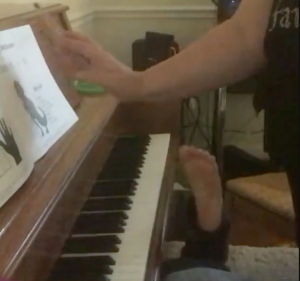
    a very stimmy toe playing a piano pedal with a bucket of stimmy toys nearby

    The correction I would note is that a “weighted pedal” is an artificial suggestion, probably an intelligent guess from all the weighted blankets and pedal pushing in my literature. Rather, I would recommend my student to try any of my sensory stimming toys and gadgets such as this Sensory Rug to provide sensory input to the feet and lower limbs, to satisfy the craving of that movement. Read what one music therapist had to say about this mat. Please visit my resources page for more stimmy ideas.

    Uncategorized Leave a comment

    I asked chatGPT to “write an Individualized program plan (IPP) for the California Self Determination Program (SDP)”

    March 17, 2023 by Henny Kupferstein, Ph.D.

    I asked chatGPT to “write an Individualized program plan (IPP) for Henny Kupferstein, who is autistic and is needing new updated program outcomes to stay on the California Self-Determination Program (SDP)”

    1/7

    Individualized Program Plan (IPP) for Henny Kupferstein

    Background Information:

    Henny Kupferstein is a 25-year-old individual who has been diagnosed with autism spectrum disorder. Henny currently resides in California and is enrolled in the Self Determination Program (SDP). The SDP is a program that provides individuals with developmental disabilities with the ability to choose their own service providers and set their own goals.

    Henny has been a part of the SDP for two years, and it is now time to update their program outcomes to ensure they are meeting their current needs and goals.

    Current Supports:

    Henny has a support team that includes their family, a behaviorist, a speech therapist, and an occupational therapist. They currently receive the following services:

    1. Behavioral therapy: Henny receives 10 hours of behavioral therapy per week to work on improving social skills and reducing self-injurious behaviors.
    2. Speech therapy: Henny receives 2 hours of speech therapy per week to improve communication and language skills.
    3. Occupational therapy: Henny receives 2 hours of occupational therapy per week to improve fine motor skills and sensory integration.

    Current Goals:

    Henny’s current goals include:

    1. Improve social skills and reduce self-injurious behaviors.
    2. Improve communication and language skills.
    3. Improve fine motor skills and sensory integration.

    Updated Program Outcomes:

    Based on Henny’s current needs and goals, the following outcomes are recommended for their IPP:

    1. Increase socialization opportunities: Henny will attend a weekly social skills group and participate in community-based activities with peers to improve social skills.
    2. Increase communication opportunities: Henny will attend a weekly conversation group and work with their speech therapist to develop a communication device to increase communication opportunities.
    3. Increase sensory integration opportunities: Henny will participate in daily sensory activities at home and work with their occupational therapist to develop a sensory diet to increase sensory regulation.
    4. Increase community involvement: Henny will attend community-based activities and volunteer opportunities to increase community involvement and build social connections.
    5. Develop self-advocacy skills: Henny will work with their support team to develop self-advocacy skills to improve their ability to make decisions and advocate for themselves.

    Service Providers:

    Henny will continue to receive services from their current service providers, including:

    1. Behavioral therapy: Henny will receive 10 hours of behavioral therapy per week from their current behaviorist.
    2. Speech therapy: Henny will receive 2 hours of speech therapy per week from their current speech therapist.
    3. Occupational therapy: Henny will receive 2 hours of occupational therapy per week from their current occupational therapist.

    Monitoring and Evaluation:

    Henny’s progress towards their goals will be monitored and evaluated on a quarterly basis by their support team. Progress will be measured using data collection and observation of Henny’s behavior and skills.

    Plan Implementation:

    The implementation of this IPP will begin immediately. Henny’s support team will work together to ensure that Henny is receiving the appropriate services and supports to achieve their goals. Any modifications or changes to the IPP will be made as needed to ensure that Henny is receiving the best possible support.

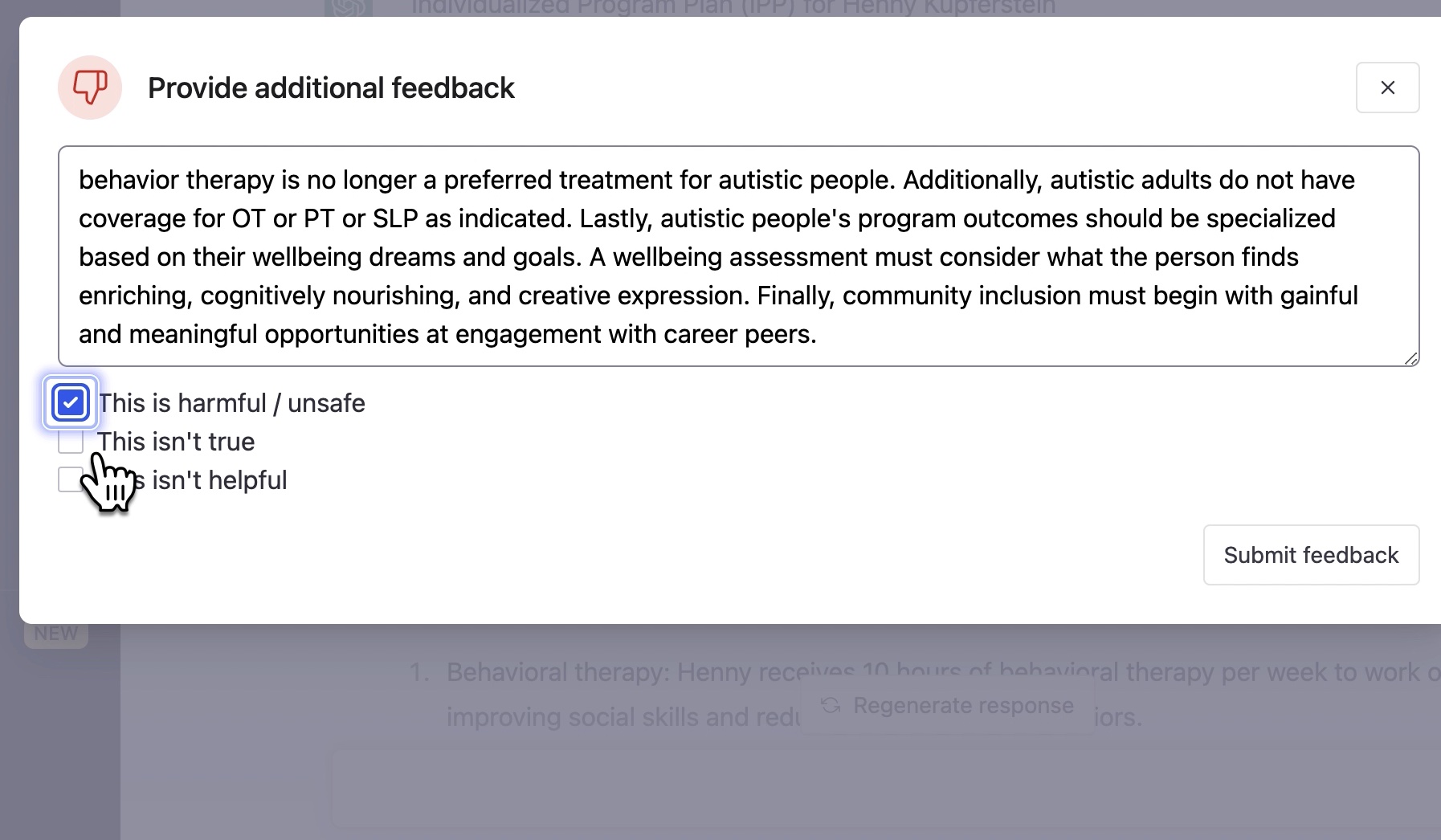
    Feedback 1 thumbs-down

    behavior therapy is no longer a preferred treatment for autistic people. Additionally, autistic adults do not have coverage for OT or PT or SLP as indicated. Lastly, autistic people's program outcomes should be specialized based on their wellbeing dreams and goals. A wellbeing assessment must consider what the person finds enriching, cognitively nourishing, and creative expression. Finally, community inclusion must begin with gainful and meaningful opportunities at engagement with career peers.

    2/7

    Individualized Program Plan (IPP) for Henny Kupferstein

    Introduction:

    Henny Kupferstein is a 28-year-old individual with autism who is seeking to stay on the California Self Determination Program (SDP). This IPP is designed to update and individualize her program outcomes to ensure that her goals and needs are being met in the most effective way possible.

    Goals

    1. Social Skills – Henny struggles with social interactions and is seeking to improve her ability to communicate effectively with others. Her goal is to develop a set of social skills that will allow her to interact more confidently and independently with others.
    2. Self-Advocacy – Henny is seeking to develop skills that will enable her to advocate for herself and make decisions independently. She wants to learn how to navigate the world and communicate her needs effectively.
    3. Employment – Henny has expressed an interest in finding part-time employment that aligns with her interests and abilities. She is seeking support to identify potential job opportunities, prepare for interviews, and develop the skills necessary to succeed in the workplace.
    4. Independent Living – Henny is seeking support to develop the skills necessary to live independently. This includes learning how to manage finances, plan meals, and maintain a clean and safe living environment.
    5. Health and Well-being – Henny is seeking support to maintain her physical and emotional health. This includes learning how to manage stress, establish healthy habits, and access appropriate medical care.

    Objectives

    1. Social Skills:
    • Henny will participate in weekly social skills training sessions with a qualified therapist.
    • Henny will identify three new social skills she wants to learn each month and will practice using them in a variety of settings.
    • Henny will participate in one social activity each week with a group of peers.
    1. Self-Advocacy:
    • Henny will participate in self-advocacy training sessions with a qualified therapist.
    • Henny will identify three new advocacy skills she wants to learn each month and will practice using them in a variety of settings.
    • Henny will develop a written list of her personal preferences, strengths, and areas of need, and will practice using this list to communicate her needs to others.
    1. Employment:
    • Henny will work with a job coach to identify potential job opportunities.
    • Henny will participate in interview skills training sessions with a qualified therapist.
    • Henny will work with a job coach to develop the skills necessary to succeed in her chosen field.
    1. Independent Living:
    • Henny will participate in weekly independent living skills training sessions with a qualified therapist.
    • Henny will identify three new independent living skills she wants to learn each month and will practice using them in a variety of settings.
    • Henny will work with a therapist to develop a personalized plan for managing finances, planning meals, and maintaining a clean and safe living environment.
    1. Health and Well-being:
    • Henny will participate in weekly stress management training sessions with a qualified therapist.
    • Henny will identify three new healthy habits she wants to develop each month and will practice incorporating them into her daily routine.
    • Henny will work with a qualified healthcare provider to establish a plan for accessing appropriate medical care.

    Conclusion:

    This IPP has been designed to help Henny Kupferstein achieve her goals and meet her individual needs in the most effective way possible. The outcomes outlined in this plan are designed to be flexible and adaptable to meet Henny’s changing needs over time. Regular progress reports will be provided to ensure that Henny is making meaningful progress towards achieving her goals.

    Feedback 2 thumbs-down

    social skills is no longer a preferred training for autistic people. It reinforces robotic and scripted socialization which may cause feelings of insecurity when masking authentic expression. Additionally, autistic adults do not have coverage for licensed therapists who have a peer-reviewed trauma informed protocol for autistic adults seeking psychotherapy, and spoken communication is not reliable in a talk therapy construct. Lastly, autistic people's program outcomes should be specialized based on their wellbeing dreams and goals that are consistent with their autistic identity and evolving esteem of self. A wellbeing assessment must consider what the person finds enriching, cognitively nourishing, and creative expression using their family values and cultural preferences. Finally, community inclusion must begin with gainful and meaningful opportunities at engagement with career peers, who are also situated within an autistic culture to maximize net value to the autistic providing labor. Self advocacy is not a preferred functional state, as it leads to burnout and tokenism. The alternative is to start finding a circle of support that is enriching to the individual, where licensed personnel can be expected to perform with cultural competency inherent in their professional standards. Lack of standards leads to abuse and harm to the vulnerable autistic who may not be interested in masking to perform in a self advocacy role.

    3/7 version

    Introduction:

    Henny Kupferstein is a 32-year-old autistic individual who has been approved for the California Self-Determination Program (SDP). The goal of this IPP is to develop new and updated program outcomes to support Henny in achieving her individual goals and maximizing her potential for independence, personal growth, and community participation.

    Section 1: Goals and Objectives

    • Goal 1: Enhance Henny’s social and communication skills to improve her ability to interact with others and build meaningful relationships.
      • Objective 1: Henny will attend a social skills group twice a week for three months.
      • Objective 2: Henny will practice initiating conversation with peers and participating in group activities during social skills group.
      • Objective 3: Henny will attend a public speaking course once a week for six months to improve her communication skills.
    • Goal 2: Develop Henny’s independent living skills to increase her ability to live on her own and manage daily activities.
      • Objective 1: Henny will attend a cooking class once a week for six months to learn basic cooking skills and meal planning.
      • Objective 2: Henny will practice doing laundry, grocery shopping, and managing her finances with the support of a coach for three months.
      • Objective 3: Henny will work with a job coach to identify potential job opportunities that match her skills and interests.
    • Goal 3: Increase Henny’s physical activity and improve her health a
      • Objective 1: Henny will join a yoga class once a week for six months to improve her flexibility and balance.
      • Objective 2: Henny will walk for 30 minutes three times a week with the support of a coach.
      • Objective 3: Henny will work with a nutritionist to develop a healthy eating plan and make healthier food choices.

    Section 2: Supports and Services

    • Henny will receive the following supports and services to achieve her goals and objectives:
      • Social skills group twice a week for three months
      • Public speaking course once a week for six months
      • Cooking class once a week for six months
      • Job coach to support job search and application process
      • Coach to support independent living skills development for three months
      • Yoga class once a week for six months
      • Coach to support physical activity and walking routine for three months
      • Nutritionist consultation to develop a healthy eating plan

    Section 3: Timeline and Evaluation

    • The IPP will be implemented immediately, and progress will be evaluated every three months.
    • The progress will be measured based on the achievement of the objectives set for each goal.
    • If progress is not being made, the IPP will be revised to ensure that Henny’s goals are being met.

    Conclusion:

    The above IPP outlines Henny Kupferstein’s goals, objectives, supports, and timeline for achieving her desired outcomes. This plan has been developed to ensure that Henny receives the necessary supports and services to maximize her potential for independence, personal growth, and community participation.

    Feedback 3 thumbs-down

    autistic people do not learn from social skills, and it is not recommended for adults or children. Autistic people who do not rely on spoken communication prefer to identify as nonspeaking rather than non-verbal. autistic adults do not need therapies to live independently, but rather personal assistance to help with motor skill tasks and maintaining a home to safety code with regard to cleanliness and organization. 

    Version 4/7

    Henny Kupferstein: Individualized Program Plan (IPP)

    Goal 1: Improve communication skills

    Objectives:

    • Increase the use of functional communication by 50% in social situations (e.g., greetings, requests, comments).
    • Improve understanding and use of nonverbal communication (e.g., body language, facial expressions).
    • Use assistive technology (e.g., communication apps, speech-generating devices) to support communication in daily activities.

    Strategies:

    • Provide individualized communication training, including use of social stories and visual supports.
    • Provide opportunities for social interactions and practice communication skills in real-life settings.
    • Incorporate assistive technology into daily routines and activities.

    Goal 2: Develop independent living skills

    Objectives:

    • Increase independent completion of self-care tasks (e.g., dressing, grooming) by 50%.
    • Increase independence in meal planning and preparation by 50%.
    • Increase ability to follow a schedule and manage time effectively.

    Strategies:

    • Provide individualized training on self-care tasks and meal planning/preparation.
    • Use visual supports and task analysis to break down complex tasks into manageable steps.
    • Provide opportunities for practice and feedback in real-life settings.

    Goal 3: Improve social skills

    Objectives:

    • Increase participation in social activities with peers by 50%.
    • Improve understanding of social cues and nonverbal communication.
    • Develop and maintain positive relationships with peers and adults.

    Strategies:

    • Provide individualized social skills training, including role-play and modeling of appropriate social behaviors.
    • Facilitate participation in group activities, such as social clubs or community events.
    • Provide opportunities for Henny to practice social skills in structured and unstructured settings.

    Goal 4: Enhance community participation

    Objectives:

    • Increase participation in community activities by 50%.
    • Develop and maintain positive relationships with community members.
    • Increase knowledge of community resources and services.

    Strategies:

    • Provide opportunities for Henny to participate in community activities and events.
    • Facilitate introductions to community members and encourage positive interactions.
    • Provide information and training on community resources and services.

    Note: This is just a sample IPP and should be modified to fit Henny’s specific needs and goals. It’s important to involve Henny and their family in the planning process to ensure that the IPP is individualized, realistic, and achievable.

    Version 5/7

    Introduction:

    Henny Kupferstein is a 24-year-old individual with autism. He is non-verbal and uses a communication device to interact with others. Henny has been part of the California Self-Determination Program (SDP) for the past year and has made progress in achieving his goals. However, it is time to update his program outcomes to ensure that he continues to receive the support he needs to thrive.

    Assessment and Planning:

    Henny’s current goals were reviewed, and a new assessment was conducted to identify areas where he needs support. Based on the assessment, the following outcomes were identified:

    1. Communication: Henny will improve his ability to communicate his needs and wants through his communication device. He will also learn to use gestures and facial expressions to express himself.
    2. Social Skills: Henny will develop social skills to interact with his peers and community. He will learn to initiate and respond to social interactions appropriately.
    3. Independent Living: Henny will learn skills necessary for independent living, such as dressing himself, cooking, and cleaning.
    4. Self-Advocacy: Henny will learn self-advocacy skills to communicate his needs and wants and make decisions that affect his life.
    5. Community Engagement: Henny will engage in community activities and develop relationships with community members.

    Interventions and Supports:

    The following interventions and supports will be provided to help Henny achieve his program outcomes:

    1. Communication: Henny will receive communication therapy twice a week from a qualified therapist. The therapy will focus on improving his communication skills, including using his communication device, gestures, and facial expressions.
    2. Social Skills: Henny will receive social skills training twice a week from a qualified therapist. The training will focus on initiating and responding to social interactions, understanding social cues, and developing friendships.
    3. Independent Living: Henny will receive training on independent living skills twice a week from a qualified trainer. The training will focus on dressing himself, cooking, and cleaning.
    4. Self-Advocacy: Henny will participate in self-advocacy training once a week from a qualified trainer. The training will focus on communication skills, decision-making, and advocacy.
    5. Community Engagement: Henny will participate in community activities with the support of a community coach. The coach will help Henny develop relationships with community members and engage in activities that interest him.

    Progress Monitoring:

    The progress towards the program outcomes will be monitored every three months by the support team. Any necessary changes to the IPP will be made at this time to ensure that Henny is receiving the best possible support.

    Conclusion:

    The above IPP outlines the program outcomes and interventions for Henny Kupferstein. It is expected that with these interventions and supports, Henny will make progress towards his goals and achieve a more fulfilling and independent life.

    Version 6/7

    Introduction:

    Henny Kupferstein is a 28-year-old autistic individual living in California who requires an Individualized Program Plan (IPP) to stay on the California Self-Determination Program (SDP). The purpose of this IPP is to create a comprehensive plan that addresses Henny’s needs and goals, and outlines the necessary services, supports, and outcomes required to meet those needs and goals.

    Assessment:

    Henny’s assessment indicates that she has significant communication and social interaction difficulties, along with sensory sensitivities, anxiety, and difficulty with emotional regulation. She requires support in developing independent living skills and managing daily routines. She has expressed an interest in pursuing a career in music therapy.

    Goals:

    1. Improve communication skills: Henny will improve her communication skills by using augmentative and alternative communication (AAC) devices to express her thoughts and emotions effectively.
    2. Improve social skills: Henny will improve her social skills by attending group therapy sessions and engaging in structured social activities.
    3. Increase independence: Henny will increase her independence by learning daily living skills, such as meal planning, grocery shopping, and managing her finances.
    4. Develop career skills: Henny will develop career skills by enrolling in a music therapy program and pursuing a career in the field.

    Services and Supports:

    1. AAC Devices: Henny will receive training on AAC devices to improve her communication skills.
    2. Social Skills Group Therapy: Henny will participate in social skills group therapy sessions to improve her social skills.
    3. Occupational Therapy: Henny will receive occupational therapy to improve her independent living skills.
    4. Music Therapy Program: Henny will enroll in a music therapy program to develop her career skills.

    Outcomes:

    1. Henny will effectively communicate her thoughts and emotions using AAC devices in different settings.
    2. Henny will demonstrate improved social skills by initiating and maintaining social interactions with peers.
    3. Henny will perform daily living activities independently.
    4. Henny will complete the music therapy program and obtain a job in the field.

    Implementation:

    1. Henny will receive training on AAC devices for communication in therapy sessions and in the community.
    2. Henny will attend weekly social skills group therapy sessions.
    3. Henny will receive occupational therapy services for daily living activities.
    4. Henny will enroll in a music therapy program and complete the program.

    Review:

    This IPP will be reviewed annually to ensure that Henny is making progress towards her goals and to revise any necessary services and supports to meet her changing needs.

    Uncategorized chatgpt Leave a comment

    California FTB Phone Tree – Franchise Tax Department

    May 31, 2022 by Henny Kupferstein, Ph.D.

    California Ftb 1-800-852-5711

    Captioned by otter.ai app for deaf, hearing impaired, and nonspeaking telephone callers

    Franchise Tax Department Phone Tree

    You reach Franchise Tax Board however, this phone number is only for those people using a TTY or TDD devices. If you’re not using one of those devices, then you should be calling our regular taxpayer services phone number which is 1-800-852-5711

    1 personal

    2 business

    #1 faq / *8 return

    0 not valid

    5 – all other

    1 received a bill or notice, 1 

    for general tax questions, 2

    1 personal

    Welcome to the Franchise Tax Board, automated taxpayer assistance line. Your call is important. Please stay on the line and Your call will be answered in the order it was received. Our representatives will be able to assist you more efficiently if you have your social security number or account number and billing notice in hand spanyol oprema at birth while you wait. Did you know Most individual taxpayers may be able to register real time for a my FTP account. To register. 

    You must have a return on file for one of the last five taxable years and answer a few questions provided by a credit bureau. Once you register. You can do tax returns, payment history, notices, account balance and chat with a customer service representative about confidential matters. Joining us today could eliminate the need to wait on home for more information on these features, please visit ftb.ca.gov backslash my MTV features FTB is aware of multiple proposals from the governor and legislature to help Californians cope with rising prices of gas and other goods while you may be seeing discussion in the media, social media on proposals related to gas prices and taxes. We have no information to offer at this time. 

    Because the ideas are only proposals and no law has been enacted yet. We are monitoring the renewed discussion and we will update our website when more information is available. If you have a balance owing from your current income tax return, you can set up a payment plan until your return is processed and you receive a bill. However, you can still make payments while you are waiting, go to mtv.ca.gov and select Make a Payment on our homepage. 

    Once you receive your bill, you can apply for a payment plan online or download FTD form 3567 installment agreement 

    for personal income tax press one 

    for business entity information, press two. 

    To learn about web self service options and how to register press three. 

    While you wait and you know most individual taxpayers may be able to or Frequently Asked Questions 

    press one Forms and Publications. 

    Press two dissolution information

     press three charities or nonprofits press for 

    any other information press five. 

    To hear this information again press star 

    six four frequently. 

    If you know the general information code, press one. 

    To hear a list of options press two 

    to return to the main menu press star eight 

    while you wait …And you know most individual taxpayers may be able to register real time for a my FTP account to register you must have a return on file for one of the last five taxable years and answer a few questions provided by a credit bureau. Once you register, you can view tax returns, payment history, notices, account balance and chat with a customer service representative about confidential matters. Joining us today could eliminate the need to wait on home. For more information on these features. Please visit ftb.ca.gov backslash my FTB features FTB is aware of multiple proposals from the governor and legislature to help Californians cope with rising prices of gas and other goods. While you may be seeing discussion in the media, social media on proposals related to gas prices and taxes. We have no information to offer at this time. Because the ideas are only proposals and no law has been enacted yet. We are monitoring the relief discussion and we’ll update our website when more information is available.

    If you have a balance owing from your current income tax return, you can set up a payment plan until you return is processed and you receive a bill. However, you can still make payments while you are winging, go to mtv.ca.gov and select Make a Payment on our homepage. Once you receive your bill you can apply for a payment plan online or download MTD form 3567 installment agreement.

    For personal income tax, press one. 

    For business entity information, press two 

    We are currently experiencing an extremely high volume of calls and cannot assist you at this time. Please visit our website@ftb.ca dot gov for information and online service options. Or try your call again later. We apologize for any inconvenience. [espanol] Then Amazon alumina Yamaga in Aleppo the most attended an ester momento for whatever sysadmins rybakina web as a de punto punto Hilde but I inform us Yan EOPS Yonezawa serbisyo Serena, I intend to mama started Libby motor school for Qualcomm Alesia?

    Welcome to the Franchise Tax boards, automated taxpayer assistance line. Your call is important. Please stay on the line and Your call will be answered in the order it was received. Our representatives will be able to assist you more efficiently 

    if you have your social security number, or account number and billing notice in hand by spanyol oprema Eldar while you 

    1  for personal income tax postponing 

    2 for business entity information press to 

    the California earned income tax credit or AITC is a refundable credit designed for individuals and families with low to moderate income. Taxpayers may qualify for a refundable credit to see if you qualify. Go to mtv.ca.gov and search for E ITC. Please select from the following six options. For current tax year refund information, press one payment and balance do press two. 

    For information regarding the Earned Income Tax Credit, 

    press three frequently asked questions. 

    First Four Forms and Publications.

     Press five and the other information, 

    press six to hear this information. Again. 

    If you’ve received a bill or notice press one 

    for general text questions press two. 

    Your call will be answered by the next available representative to ensure quality service. This call may be monitored or recorded. 

    Please enter your nine digit social security number

     thank you for calling. All of our representatives are assisting other callers rather than wait on hold we can call you back when it’s your turn between two hours and two minutes and two hours and 56 minutes from now. You will not lose your place in line if you choose to use the service. 

    To receive a call back press one for more options.

     Your phone number has been recorded as ***-***-****

     If this is correct, press one 

    to reenter press two. 

    Please speak your full name at the tone 

    press any key to end recording.

    “Franchise tax board calling me back!”

    You will receive a call back between two hours and two minutes and two hours and 56 minutes from now. Thank you for calling. Goodbye. Goodbye

    Uncategorized Leave a comment

    Amazing Grace (My Chains are Gone) lyrics karaoke video with Chords for piano

    August 30, 2021 by Henny Kupferstein, Ph.D.
          D             G         D     
    Amazing grace how sweet the sound
    
          D                  G
    That saved a wretch like me
    
         D                         G
    I once was lost, but now I'm found
    
        D           G    D
    Was blind, but now I see
          D                     G         D     
    T'was grace that taught my heart to fear
                   D      G
    And grace my fears relieved
         D                        G
    How precious did that grace appear
         D       G       D
    The hour I first believed
                  G                    D
    My chains are gone, I've been set free
                  G            D
    My God, my Savior has ransomed me
                 G             D
    And like a flood His mercy reigns
         A7
    Unending love
         D
    Amazing grace

        D                   G    D     
    The Lord has promised good to me
        D                G
    His word my hope secures
        D                 G        D
    He will my shield and portion be
        D       G      D
    As long as life endures
                   G                D
    My chains are gone, I've been set free
                 G                 D
    My God, my Savior has ransomed me
                 G                 D
    And like a flood His mercy reigns
              A7
    Unending love
            D
    Amazing grace

    Songwriters: Chris Tomlin / Louie Giglio

    Uncategorized Leave a comment

    Peer Support with Dr. Henny

    August 25, 2021 by Henny Kupferstein, Ph.D.

    The peer mentorship model is really considered for autistic people. The federation for the blind was started by a blind a lawyer who was also a black man. The United Cerebral Palsy (UCP) was of course, also started by a group of people with cerebral palsy. These organizations continue to serve as a safe place for individuals to experience employment opportunities where disability accommodations are de facto provisions.

    Autism Speaks is the largest recipient of state and federal grants and their agenda is to fund research aimed at treatment, cures, and early detection. This goes against the grain of autistic culture and does not consider what the people they claim to serve are asking for.

    Peer mentorship with Dr. Henny on your schedule and the “Book Online” button will connect you to her calendar, adjusted to your time zone. Cost is $250 for 50 minutes. Please inquire about scholarships and discounts.

    BOOK ONLINE" Button (order now e-booking internet web check in) Stock  Vector | Adobe Stock

    Dr. Henny Kupferstein

    Henny Kupferstein, Ph.D., holds an Associates Degree in Human Services, a Masters Degree in Transformative Leadership, is trained in music therapy and earned her Ph.D. in Psychology. In November 2020, she published a pivotal report that supported the $10.3-billion allocation of funds for developmentally disabled people in California to transition to the Self Determination Program (SDP) for July 1st, 2021 [Autistic Communication Support – 5 year Outcome Report (2014-2019)]. 

    Dr. Henny is an autistic savant who pioneered an evidence-based piano lesson curriculum that guarantees full and independent movement of all 10 fingers for students with neurological movement disorders (i.e. dyspraxia, cerebral palsy, post-stroke paralysis, etc.). Additionally, she conducts ongoing lobbying and policy reporting for the Doogri Institute, and informs members of the Assembly on ways to meet the needs of their disabled constituents, and laws that lend them to navigate local and state government bureaucracy with positive outcomes.  

    In 2020, she published the AGP Model for analysts, pedagogues, and divergent artists. An advocate for humane and ethical research, Henny works tirelessly to disseminate the AGP Model to promote the “I am #ablegrounded” movement for diversity, equity, inclusion, and acceptance. Her research interests include perfect pitch, sensory integration, augmentative communication (AACs), cortical vision impairment, and societal trauma. Henny calls herself the “accessibility queen”; in the spirit of streamlining interpersonal connection, she offers this https://linktr.ee/drhenny for people to find her work and contacts through any platform, and all her videos have closed captions. She always says ‘yes’ to bougie avocado toast.  


    how to Escape from a Cult of polygamy and Incest — Ask for Insider’s help!

    ex polygamist Spies tell the story of how they help their loved ones leave. There are about 6,000 polygamist members of the Kingston clan in Utah, and despite federal trials and imprisonments for incest and sexual abuse for child marriages, this continues to go on. 

    If you want to know how to escape a cult or if you need help thinking it through, contact me. I am Dr. Henny and I write letters! click here to find me on every platform

    Uncategorized Leave a comment

    Autistic begging Sia for representation are #literally not patrons of the arts

    March 29, 2021 by Henny Kupferstein, Ph.D.

    More of drhennyk [on TikTok] [on Instagram] [FB link for sharing her page] [Follow on Twitter] [on LinkedIn]

    The Doogri Institute services and supports are publicly available online to students everywhere. Students of all abilities are welcome to participate in online school lessons, communication support, AACs for communication, and 10-finger keyboard typing. New York families with self-direction eligibility may use their budget to pay for the tuition and fees.

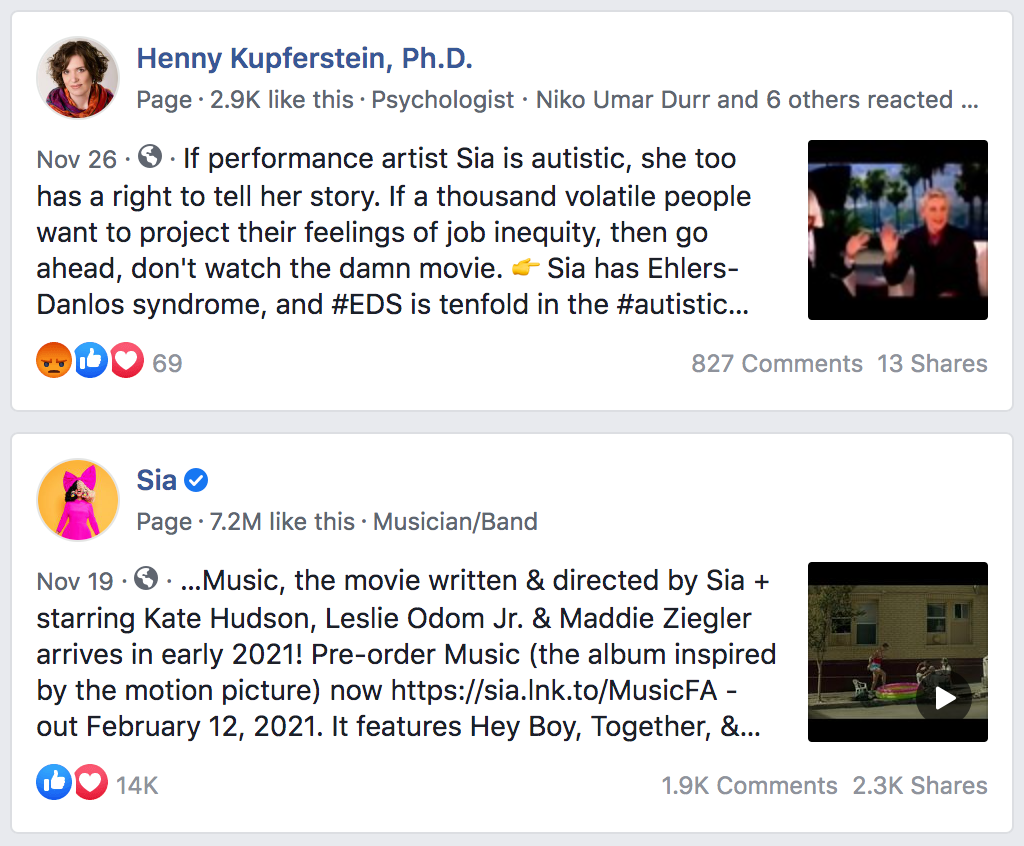
    If performance artist Sia is autistic, she too has a right to tell her story. If a thousand volatile people want to project their feelings of job inequity, then go ahead, don’t watch the damn movie.
    👉Sia has Ehlers-Danlos syndrome, and #EDS is tenfold in the #autistic population, including myself.
    👉Nearly 100% of autistic people have #perfectpitch (97%, read my study). Sia’s clarity in her vocal range is very impressive to my trained ear.
    👉Hiding the face with extreme costumery is a brilliant stunt to create social distance between fan chitchat, eye contact demands, and any interaction outside of the live performance.
    I offer this clip where you can decide if you can spot an autistic on Ellen DeGeneres. Can you see the 🕶️ masking, the forced speech, the hand fidgets, the tight ankle cross, the scripting from lyrics, and the use of stress laughter to make conversation? How would you act if you are #autistic and are on the Ellen Show? The costume deterred Ellen from hugging and petting, which we all know is a part of live TV. Score!
    The outrage by #autistics begging for “authentic representation” by way of #actuallyautistic talent is an old cry. It stems from lack of #inclusion in training programs, which I advocate for on an hourly basis.
    When I was studying music therapy, I was regarded as an imposter and hacker, someone who had to be defeated. My art has been misunderstood, my talent 🎹 has been blamed on scammery, and my inclusion was blocked through denial of #accommodations. I pulled through 🎓 because I paid more attention to my goals than they gave to destroying my soul.
    The arts requires stellar 🎩 representation to a storyline. Any media attention is positive attention (so go ahead and + hate me too +).
    I would much rather have 25 more Rain Man movies come out this year, than none at all.
    Thank you Sia for selecting seasoned and talented actress to portray the gifts and capacities, the use of #AAC typed communication (which is the law), and above all, the story of  ❤️❤️❤️INCLUSION IN THE ARTS.
    Signed,
    An #actuallyautistic artist who is delighted that you choose to tell your story in your unique and artful way.

    Elissa Milne

    Wow. Lots of people calling Henny “sweetie”.

    Lots of big feelings.

    Feeling outraged is a choice we’re all quite good at these days.

    It takes a bit more work to actually engage with ideas, and it’s perfectly understandable that a lot of people in late November 2020 are a bit too emotionally wrung out for that kind of engagement.

    This whole question is about what representation is in the performing arts.

    https://www.pinterest.ph/pin/224687468885941223/Does the stage musical of the Lion King require a lion in the lead role? Is it wrong for the story of a lion to be told with a human in the role?

    Is it wrong to perform Shakespeare in a historically accurate manner, with men playing all the parts?

    Would it be wrong for a woman to play Richard III?

    Is it wrong for an Asian opera singer to play the part of Violetta in La Traviata? And is it appropriate for any singer to take that part unless they have already died of tuberculosis?

    Henny Kupferstein, Ph.D.

    Here I am sitting on my fainting couch, laughing way too loudly. It’s about time we see a lion on stage!!

    Elissa Milne

    WE COULD GO FURTHER.

    Is it wrong to depict assault on stage, if the actor is not actually assaulted?

    Is it wrong to use stage craft to communicate plot points THAT ARE NOT ACTUALLY HAPPENING TO THE ACTORS?

    etc etc

    Representation in the community is a completely different kind of representation to what we talk about when we refer to “representation” in the performing and recorded arts.

    Vocalists have all kinds of effects added to their tracks – their voices are a part of the finished “representation” that is a song on Spotify, but we’re not literally hearing that person’s voice and that alone – it’s all adjusted, treated, transformed, compressed, amplified, all kinds of things.

    The product you consume in the arts is made up. It’s not a naturally occurring thing. Duh.

    Henny Kupferstein, Ph.D.

    The only naturally occurring thing in this post is natural selection.

    Elissa Milne wins the internet. Maybe covid20 will be all the #autistics searching for tuberculosis to be authentically represented in the arts. Natural selection is naturally self evident. 

    Elissa Milne

    Is it wrong for an Asian opera singer to play the part of Violetta in La Traviata? I don’t think so.

    Is it wrong for a woman to play Richard III? I don’t think so.

    There is so much missing from an understanding of the performing arts in any take that says that the character must be portrayed by an actor with the same characteristics, it’s really hard to see a place to start with helping develop a more informed perspective.

    Look at the work of Caryl Churchill (link below) for an example of creating work where distancing (in a Brechtian kind of way) is accomplished by casting characters into unexpected bodies, and where the impact is a subversion of power and a highlighting of abuses of power.

    Consider theatrical traditions where roles are cast very deliberately against physical types.

    The profundity of human theatrical expression that relies on the performer not being the thing being performed is immense.

    Elissa Milne

    Is it wrong for an Asian opera singer to play the part of Violetta in La Traviata? I don’t think so.

    Is it wrong for a woman to play Richard III? I don’t think so.

    There is so much missing from an understanding of the performing arts in any take that says that the character must be portrayed by an actor with the same characteristics, it’s really hard to see a place to start with helping develop a more informed perspective.

    Look at the work of Caryl Churchill (link below) for an example of creating work where distancing (in a Brechtian kind of way) is accomplished by casting characters into unexpected bodies, and where the impact is a subversion of power and a highlighting of abuses of power.

    Consider theatrical traditions where roles are cast very deliberately against physical types.

    The profundity of human theatrical expression that relies on the performer not being the thing being performed is immense.

    Henny Kupferstein, Ph.D.

    Elissa Milne Even the Jews had to wear a penis prosthetic to fill the role of perfect human form for athleticism during the olympic games, because their circumcision represented mutilation or lameness.

    Elissa Milne

    Gosh – I’m not quite sure what to do with that information!

    But now you have mentioned penises…

    Hugh Sheridan musical Hedwig and the Angry Inch cancelled after outrage from transgender activists

    Henny Kupferstein, Ph.D.

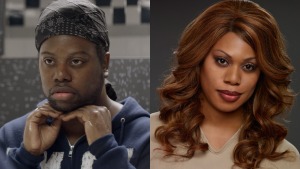
    Elissa MilneOf course we must mention penises. A star’s show gets ‘cancelled’ (the show biz kind, not the online kind) because he is the wrong rainbow on the flag? Well, as we’ve learned from Orange is the New Black, not every Laverne has a Cox to play her pre- and post-.

    #goals

    Resources
    1. If you need help, try reading Karma Can Crush Creeps Autistics – AUTISTICS FTW! My Autistic Brain has at least 4 Logical Ways tot End Cyberbullying
      • Please join the “Asking Dr. Henny 🏋🏻‍♀️ re: Cyberbullying Autistics” facebook group for application of this method.

    Follow Elissa Milne here

    Interested in becoming a member of the Doogri Institute? Members get 1 free Zoom event per month. Click for membership options and perks.

    Registration for Zoom Support Group

    click on the Zoom button to register
    Look for the wide blue image to click and register
    Uncategorized actuallyautisticautisticsdoogridrhennykElissa Milnehenny kupfersteinperfectpitchSia Leave a comment

    For every murder, there are 3 suicides.

    March 1, 2021 by Henny Kupferstein, Ph.D.

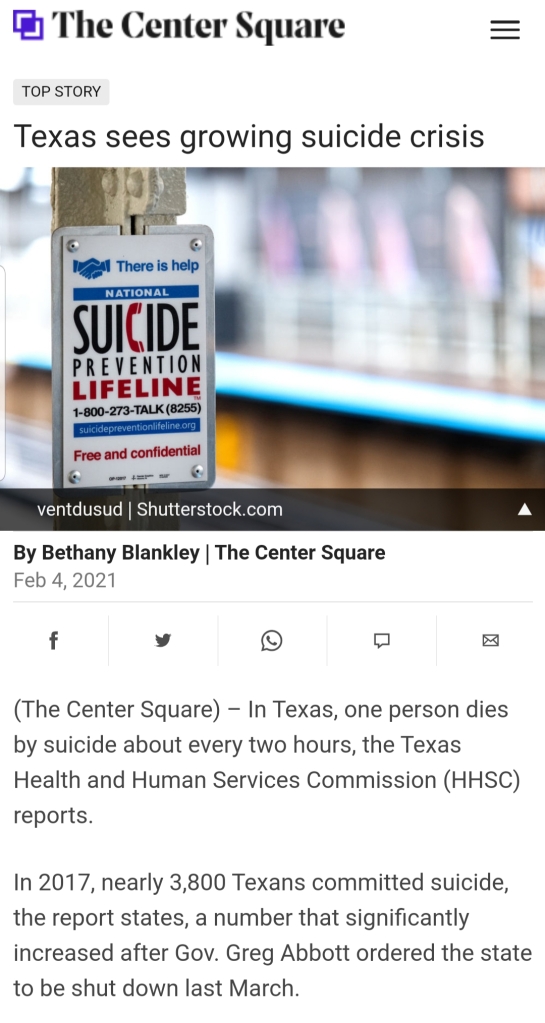
    Deaths on the news are fixated on murders. Suicide is rarely mentioned on broadcast television. Why is the CDC reporting on deaths as an unintentional injury, if not to hide a national truth about suicide? Nearly 50,000 people died by suicide in 2018. One person dies by suicide every five hours in New York State.

    [ Share my LinkedIn post ] [ Share my FaceBook post ] [ Share my Tweet ] [ 15 seconds on Tik Tok ]

    Facts from the Centers for Disease Control and Prevention (CDC)

    • 9 Assault & Homicide Deaths per 100,000 population
    • 15 Suicide Deaths per 100,000 population:

    Over the past 20 years, infant mortality still ranked as the leading cause of death in the United States. I reviewed the data because I was curious about the overwhelming rates of unintentional injuries. 

    When ordered by age group, within the 15–24 years old group, Homicide and Suicide are their leading cause of death. That triples in the 25–44 age group. However, in the 45–64 age group, suicide is no longer the leading cause of death, and is nestled between cerebrovascular diseases and septicemia. 

    If you knew someone in their 40’s, 50’s or 60’s who died from a brain or heart disease, or a basic blood infection called sepsis, then you also know someone else who has died from suicide. 

    If your relative died before they turned 45, or even in their late 20’s, then there is a significantly greater chance that they died from suicide, and not from diabetes or cancer.   

    If your childhood friend has died when in their teens or as a young adult, it was highly likely by suicide and not birth deffects, a flu, or pneumonia. 

    The media portrays homicides as tragic murders. Suicides are rarely discussed. The prevailing attitude is that discussion may lead to ideation. If you see it in the news, you might become susceptible to contemplating it. 

    Psychologists know that media discussions do not cause suicides. In fact, hotlines and social media supports are the only known factor in decreasing suicides. Let’s discuss. 

    Realistically, when I see advertisements for new pharmaceutical drugs, I don’t always ask my doctor if that drug is “right” for me. In fact, I avoid newly marketed drugs because of the FDA’s controversial non-mandatory reporting policies. Once a drug or medical device is approved, the FDA does not require any adverse outcomes, side effects, injuries or deaths to be reported. Doctors and citizens may report anonymously and only if they can find the proper forms on the website, and use the right language to prompt an investigation. 

    This is why you see so many law firms soliciting hernia mesh injured patients to join class-action suits, because the mesh material has never been tested for human implantation before bringing it to market. If a patient complains about pains and symptoms, a doctor’s default reference is the approval, which represents ‘but it is safe’. 

    The data are based on death certificate information compiled by the CDC.

    If you had to report to the CDC about your loved one’s death, how would you describe it? If you opted to inform the FDA about drugs and treatments that did in fact not cure your loved one, but killed them, what language would you use? 

    Typical Resources are:

    1. Call the National Suicide Prevention Lifeline (Lifeline) at 1-800-273-TALK (8255)
    2. text the Crisis Text Line (text HELLO to 741741). 
    3. Both services are free and available 24 hours a day, seven days a week. 
    4. The deaf and hard of hearing can contact the Lifeline via TTY at 1-800-799-4889

    I propose free and public discussion online to end the stigma, misinformation, and promote support that is proven to help.

    [ Share my LinkedIn post ] [ Share my FaceBook post ] [ Share my Tweet ] [ 15 seconds on Tik Tok ]

    Uncategorized Leave a comment
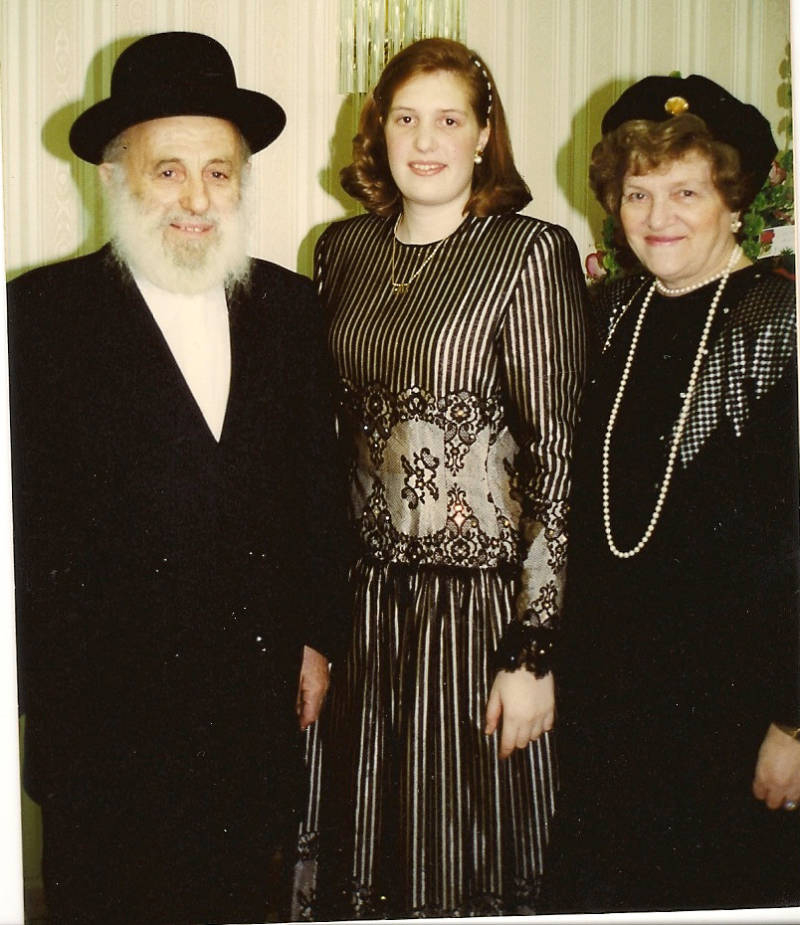
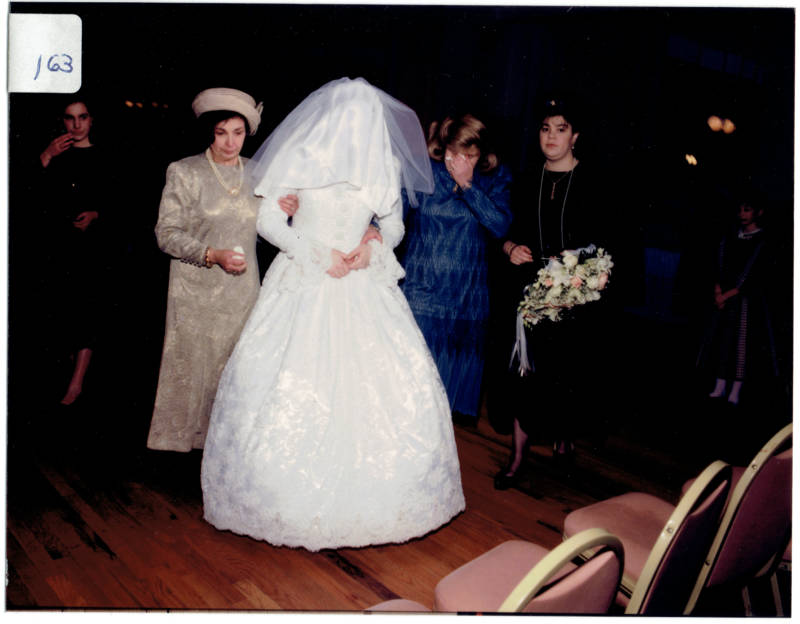
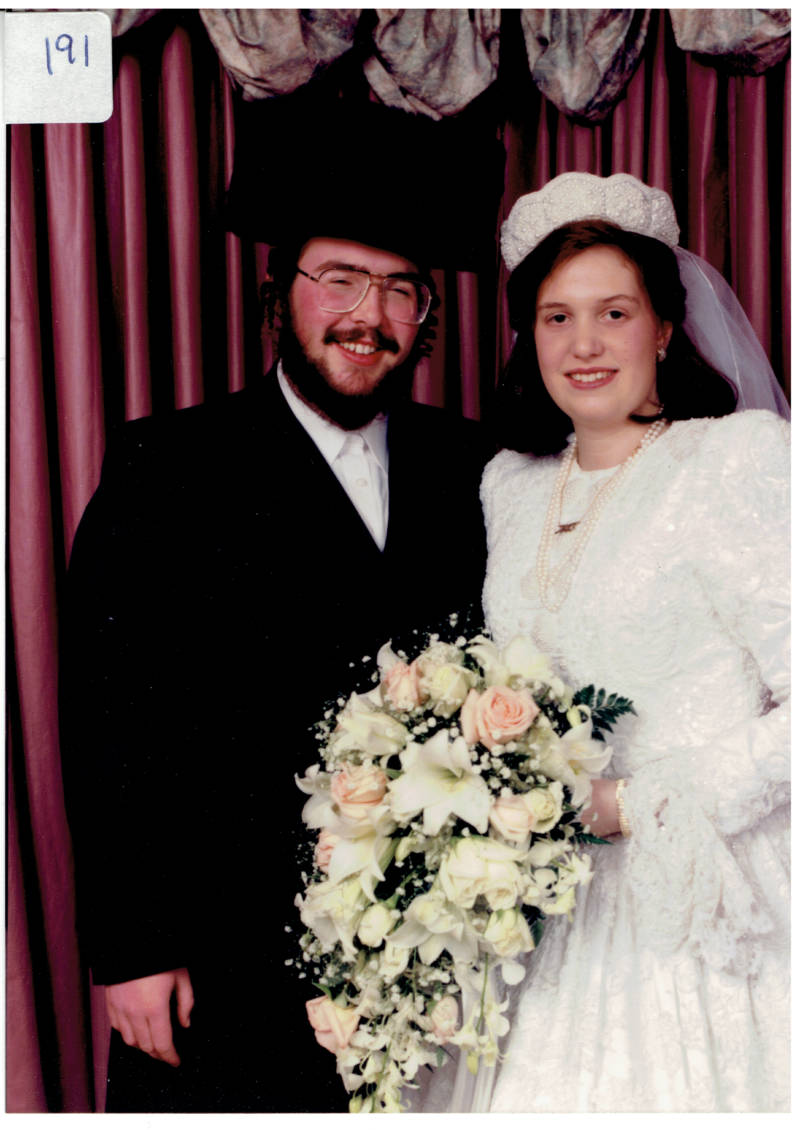
    Henny Kornbluh, a chassidic bride fasting and praying before the ceremony

    The Joys of Shabbos

    February 18, 2021 by Henny Kupferstein, Ph.D.

    [ Share on Facebook ] [ Share on LinkedIn ] [ @drhennyk Tik Tok ]

    Henny Kupferstein as a bride, fasting and praying before the ceremony, Feb 18, 1997

    Imagine if this book was an inspirational book, full of sacred references. The commentaries would guide you to a holy place. You would credit their wisdom for the feelings you experience each weekend. What if this book is a cynical anthology of anecdotes. How I was possessed by the shabbos demons. How I was released and liberated to be the queen herself. Perhaps a collection of miles which I have trekked in my journey to come face to face with shabbos herself. I had some things to tell her. You didn’t know this would be a parody on The Joy of Sex classic, or the Kosher Sex handbook by Rabbi Shmuley Boteach. Yeah, nobody told me either.

    When I finally confronted the shabbos queen, she was anguished. She expressed rage as though a betrayal of a fellow sister was the worst kind. Maybe like cheating with the neighbor’s spouse in the garage. Worse than calling God by His name. I tossed and shook, like a rabid dog frothing at the final frontier of razor sharp teeth. I was armed and loaded, ready to shoot her down. 

    I shot in the dark, and saw the explosion of light around my shot. The halo made me remember the days when I first lit the shabbos candles as a newly minted married woman. I had just turned 19, and I told myself these were magical flames. I would light them so earnestly, each Friday night at sundown. I convinced myself that the kindling of the candle releases my prayer to god. The blessings were personal, written just for the married woman who lights the shabbos candles. It felt so intimate, so private that I bashedly covered my eyes in emotional prayer. 

    Henny Kornbluh, a chassidic bride fasting and praying before the ceremony

    Henny Kornbluh, a chassidic bride fasting and praying before the ceremony.

    Nobody ever told me that the tradition was from medieval times, when couples fought over saving their candles for one meal a week. When candle fat was so scarce, that weeknight meals were pure misery. After a week of hard work in the market, at the silversmith, the cobbler and the butcher, everybody wants some comforting time with the loved ones. Without a candle or a hearty meal, it was merely an extension to the week. 

    Friday night was the special time. It was a time for ambience, predetermined meals to express lavishness, and a time for hot food without the hassle of preparing it fresh. They never told me that enjoyment was derived from everyone eating together, instead of a spouse slaving in the kitchen. They never warned me that he would be expected to be served as a king, while he sat on his shabbos throne beating his fist on the mahogany table covered in a $1,200 Wall of China white cotton tablecloth.

    To avoid infringing on the labor prohibitions, extra precautionary provisions were added. Everyone was encouraged to bathe specifically in time for candle lighting. The nicest clothes were donned for the evening. Cooked food was kept on a low fire to keep it heated until after the evening prayers were completed. If you had any pure white articles of clothing, you were encouraged to visibly don it. Women began to wear a frilly white apron reserved for the weekend. Those who wore kerchiefs reserved the white silky ones for shabbos. 

    Nobody told me that he was waiting for the shabbos ambience to get into the mood. And by mood, I mean me. They didn’t warn me that his extretions would smell like a bleach spill on Friday night, but a sardine factory by Saturday afternoon. They didn’t tell me I’d be dribbling his stewing eggs in uncontrolled flows, making me feel as though a jellyfish crawled out of me every time I stood up or shifted my weight on the couch. I didn’t realize that most hygiene rituals would be prohibited, leaving me with an unrelenting compulsion to alter my body smell and disposition. I fantasized about the day when I would use a baby wipe, and clean up. I was delighted with the wicked thought that one day, I would accidentally open the hot water faucet in the bathroom sink. Anyone hearing from outside the door wouldn’t be able to ever know my secret. The anonymity of this dreadful sin had me tickled. I planned these elaborate ideas which empowered me, and helped me see my present through the future’s liberation. 

    I also smelled of his body odor. It was a mixture of Marlboro, minty breath freshener, germy teeth plaque mixed with old cheese, and aqua net hairspray on his beard. I was dumb, dumb, dumb, when I surprised him with cologne for his 30th birthday. He doused himself so extensively that weekend, that I smelled of him, his deposits, and his cologne. The horror of this sensory violation can only be described as the dollar store lavender bathroom spray mixed with the smell of a giant poo. I thought of myself as a walking port-a-potty. I felt like the blue water, a vessel accepting everything and turning all of it into a mysterious disappearing reality. I was always shit sprayed on the walls, with pee splatter for extra embellishment. 

    Six years into the marriage, I finally used my words to make him hurt as much as he hurt me. After about 14 minutes of humping a wall of dry ice, he walked himself back to his bed. I shouted after him, “don’t forget to flush!”. The purple circles on his cheeks spread to his ears, and he was steaming from his nostrils. Rather than his ear sirens going off with a shriek, he screamed through clenched teeth, “How can you even say such a thing?!!!”

    Nobody told me that I could say such a thing. And that it would liberate me from the pits of my hell. That I would now have permission to cry, laugh, talk to myself, or anything, but he would still get his job done without disturbing my mind. Oh how wonderful those trips were. I would fly first-class to exotic islands with turquoise seas. The mineral baths and sauna were always so exciting. I saw them opening my pores, seeping into my skin, and nourishing me with hygiene and invisible endocrine stimulants. Those dreams took me so far, that I would ride the high from my travels for a day or two. Sometimes, I even needed a vacation from my vacation. Those vacations always had me squeaky clean, and my hygiene fantasies were very fulfilling.

    I hated myself so much, that I couldn’t even bother taking off my expensive shabbos house robe for naps. After the shabbos morning meal, I would pass out from exhaustion. I often slept for 2-4 hours, and it was a major boost for the week. Something in me thought that going to bed in clothes would be a signal for how exhausted I am, and that I should be left alone. I was never warned that the image of a shabbos queen in traditional clothing would fulfill his Freudian appetite and the love for a matronly figure in his own bedroom. I stopped shaving my head the day after he put his hands under my turban, feeling my peach fuzz. I knew he thought about his mother in that moment, and I was determined to discontinue that fantasy. I will not be degraded into being thought of as sex idol for a practice that was designed to downgrade me to a disgusting beast like all the abused women. 

    Prisoners were shaved in Auschwitz. I knew my hair would set me free. My dreams now had me walking down the main street with my hair blowing in the breeze. I saw the smooth thick waves bouncing on my shoulder, growing long way past my face to hide my double chin. It would be as long as I wanted, and I would no longer be forced by my mother to have short bangs. I knew I owned my hair now, and I used it to regain the power I needed to survive. 

    I had no idea that he would like my hair. Now he started mocking my head coverings whenever he entered the bedroom. “Take off that corny thing on your head. It makes you look so ugly.” The children would barely be asleep, and I couldn’t have any of them walk in and see me without a headcovering. It never occurred to me that they would see way more disturbing things than a mother in a ponytail. 

    Women who didn’t shave their heads made it very obvious. It was a status symbol, a sign that she was more “modern” than her neighbors with a naked skull. They usually pinned the hair up in the back. We saw the giant bump in her headwear. Over time, women with ponytails finally developed a new style of headcovering so they didn’t explode inside a turban. They began to wear snoods, and it was a very hot trend. This is because the snood is merely an oversized knitted hat with a tight band for the face. Women would put up the appearance that they are casually overworked, and the frumpy style was to have the snood accidentally show some hairline. Now those ladies were the real tramps. 

    When my hair first started growing back, it was thick. It was almost 15 months with horrible migraines. The short pointy ends stood straight up and hit the turban like a tight squeeze to a mophead. The competition was fierce, and the turban always won. After 7 months, the hair finally began to bend to a side, and I was able to brush a side-part. It began to stay down for the first time. It felt so exciting to have this secret growing in the privacy of my own sleep. I finally grew my hair until I could gather into a ponytail close to two years later.

    I worked myself up the status to have a conspicuous ponytail bump at the back of my wig. I personally hated those mushroom heads, and vowed to never be that woman. I wasn’t. I figured out a technique for tucking my hair up and held together with giant flat barrettes. The back of my wig was snug and revealing of my true head shape. Nobody would know unless they touched my wig in the back and felt clips behind the net. He hated those clips. He always asked me to take them down and shake my head back and forth. It made me dizzy and I felt like a cow shaking off her teats after a milking. 

    He was told that Shabbos was his special time with his queen. Me me me, all about his ego and his power. With every flick of a match, I silently put myself into the flaming hole of my weekend. The smell of the sulfur was a sign of my consenting acquiescence. I got sucked into the vacuum of the wick catching the flame, and I melted into the halo over the candles. I remained dazed and frozen until the thaw of the havdala candle, signaling the end of the shabbos. The havdala candle was kept in the freezer to prevent rapid dripping during the havdala ritual. How I love putting the smelling candle with a freshly burnt wick into the inviting freezer. I imagine crawling into it together with the candle, having a dark cold, silent and insulated cocoon to defrost my rage. I preferred to die from lack of oxygen, than use my oxygen to kindle him. I needed a way out. I wanted my loins back. They never asked me before they made the rules. “Oh, the shabbos queen has arrived,” he said as I lit the candles for the last time with him breathing down my neck. I was 31.

    [ Share on Facebook ] [ Share on LinkedIn ] [ @drhennyk Tik Tok ]

    Personal Life arrangedchassidimforcedhenny kupfersteinmarriage Leave a comment

    Brainosaurus Tool for Conquering Distractions, by choice

    October 14, 2020 by Henny Kupferstein, Ph.D.

    [Live video on FB]

    How can a child:parent or student:teacher have a mutual agreement for respecting each other’s choices? What if distractions feel real a person, and they’re being stopped to deal with it?

    Did professionals label it ADHD, ADD, ASD, OCD, ODD, and any other conduct disorder pertaining to distractibility? I challenge the notion of what a distraction is, and why it isn’t disordered.

    Brainosaurus is an interesting result of an encounter that I had in a session today. We have a teenage student who is really ridiculously gifted. Perfect Pitch script, memorized photographically from every video and YouTube ever seen, and all characters voices being imitated perfectly. 

    So, he has an elaborate library in his mind. Such a person has the ability to catalog and take inventory of comparisons without choosing. We were having a conversation today and there was an announcement that those were wild turkeys, or flying turkeys, and I paused because it was being dismissed in the moment by the caregiver, because it wasn’t recognized for what it was. So we paused to say what about the flying turkeys. 

    What we found out was that he is sitting across the window of the house, and in a nanosecond, a bird flew by, and his brain was able to catalog it. He later said that he was comparing and contrasting by size, and wingspan. I said, “why isn’t it Canadian geese?” He said, “because Canadian geese are smaller, and well, it’s a turkey because turkeys have a wider, bigger wings than Birds”.

    So there I had my answer. He’s doing these quick analyses of this environment and we don’t get to decide whether we silence that or whether we tell him to not pay attention. Because he has those gifts, we incorporated this into a tool. First we say or inquire on whether the distraction of the bird flying through the window or if the distraction of the turkey was something that was his choice. Did he want that extra information in his brain or did it come into his brain without choosing?

    He said it was not a choice. When it’s not a choice, we know that it is a real occurrence in the brain. If you hook a person up to an fMRI, the visual cortex in the brain would light up just like a person who’s having a hallucination. It’s real too.

    Mark S. Cohen PhD.
    Cohen, M. S., & Green, M. F. (1995). Where the voices come from: Imaging of schizophrenic auditory hallucinations. Society for Neuroscience, 21, 259.

    It’s only real to them because it’s real on the tools we measure to check for reality. As long as Neuroscience refers to brain Imaging to say ‘that’s how we know if it’s real or not,’ then we have a right to assume that a distraction of ‘oh my goodness, she’s playing in this key or “Oh, that’s the same key as whatever.” 

    That’s not a distraction. It’s a legitimate experience given a stimuli that was just provided. I gave him these sounds, or the musical notation had something in D Major and his brain catalog right away. Where else he’s heard that before? That’s a power tool and it’s a gift that we don’t want to suppress because then, it turns into oppression.

    Credence

    Today we talked about a hypothetical arrangement during geometry homework. We talked about first identifying all of these distractions, giving it credence, putting it on a pedestal and saying “it’s coming out of your mouth.

    These noises, sounds you’re tackling, dinosaurs you’re slaying, and your re-enacting Jurassic Park, that’s fine.” Then, establishing clearly that it’s in the middle of geometry homework. Therefore we have to give it a name. So first we start with asking whose voice are you making?

    Oh, it’s Al from x. okay.

    Is it Al from a movie, or Al from a YouTube? 

    So it’s Al from the “manners” YouTube. He’s doing imitation. Okay. 

    Now we have sorted out that it’s a character. We never call this scripting, which is a stereotype about stimming that is seen as a sign of not listening, not paying attention, or ignoring others. 

    We know that it’s a character, and we know that it’s a voice, and it’s being re-enacted and it’s happening at the same time that the expectation is to have this class, this homework, this assignment.

    Slay or Get Slayed

    One of the things we did was thinking about going into a karate class. So tomorrow you’re going to start karate. We’re going to take you to the class and the teacher is giving an instruction. The teacher says, “everyone, put your arm up in defense position.” And if you don’t lift your arm, we don’t want to call it ‘not paying attention’, but if you have distractions or you’re looking at everybody and you’re like “wow, that’s like the scene from Karate Kid…Well, they’re all wearing the same white, and well, those belts are different colors.” So those observations are legitimate. 

    They’re valid. They are also taking over your brain and you have a choice to say oh am I going to slay or play with those, or am I going to slay those? What are the consequences of playing with them? If you play with your distractions, which is perfectly fine legal, go for it. Have a wonderful day.” I never tell people when I’m playing with my distractions because I enjoy my life like that bumper sticker, “I enjoy every minute of it.” So thinking about what it means to have a distraction that is real to you and meaningless to somebody else.

    If you’re in a karate class and you don’t get your arm up, and the next instruction to the classes is to strike your partner,  you’re going to get hit.

    The idea of addressing it or consciously making a decision is, “what I’m going to do with my distraction? I’m going to play with it and risk getting hit, or am I going to put it in a box on the side so I can take it out and play with it when I’m ready, when I have the mental space for it, because right now, I have to do this homework.” 

    The consequence this student described is The Prompt of the people who don’t give credence and address it as prods 

     you’re distracted

    sit up 

    sit down. 

    Stop that 

    stop moving 

    straighten up your body. 

    Look at the page.

    Don’t look at them

    …all of those. He said it’s breaking his brain.

    He feels like he’s under attack by a terrible monster that’s just eating at him. His natural first response is a dinosaur attack. He goes into attack mode because of his self defense. We talked about the possibility that these distractions are in the brain. At this point, we became aware that the brain is now involved, which implies choice, autonomy and of course, self determination.

    Since the brain is involved, we decided to make a picture of the brain. For my drawing, I thought his brain looked like a brainosaurus. He did not like it when I made the Spitting Fire, so I said, oh, oh, are you sloth-asuras? Does your brain work like a sloth, and do you only eat grass? Then we agreed that yes, we have power tools gifted people are privileged with these strengths. 

    Brainosaurus Tool

    We have a powerful Brainosaurus, and we yearn for a nonverbal way for the prompts to stop. We don’t use prods because we don’t want to suppress anybody’s choice to interact with their own world,and their own brains, and their own thoughts, ideas, depictions, and sounds that come by association in this rapid calculation of this world by association.

    That is really the beautiful wonders of the autistic brain. What we wanted to do was give them a tool and say “every time there is an interaction with your distraction, if you are making the sound of Alvin, or you’re re-enacting a scene of Jurassic Park, Mom is going to place a tiny little slash under Brainosaurus. You don’t have to look at it. You can ignore it. You can let it go. So she’s making these bright pink slashes to mark a moment in time.

    These slashes come without prompts. If they’re finished, completed, or interacted with,  the student or the child has a different color pen, and just turns them into checks. A real example in this case geometry homework, requires Brainosaurus. It requires your full powers. One of the power tools you have, is to choose what is motivating you more. Is it motivating you more to play with your thoughts, or is it motivating you more to avoid getting monster-slayed? Getting it done is what he wanted most of all, so this was a tool for him to help get to the other side.

    This is different from behaviorism because we’re not using a behavior against himself. We’re not using the expression of any scenery that he has in his brain as a behavior problem. We’re not seeing it as a distraction because of something he wants to avoid. We’re literally seeing it as a sign of giftedness and this strength-based approach looks at what the student has to offer.  

    Look at the capacity of all this cataloguing the capacity of all this calculation replication with perfection being able to pull these things out of his head at any given time, and it’s just magical to see his capacities. Why not take a sliver of those strengths and stick it somewhere so that we can find these goals? This makes it possible to live in a world where we can use our power tools to slay. We can’t actually make Mom stop telling us what to do. We can’t make the teacher stop telling us what to do. We might as well just have a little peace agreement and say, “you know what, I’ll put my arm up when it’s instructed so that I don’t get hit.”  Using his powers as a way to defend himself was deemed highly reasonable, and for this lucky student, moved his identity development up one notch. 

    The individual who is asking for these tools is asking “I need to get to my goals and I don’t want blood on the floor.” Why is everything an argument? 

    Rule number one, give credit to the expression put it out there. Give it a name and ask where it’s coming from. Identify the source and value it as a legitimate occurrence.

    One of the distractions we have today was a walrus.

    Is there a real walrus right now in your living room or is it in a movie that’s in your head right now? 

    Oh, it’s in the movie. 

    Oh, okay. So that’s fine. No difference. 

    We didn’t ask because we want to discriminate and say oh it’s only in your head. It’s not a real danger. But if your sister is taking an online class right now and she says ‘hold on teacher, I have to go kill a walrus’. Is she being responsible or irresponsible?

    Well, in reality, I have a walrus to kill, and I have to take care of my life. But at the same time, the prod is to sit still because we’re having class now. Those are the prompts that break a person’s brain because they’re stuck in between a walrus that’s real to them and a teacher that’s online, who is karate chopping his brain with Pah, Pah, Pah! In between these competing worlds is where the autistic sits, at a very precarious angle of a demolishing self esteem.   

    Please read: AUTISTIC ABA SURVIVORS GROW INTO SOUL-CRUSHED TEENAGERS: TRACING THE ROOTS OF THE DAMAGE

    Uncategorized Leave a comment

    Ban ABA Initiative

    April 6, 2020 by Henny Kupferstein, Ph.D.

    Autistic psychologist Henny Kupferstein, Ph.D. is taking names to push the #federal #banABA of #ABAtherapy in the United States.

    Image may contain: 1 person, text

    We are a 👨‍🔬👨‍💼👩‍🔧👩‍🎤🕵️‍♀️🧕👮‍♀️👩‍⚕️ rapidly growing movement ✌️ established after watching #cripcamp on #netflix.

    💪 Join our private FB Group for ongoing discussion https://www.facebook.com/groups/federalbanaba

    👂 Follow 👉Henny Kupferstein, Ph.D. for updates with the #BANaba hashtag 👈

    If you have been cyberbullied by an autistic person, please join the Asking Dr. Henny 🏋🏻‍♀️ re: Cyberbullying Autistics facebook group.

    To report inequality, please submit the Person or Entity information to our Single-Entry form. Your information must be obtained legally and from public domain.

    click-here-to-get-started-logic-board-repair-service-new-york-computer-help  | New York Computer Help
    Click to launch the single-entry database form

    Who is a Token? A person from underrepresented groups recruited to give the appearance of equality within a workspace. Dr. Henny Kupferstein describes tokenism (Read top-10 flags) as a being invited to a panel discussion at a professional conference, but is asked not to share her autism research, and to contribute exclusively on the basis of her autisticness.

    Who is an apologists? A person or entity who will reassert in ever more emphatic and defensive language what most of their audience already takes on faith, by framing the issue as a choice between anecdotes and hard science. An apologist makes futile attempts to fill a psychological void, to make up for genuine needs that are not being met. Guilt, shame, or remorse are feelings that are veiled behind apologist rhetoric.

    Who is a Behaviorist? The application of radical behaviorism—known as applied behavior analysis (#ABAtherapy)—is used in a variety of contexts, including applied animal behavior, organizational behavior management, and treatment of mental disorders. Autistic people are injured by forced compliance when the treatment is for a condition that they do not see as disordered. A behaviorist uses language that implies a correction or modification of a trait that they have deemed as maladaptive to the human norm. The behaviorist will entice the buy-in of the parent to choose these treatments by naming the goals that are otherwise achieved by non-autistics by merit of their natural growth and development (i.e. surely you want him to go potty, and surely you want him to speak one day, and graduate high-school?).

    Who is an autism hero? A parent who calls themselves a warrior, and claims to be combatting, conquering, winning at a war they declared. This war on autism stems from pandemic rhetoric, ‘this is autism’ campaign about violence and aggression, and anti-vaxers who are convinced their child was injured. Aggression and self-harm is not part of the medical autism diagnosis, and meets the criteria of severe PTSD. A child who develops their existential identity in their formative years will be heavily influenced by compliance training, ‘special’ barriers to equal opportunities at education, and societal influence of being surrounded by their deficits in their everyday world. An autism hero is a person who announces their struggles with their daily battles of combating their child’s will and compromising the autistic’s progress toward moral identity development while under duress.

    Uncategorized abaautisticbanabainiatiativemandate reportptsd Leave a comment

    From Budapest to Auschwitz to Chassidic Valentines in Brooklyn- Tribute to my Maternal Grandmother Ima Bubbe

    February 15, 2020 by Henny Kupferstein, Ph.D.

    From Budapest to Auschwitz to Chassidic Valentines in Brooklyn – Tribute to my Maternal Grandmother Ima Bubbe

    February 1926 – December 2018 #RIP 

    • Trending on FaceBook
    • Follow this Developing Story: Relatives reached out!
    • Here I am singing Happy Birthday in Yiddish to my cousin 3 years ago, a Hungarian accented version in the style of my late Ima Bubbe! Who knew Ima Bubbe would be come famous overnight?

    Transcript:

    My maternal grandmother, fondly referred to as Ima Bubbe, was born in Hungary before WWII. Although her birthday was February 10, we enjoyed humoring her with birthday presents on Valentine’s Day. Growing up in NYC, my family did not celebrate American legal or secular holidays. Valentine’s Day was a mere convenience, where we were able to find nice red and pink items on sale the day after. For many years, we all pranked my grandmother with new red underwear, because they were on sale, and hilarious to all of us. She always giggled heartily, but appreciated the 8-pack! 

    Ima was a survivor. She outlived three husbands (Weiss, Oberlander, then Moskowitz). She spent most of her life walking on 3 bullets embedded in her feet at Auschwitz. She hobbled and wore special shoes on a large wedge. It looked like toddler booties with a wide front. She resisted a cane, and resisted a wheelchair. She always put a smile on first, and never allowed anyone to see her without her dentures, or without her wig. Lipstick and clip-on earrings were her friend. She smelled of Bengay and goulash, with a hint of Dollar-Store musk perfume, which made me cough.

    Ima and I had a special relationship. I was the obnoxious relentless trouble maker, but also a wiseass. I learned quickly all matters that were of interest to me. Languages being one of them, I was the only grandchild to learn Hungarian by listening. How I made her laugh with my Hungarian wisecracks! The song  סְאָל אָ קָאקָאש מַאר as well as Mókuska, Mókuska, a children’s song about a squirrel, were my specialties. My mother, her siblings, and all the grandchildren, had a very specific job around Ima. We were required to help her by massaging her feet, knees, and shoulders. I was the only grandchild that she preferred, and called me גאלדענע הענטעלאך, העניקא פּעניקא! “goldene hentelech, Hennyka Pennyka,” translated to “Golden Hands, Henny Penny.” To date, my hands betray me due to dyspraxia, a neurological motor movement disorder. But my intuition and empathy allows me to provide comfort in ways that surpass the person’s capacity to indicate or request it. My grandmother recognized my gifts for energetic intuiting. She appreciated my wit, and humor. She liked my spunk and creativity, and she loved my style.

    When she was dying in the hospital last year, my family forbade me from visiting. I was in New York at the time, and they threatened me in all kinds of ways. I begged to be on speaker phone, at minimum, just to sing for her in Hungarian one last time. The response was mainly, “no, it’s going to kill her!” She died the next day, almost 93 years old. I cannot forgive that she took my family’s position about my divorce, after herself having suffered a lifetime of abuse and oppression, and denied me 10 years of family time. 

    I can work on forgiveness if there is more communication about her story. But I have been withheld all of her life details that my family did not want us to know, such as the secular lifestyle that she had in the first 10 years after WWII living in Hungary with her husband Imre Weiss. Even the circumstance of his sudden death, rendering my grandmother a widow with 3 children under the age of 6, was a family ‘mystery’ and blamed on “sick from the war”. She simply never shared photos of him. I found some of those photographs. There were no wigs, beards, yarmulkes, etc. My grandmother looked sexy, happy, and encouraged by how her life was rebuilding after the holocaust. 

    Today, I reflect on the positive memories. The times that she shared freely with me how she whipped out all her magical Hungarian dishes. I am the grandchild who holds those magical memories and skillsets directly passed onto me with love. I am the grandchild that cries softly when an 8-pk of red panties are on sale today in the store. I am the woman who has her stamina, her humor, and her creativity. Together with my pragmatic/logical, non-love paternal lineage, I have become an unbreakable warrior, inoculated against trauma. There is nothing left that will break me or scare me into irrational coping. How wonderful that I can see my face in my grandmother’s, and remember that I have so much left to aspire to. RIP Ima Bubbe, on your 94th birthday.

    Personal Life auschwitzbrooklynbudapestchassidimcolorgrandmotherholocausthungarianima bobbyima bubbeimre weissmoscowitzolga oberlanderriptributevalentinevideoweiss Leave a comment

    Stanley Krippner’s lawsuit against Saybrook University and TCS Education

    January 18, 2020 by Henny Kupferstein, Ph.D.

    Stanley Krippner (born October 4, 1932) is an American psychologist, parapsychologist, and an former executive faculty member and Professor of Psychology at Saybrook University in Pasadena, California. Krippner was director of the Kent State University Child Study Center (of Kent, Ohio), and director of the Maimonides Medical Center Dream Research Laboratory (of Brooklyn, New York).

    DR. STANLEY KRIPPNER WAS FIRED AT AGE 87 AFTER 42 YEARS OF SERVICE TO THE INSTITUTION, TWO WEEKS BEFORE EMERITUS STATUS

    In Stanley Krippner PhD against Nathan Long, Saybrook University and TCS Education Services: ‘Complaint-Wrongful Termination Filed’ Case number RG19035758 was filed in the Alameda County Superior Court.

    Henny Kupferstein with Dr. Stanley Krippner

    Henny Kupferstein with Dr. Stanley Krippner

    Information on the $90 million dollar lawsuit:

    • Read the 100-item complaint in the $90 million dollar lawsuit filed – Krippner Pleadings Plaintiff’s merged file complaint with exhibits filed OCR (accessible readable PDF)
    • Support For Dr. Stanley Krippner GoFundMe

    • FaceBook group to Support Dr. Stanley Krippner
    • Stanley Krippner on FaceBook
    • Students interested in the class-action lawsuit
    • Read the lawsuit on Academia.edu or ResearchGate.net
    • WASC regulators have kept a close eye since Saybrook became part of T.C.S. Education Systems in 2014. Michael Horowitz, has quietly become one of the highest-paid higher education officials in the country.
    • Contact Dr. Krippner through this website.


    Uncategorized 2 Comments

    Why I created #whinywednesday for my FaceBook followers

    September 5, 2019 by Henny Kupferstein, Ph.D.

    On Wednesday, August 21, 2019, I posted an invitation asking my FaceBook followers to post their crankiest issue of the day. The teaser introduced #whinywednesday hashtag was accompanied by a photograph of myself in a hospital setting. I replied to every comment, with a sarcastic twinge and dorky emojis and animated gifs to complete the mockery of the absurdity.

    It’s #whinywednesday. Post your complaints below. I’m serious. I love being distracted 😀

    Humor and sarcasm has always been my default perspective on life’s complexities. I live with genetic comorbidities known to cause complications in autistic people. As I started a new treatment this year, I found myself in the infusion clinic, surrounded by people receiving chemotherapy. The energy in the space was threatening the sanctity of my positive thoughts.

    I fought back by posting a picture of my IV arm, and a goofy grin. The teaser offered an opportunity for anyone to make a laughing stock of life’s complexities, by reframing them as trivialities. The original premise was to showcase my attitude during a challenging moment, while inviting the observer to join me in silly play. I was not prepared for the awakening I experienced when reading about people’s daily grind.

    Hey hey hey, it’s #whinywednesday today. So please share, what’s the crankiest ☔️ thing that happened to you today? For me, my mint plant 🥦 decided it no longer wants to live outside, so now I have green stuff in my kitchen. Okay, your turn 😀

    One person shared that he just completed his oral defense for his dissertation proposal. When he got home to celebrate, he found that his brother had drank all of the scotch that he was saving for 20 years for this occasion. Others spoke about their hassle with paying their taxes, the struggle to buy printer ink at the Best-Buy, and the muscle pain of finishing physical therapy only to be followed by a gym workout.

    Overall, this experiment is helping me be a better person to myself, and a more compassionate member of a community of support. Our shared interests seem to be aligned toward acceptance of autistic people, and a world that works together to create a safer space for people who are made to feel that their existence is a threat to the species. One week later, the commentators have thanked me for creating this space for safe whining. But have I created this, or have they made it what it has become? 

    Personal Life copinghealinghenny kupfersteinhospitalhumormedicalsarcasmsicktherapytraumawednesdsaywhinywhinywednesday Leave a comment

    Perception of Recovery Causes Autism Parent to Choose ABA Therapy

    July 27, 2019 by Henny Kupferstein, Ph.D.

    An autism parent’s stress level correlates with the perception of recovery. When a parent believes that their child looks normal, and therefore can be made to behave normally, then they are imagining a recovery. A parent of a child who looks developmentally different, will be more likely to expect normalization, and then focus the intervention on skills acquisition.

    What does this say about Applied behavior Analysis (ABA) and the explicit focus on normalizing autistics by force, because of a parent’s shame?

    The parents who have children diagnosed with autism are statistically significantly more stressed out than the parents who have a child with down syndrome. So there is something extra there. It’s not just the fact that they have developmental disability, it’s even more when you have a child with autism. And I think we can guess why: you can’t recover a child with down syndrome. You can’t, but you might be able to for a child with autism, if you do 40 hours of work a week, through a Lovaas program or some other type of applied behavior analysis approach. That exacerbates a lot folks’ stress.

    Daniel J. Moran (Author), (2012). Acceptance & Commitment Therapy: Immediate, Effective Clinical Interventions – That Really Work!. PESI Inc.. [Streaming Video].

    Uncategorized Leave a comment

    Presenting While Autistic – Top 10 Red Flags of Tokenism and Exploitation of Autistic Professionals

    April 21, 2019 by Henny Kupferstein, Ph.D.

    Henny Kupferstein presenting her most recent research at CalState Chico Autism Conference, 2018

    Henny Kupferstein presenting her most recent research at CalState Chico Autism Conference, 2018

    You were invited to present at your local community college event. This feels like a high moment for you. Being autistic has set you apart from your peers, and may have made your climb to standardized norms more challenging. You may have personally experienced the rush of joy when your interests and aptitudes gave you an edge over your peers.

    Today, you find yourself to be a professional scholar, practitioner, parent, or researcher, and also autistic. That invitation feels nice. So what could possibly go wrong? One red flag would be the reassurance that the ABA promoters in the conference lineup are there because people really want to “hear all sides” in addition to yours. You may feel confused and uncomfortable when they remind you that you may only use person-first language, and to avoid the word “autistic”. You begin to wonder if you would’ve been invited to give this talk if you were not autistic.

    “Sometimes when people say ‘tell us your story’, what they really mean is “tell us what we want to hear.” ~ Jim Sinclair

    If the talk is specifically about the autistic experience, any speakers who aren’t autistic themselves would be a questionable choice for the organizers. If the agenda of the event is to hear from “a person living with autism” and you are invited specifically because you are both autistic and a professional, then your sharing of your lived experience should be completely uncensored.

    If the conference is about people showcasing their professional accomplishments and making recommendations to the field of autism, then this is how you’d recognize when your autisticness might be the only reason you were invited to this speaking engagement:

    1. You are not treated as your professional colleagues are—you are addressed as an autistic individual rather than a professional, or without referencing your academic credentials.
    2. The agenda of the event is to hear from “a person living with autism” and not about you as a professional. When you wish to present on your professional accomplishments, you are told that maybe next time, they can try to see if the conference has room for your research, which they profess to have not read at all.
    3. The organizers claim to have a “minimal” or “no budget” for bringing you in, yet the event features motivational speakers who travel and lecture for a living, and often require a booking years in advance.
    4. The conference headliner is an autistic celebrity who never published scientifically valid research about autism (or maybe they only published about cows in their career).
    5. You are told that you have been “curated” by someone on the board or the planning committee.
    6. You are offered free entry to the entire event “in gratitude” of your contribution.
    7. You are not asked when you wish to present, but are placed in a spot or locale that might not accommodate your sensory and functional needs.
    8. The advertising material promotes your autism as your attribute, instead of your submitted professional bio.
    9. You are listed as a footnote, while the person who “found” you is in the title of the event. Meaning, they are taking the credit for the content you will speak about.
    10. The event is about autism and employment, but autistic presenters are not paid.

    Why These Autism Employment Issues are Problematic

    They are asking you to present because you have “personal, lived experience” and not because they want to hear how your experience has informed your practice as a professional. They don’t want to hear about your comorbidities, all the ways you are masking and exposing yourself to sensory violations to deliver your presentation. The work you identify with is irrelevant, because you are primarily brought in as the diversity token on their agenda.

    They want to hear about the shiny ways you overcame obvious stereotypes. The therapists in the audience are hungry to congratulate themselves for the work they are doing with people like you, and the parents are hoping that their children will acquire a semblance of presentability, the way you have. Overall, they are hoping you will make them feel more inspired just because they made the effort to listen to one autistic person.

    “I don’t tell my story to teach. That would be free emotional labor.

    If anyone learns from my words, that’s because they choose to listen.” ~ Amy Sequenzia, Author

    They’re not looking for #ActuallyAutistic professionals. They are not #AskingAutistics to share their work. They just want to fill their quota and earn their benevolence brownie points. As for you, know that the IRS declaration for speaker honorarium should also include travel, lodging, and meal reimbursement, reported as “non employee compensation”. Do you have examples of how you may have been taken advantage of? Please share your experience with tokenism and exploitation on the basis of your diagnosis.

    Recommended Reading:

    • Telling your story without being a self-narrating zoo exhibit Ruti Reagan
    • “Often, what they really want is for you to be a self-narrating zoo exhibit, and satisfy their curiosity without inserting your opinions or having boundaries.” Jim Sinclair
    • “Those non-autistic speakers often receive speaker’s fees while autistic speakers do not.” Nick Walker
    • “Pay good autistic people.Fairly. Because you don’t want a future where your child is worth nothing.” Ann Memmot


    Credits

    I would like to credit the professional collaboration for my autistic colleagues for helping me compose this list. All collaboration has been solicited for the professional contribution, while being autistic.

    Tania Melnyczuk is the Director of Programme Design at ProjectManagement.co.za and former virtual faculty at the University of Stellenbosch Business School (USB-Ed). She is also the founder of the Autistic Strategies Network, arranging the world’s first autism seminar for health professionals presented entirely by autistic people. She is currently working on a paper on the channelopathic pathogenesis and treatment of sensory overstimulation for the SA Medical Journal, based on the work of Benjine Gerber. Aside from her professional contribution, she identifies as a cisgender autistic woman.

    Uncategorized Leave a comment

    Popula FaceBook Posts, clickable directory

    January 11, 2019 by Henny Kupferstein, Ph.D.

    OMG I can’t believe I just read that about Henny Kupferstein

    Summary of popular FaceBook post at http://www.facebook.com/HennyKupferstein


    October 16, 2018 · 

    “Congratulations, you have a disease! Or an explanation for what is going on, and meeting published peer-reviewed diagnostic criteria for a mast cell activation syndrome.” I never thought I’d hear these words. Today is the day that my #MCAD was formally diagnosed by Dr. Lawrence Afrin, hematologist and #MCAS expert in New York.

    “Congratulations, you have a disease! Or an explanation for what is going, and meeting published peer-reviewed diagnostic criteria for a mast cell activation syndrome.” I never thought …


    HENNYK.COM
    “Congratulations, you have a disease!” MCAD Diagnosis today
    “Congratulations, you have a disease! Or an explanation for what is going, and meeting published peer-reviewed diagnostic criteria for a mast cell activation syndrome.” I never thought …
    “Congratulations, you have a disease! Or an explanation for what is going, and meeting published peer-reviewed diagnostic criteria for a mast cell activation syndrome.” I never thought …
    Personal Life Leave a comment

    Meet Nico: The Autistic Teen Who Talks with Piano Fingers

    December 16, 2018 by Henny Kupferstein, Ph.D.

    This video was directed by Nicolas Joncour, a pianist and university student in France. Nico spells to communicate. He shared his message about nonspeaking autistics and what he wants the world to understand. Click for captions, or full transcript below:

    I was born in October 1999 in France, a country that was not ready for me. I resembled my maternal grandpa, and my personality was like my father. I don’t remember much from when I was a baby, but I remember books. I read books in my bedroom. By reading, I learned a lot.  I had musical notes in my head since I was born. I think I have antennas on my head for music!

    “GUITAR” was my first word, but I had to wait until my third birthday until I got my first guitar. When my family sings Happy Birthday, it feels like a jackhammer to my head. But the electric candle from the cake had a pleasant happy birthday song, which was more exciting.

    In school, when I was 3, the teacher understood that something was different about me about me, even though the family doctor did not notice anything.  I was 9 years old when I realized that I was not like everyone else everyone else around me. I felt different and knew I was autistic. From that age on, people called me out for being autistic.

    The Shoah Holocaust Memorial in Paris was of great interest to me. Most people were surprised that I was the one asking to attend. “How could this 10-year-old understand the story?”–they wondered.  

    I was 12 when we adopted a dog from the shelter in Fougères and brought her home to Rennes. I chose the name Fourenne for her to combine the names of both towns. She knows that I love her but I can’t play with her–it’s hard.

    Today at the university, it is different than my schooldays. This is because I am recognized as a student, just like all my peers. I describe my personality as reliable, you can count on me, honest, and a high defender of justice. But when strangers first see me, they usually think I am stupid, deaf, and can’t understand what they are saying.

    I can’t control the sounds that I make. I do try to control it and to make less noise. It is very difficult for me to learn to play the piano, but when I play an instrument, I decide what gesture I want to make. I am in control. I calculate in my brain to successfully move from one key to another. When I do math, I can feel my body. Playing piano gives me the ability to be the master of my spirit.

    Henny: Nico,  if science fiction would make it possible for autistic people to use math in their heads to control speech, do you think we should ask people to do math to feel their mouth?

    It would be great to realize that, to make it possible. I would like to speak. I love Math. I wish language would be as easy as mathematics.

    And do you think that we should push autistic people to use speech?

    I want to talk, to speak, but not by way of force or pressure. It would be like forcing my mom to speak with a lot of people and being social in a large crowd.  Mom: “It’s horrible, it’s a torture”.

    A really bad key or a wrong note played is like a knife on the brain! It is very painful. But when people see me playing a wrong key, they think I cannot read the notes.

    They must understand that I have no capacity to control my gestures and movement. They should have a different opinion, but the problem is, that I can’t force them! Teachers of young autistic children must understand that we are clever, we can learn. Parents should understand that we are real people on the inside.

    In ten years from now, my dream is to be the pope! I want to be the pope for people who are oppressed–people who have no education. In ten months from now, I just want to pass my exams.

    I want the world to look like you, Henny.

    Thank you, Nico!

    Uncategorized autismautisticdyspraxiafacilitated communicationfclanguagemathmett nicomotor movementmusic theorynonspeakingnonverbalpianopiano lessonrapid prompting methodrpmspeech Leave a comment

    Concern: Zoom Piano Lessons Will Never Work for My Autistic Child Because…

    October 27, 2018 by Henny Kupferstein, Ph.D.

    I only teach piano to nonspeaking and autistic students. All the lessons are online through Zoom, even for families who live locally nearby. This helps me reach students all over the world and in underserviced areas. The format is a 1:1 personalized lesson, not a class taught to more than one student. Oftentime, parents will worry about the online format, given their child’s history of requiring hands-on support or in-person prompting. Other parents often remark that they are unsure if the iPad would be a distraction during the lesson. Lastly, many parents wonder how the lesson proceeds if the student runs off or steps away from the instrument. Please read: Why Piano Lessons for My Autistic Child? Top 10 Questions Answered by Autistic Piano Teacher. Here are some frequently asked questions to dispel some fears about the online structure.  

    Sensory

    • Your child will also do better if I am in their learning space without being in their physical face.
    • Driving in rush hour traffic and reorienting to the teacher’s house and the smell of her dinner cooking may be too much for one day.
    • Having a lesson in the comfort of your home is optimal where the sensory accommodations are already established.
    • I am autistic too and I arrange my environment to accommodate my sensory needs. Once organized, I am able to be fully focused on the teaching. I can’t have people in my space while I teach.

    Physical

    • Mother providing hand-over-hand support to nonverbal autistic piano student with dyspraxia

      Dogs and pets are welcome, if that’s what the student likes. I even teach turtles, cockatoos and Darth Vader.

    • It is important that the room be arranged with everything comforting. All efforts should be made to turn the piano lesson room into a safe space.
    • Some students require upper core support, so experimenting with lumbar-support chair or office chair may be helpful.
    • Arms should be like the capital letter L extending to the piano. However, many students spend the first year with elbow and shoulder support, rendering their hands in the T-Rex position. The awkward posture helps build proprioception in the fingers, which are the farthest point to receive motor signals. As the fine motor skills become reliable, the hands lower into the L posture and support is faded.
    • Some students sit with pretzel legs, one knee up to the chin, or on swiveling chairs. All postural adjustments are encouraged and discussed to enhance accuracy of the finger movement.
    • If the child utilizes larger sensory tools, keep (for example) their trampoline and bouncing balls nearby. The student may utilize anything they need to redirect their body to the piano during the lesson.
    • If the student runs off or rolls on the floor, I don’t consider that a “behavior problem”. Parents should never drag the child back to the piano, bribe them, or threaten with a punishment. Rather, I encourage the student to return to the piano using a variety of tools that I have taught them.

    Visual

    • From my observation, almost every student so far has displayed a photographic memory. They will take a quick peripheral glance of the material and almost never refer back to the page for visual prompts. Instead, they are ‘reading’ from their heads.
    • The student is not required to “look” at me. This means that the device is set off to the side where I can see their profile while seated at the piano. I do not allow parents to prompt “look at the book!” or “look at Miss Henny!”
    • If I require the student to use their eyes in any way, I will instruct them on the best strategies to accommodate their visual depletion rates and perceptual differences.  
    • Students with visual impairment, cortical, TBI, or congenital, are encouraged to consider learning to play from written music. Accommodations are made to enlarge the music, use clamp-on magnifiers, colored overlay filters, and a referral to an Irlen diagnostician. At this time, I am not skilled to teach braille note-reading.

    Auditory

    • Piano student wearing noise-cancelling headphones during lesson

      It’s quite alright if the student covers their ears or wears noise-cancelling headphones. These devices are designed to silence the disrupting surround sound and filter only the dominant sound they wish to hear, which is the piano.

    • Students may appear to be bothered by the sound distortions to my voice on the iPad. The volume may be lowered, we can try to call again with a better connection, or complete the lesson using a smaller device (cellphone).
    • I almost never play on my piano together with the student because our pianos are very likely in different tuning. I use the classical guitar to accompany the student. I slide my fingers to adjust to your tuning, rather than making the student adjust to mine. With the nylon strings, it is a warm and pleasing non-metal sound which is quickly an instant favorite for many.
    • You will notice that I NEVER repeat any instructions and speak in age appropriate language. I don’t require that the student appear to be actively listening in a manner that has been determined as appropriate by others. Rather, I keep teaching knowing that he can hear me from any point in the house.

    Accommodation

    • student foot on pianoSome students are bothered by seeing themselves on the screen. For the first few weeks, they find it helpful to cover my face onscreen with a post-it note.
    • A post-it note can also be used to hide the notification bar and charge percentage, which distracts many students.
    • Sensory stim toys are encouraged, so please do keep your string and straw collection nearby! I’ll show the student my collection and encourage the use of all available tools to organize the physical body.
    • When there is a siren or airplane on my end, I will press mute on my computer.
    • Students who wear hearing aids or cochlear implants may remove them if the sound is distorted or overwhelming. We learn to feel our way around the instrument and listen for vibrations to correct the notes when playing.
    • Vocal stimming and all stimming is ignored. It doesn’t bother me and I continue to teach.
    • Crying or screaming is a non-issue for me, but it is discussed to learn more about the triggers. These triggers are resolved with an agreed upon accommodation, and the lesson continues.
    • Students may be dressed, in their underwear, or wearing anything that is comforting to them. I am not perturbed by students who suddenly strip.

    Literacy

    • Parents sometimes insist that their child “can’t” or “doesn’t” read yet. A student does not have to prove that he can read in order to be able to read. Many students are hyperlexic and have an early ability to read without ever being taught. I presume competence until otherwise proven.
    • During the lesson, I will sing the lyrics of the song rather than the note names. This encourages the student’s eyes to hunt for the next note to play based on where he’s up to in the song. The parent may observe that he is reading and finding his way through the book.
    • I also ask students to sing the lyrics of a song. I prompt by speaking the lyrics first, and then have them play and sing. This offers the learning opportunity for pre-readers to learn phonetic skills on the fly, and piece reading concepts together almost instantly. Within 3-4 weeks, students are often literate above their age level.

    Communication

    • Student is spelling on a RPM laminated letterboard to communicate during the lesson

      All types of communication is welcome. However, I have a strong preference for families to already be experienced in the Rapid Prompting Method (RPM) and/or Facilitated Communication (FC).

    • Please have the AAC device on hand for communication during the lesson.  
    • I never ask a question and demand an answer, spelled, spoken, or signed. I presume competence and ask instead: “Which one is that starting note? Show me on piano”.
    • The piano becomes the instrument to demonstrate knowledge much like the letterboard is a tool to spell a response.
    • I am knowledgeable in basic American Sign Language and do try to sign while I speak to build fluency.

    Social

    • Parent often request an assignment to play for grandma, or family Thanksgiving party, or for a school talent show. These requests are challenging to the student’s progress. They are a tease to what the student may want to do but may not be technically ready to do at that point in time. Playing piano publicly as a form of socialization is truly the highest compliment to your child’s training. However, please allow me to direct the pace and type of socialization.
    • Oftentimes during the second year of instruction, I will recommend that a family visit their local church and obtain permission to sit in the back while the choir rehearses. At that point, the student is ready to not only follow along on the sheet music, but they are skilled in solfege and sight-singing. It is delightful when the perfect pitch musician from the back of the room begins to sing without a pitch prompt, while most choristers are waiting for the note from the pianist.
    • Other socialization options are offered as time goes by and connections are made in your local and broader musical community.
    • The student and their family are informed when they are ready to join a band, orchestra, choir, or audition for colleges.

    Learning

    • Your child’s learning style will be actively assessed in the first year. How they take in information, how they process and produce may be very different.
    • After the assessment, I will ask the student to rearrange their learning and productivity around their strengths. Sometimes a parent will insist “but my child needs a visual aid” or “can you just play it for them so they know what it sounds like?” I don’t teach in the traditional manner where supplemental supports are offered. Rather, the student is encouraged to use strengths from within to flourish.
    • It is my goal to build an independent musician who can demonstrate their talents on any piano from anyone’s music, without colored stickers, highlighters, and adaptive tools.

    Emotional

    • I no longer teach students who have been exposed to Applied Behavior Analysis (ABA) interventions. The forced compliance and normalization takes a heavy toll on the child’s psyche. They become prompt dependent and wait for instructions to complete a task. I don’t offer ABA styled instruction in the lesson, nor do I allow parents to use ABA language during the lesson, such as “After piano, you will get MineCraft time”.
    • The lessons will be most successful if a healthy student-teacher relationship has occurred in the past. If every student-teacher encounter has resulted in trauma, I will be perceived as a threat. This would require the lessons to be hijacked by the emotional needs and relationship building, and little learning will take place.
    • Students who are homeschooled or unschooled may not consider me to have anything to offer to them, as they are accustomed to pace their learning based on their strengths rather than a class schedule. This is a positive and I work to build that learning relationship, but there may be lots of resistance at first.
    • Sometimes a student is having a rough day. We pause the learning and discuss it. It is not conducive for anyone to be forced to learn when there are other things going on. Sometimes a mere acknowledgement of their disposition is enough to get back on track without derailing the entire lesson.

    Music Teachers — Learn the evidence-based method and teach piano to autistic students. Qualified piano teachers and senior-year music majors are eligible to enroll in the Doogri Institute training program. Click to learn more and inquire about your own professional training, and how to become a licensed Developmental Music Educator™ (LDME).

    Please read: Why Piano Lessons for My Autistic Child? Top 10 Questions Answered by Autistic Piano Teacher.

    Uncategorized abaABA piano lessonasdautisticbehaviorcommunicationdyspraxiafcletterboardnonspeakingnonverbalonline lessononline teacherpiano lessonpiano teacherrpmspecial needsspectrum musicspellerspeller the moviezoom lessonszoom pianozoom teacher Leave a comment

    Evaluating Behaviorists’ Claims of ABA as Evidence-Based and Best for your Autistic Child

    October 6, 2018 by Henny Kupferstein, Ph.D.

    Hi, I’m Henny Kupferstein, and this video is a short response to the self-confirmatory tactics employed by behaviorists, to justify their practice. In my recent paper (PDF), it is discussed that (1) an autism diagnosis comes from a parent who fills out a questionnaire about their child’s behavior and (2) the evidence for effectiveness of ABA comes from the behaviorists themselves. So—if the parent can purchase or create an autism diagnosis, (and I know this as a parent myself) and the behaviorist can fabricate an effectiveness, then I can use the survey as instrument to check for symptoms and to check for effectiveness, and to check for parent satisfaction. Behaviorists use the exact same instruments to prove their worthiness, but they are challenging my use of the same instruments to test for ineffectiveness.

    It is well documented that the tobacco industry funded and used scientific studies to undermine evidence linking secondhand smoke to cardiovascular disease. Tobacco-company-funded studies have been conducted specifically to support the development of so-called “reduced-harm” cigarettes. Back in 1971, president Nixon appointed a special committee to push the increase for corn farming to sustain an income to farmers who were influential in the voting and representing their dying industry. Burgers became bigger, fries were cooked in corn oil, and corn syrup was used to sweeten cereals and 90% of foods eaten by Americans. The government initiative sponsored research to insist that corn does not contribute to obesity and to refute the effectiveness of low-carb high fat diets. Some studies even suggested that such diets were directly linked to the increase of heart disease!

    Autistic people and autistic parents should be advised to keep the faith alive. You are not going to be hurt for much longer. Trust your intuition, follow your heart, and do right by your child. When you stand up to a so-called professional who says you must listen to them to prevent lifelong disability and dependency, check with yourself if those are outcomes that you are aligned with. Do you wish for your child to be normalized and be made “indistinguishable from his peers” by subjecting him to an intervention that was used for conversion therapy, and to support the practice of pray the gay away?

    Behaviorism is no longer allowed for animals and it is unethical to train animals with rewards and punishment for scientific exploration. Know the facts, and stick to your guns. It’s your life. You should be in the driver’s seat when deciding on what your needs are. How you coexist in the world is of nobody’s concern except yours. YOU MATTER!

    To all other ethical researchers out there—here is a call for you to propose research to demonstrate effectiveness of your work. However, when using the voice of the people you claim to help, you need to justify why you are excluding the voice of the people who you regard as incapable of providing informed consent or owning their narrative, in whichever way they relay it.

    As an autistic researcher, mother of autistic children, and practitioner to nonspeaking autistics who rely on radically different means for communicating, a counterstudy must be able to account for the bias that is glaringly obvious. Thank you for sharing. Please subscribe to my channel to stay up-to-date on my research.

    Uncategorized abaanimal trainingapplied behavior analysisautismautistic therapybehaviorismchild abusecommunicationinterventionnarrativepseudosciencesurveytorture Leave a comment

    Got Perfect Pitch? Carol, Please Delete This Group: One FaceBook Group’s Cultural Evolution

    January 15, 2018 by Henny Kupferstein, Ph.D.

    I first joined the “Got Perfect Pitch?” FaceBook group because I wanted to be in a supportive environment where I wasn’t the only wacky and misunderstood person in the world. Soon enough, I was able to share anecdotes and relish in the stories others shared too. One day I posted about my delight as I was driving on the freeway—I was able to adjust my cruise control so the lines on the road were pulsing in the exact rhythm as the symphony on the radio. Everyone in the group understood me. The other day I shared how tickled I was to be driving in between two mountainous regions which made me hear two neighboring radio stations simultaneously. Imagine, one was a chorus in Latin and the other was a trumpet concerto and both were in the same key—what were the odds? More importantly, what are the odds that anyone outside of this group would care or even understand why this was delightful to me?

    The group started out for people to first find out what pitch abilities they shared with other members: “Can you do also do that?” Along the way, we discovered that some leading researchers were lurking in the group, especially the ones responsible for secretly editing the Wikipedia definitions in the dark of night. At some point, synesthetes began arguing about what color C was, leading to endless battles comparing harmonic hues and textures.

    When savant Matt Savage graduated from Berklee and joined the group, he sometimes ‘liked’ posts while traveling to perform around the world. Then, the movie Pitch Perfect 2 came out, and membership surged. New members were highly disappointed that the group had nothing to do with the movie. Remarkably, the existing members responded with a cohesiveness to the imposters trolling the group. Puns were not spared, “name this note” tests were posted, and all kinds of antagonizing tests were initiated to provoke and scare off the posers.

    And then, Carol joined. Judging by her profile photo, Carol seemed like a polite retiree who enjoys a glass of red wine with her dinner every night. According to her about-page, she is from Green Bay, Wisconsin and went to Green Bay East High School, and she currently lives in Durham, North Carolina. She also studied to be a Prevention Specialist at the University of North Carolina at Chapel Hill and worked at Eno River Unitarian as a Universalist Fellow.

    Oy, oy, oy!

    Carol never participated in any group discussion, but on January 11, 2016, she posted, “Please delete this group.” The brazen discussion-starter yielded 34 likes in response to the first WTF comment within the first few hours. One very polite member tried to ask, “Carol, are you trying to leave this group? Or do you first want to hear the lamentations of its members?” Next came this comment, “Between this and the weirdo who thought the group was about the Pitch Perfect series, I’d say we really need a screening process for future comments” and finally, someone polished off the thread with the grumpy cat “No” meme.

    After fifty-nine comments with varying degrees of not-so-niceties like “Y’all, she’s like 800 years old, she doesn’t understand the e-net and inter-mails,” it was determined that Carol may have been tipsy, was jealous of those with perfect pitch, or this accusation, “Your ‘g-string’ must be a bit tight because you’re not really ‘in tune’ with what’s going on.” Yes, perfect pitchers do have an addiction to puns. In the end, the moderator wrote “I just deleted her as per her request (I think) but this thread is too epic to delete.”

    For screening new members, people proposed a captcha code of pitch identification. Members argued it would be cruel and the moderators opposed it, reiterating that this group is free and open to anyone who identifies with having perfect pitch. The territorial nature of this reaction is what taught the group members so much about each other. What started as a group for people to find commonalities with others who possess the same gift, turned into a safe space for sharing their vast weirdness, comorbid with perfect pitch.

    Turns out, the epic thread engaged so many people that previously-silent members got to make friends and reunite with people from a previous life: “We were in band together, remember?” The love was alive and kicking from all corners of the world: “Sheesh, I leave this thread for a few hours to go to orchestra rehearsal and I come back to more of this! You people are crazy.” And to polish off Carol’s epic thread, was this last comment: “GET OUTTA HERE!!! IN G# DIMINISHED OR MINOR CHORD!!! BYE!!!”, with an immediate response: “Wait, you mean you want to leave things unresolved?” finished off with, “But this is such a sharp group and life would just be flat if it were deleted!”

    Today, most posts include the Carol treatment, which is an insider joke that newbies learn to quickly study or die trying to adapt. People will either be sent to their room if they create dissonance or get Carol’d and be threatened with deletion, please. As a trigger warning, people are known to add “and stay out of this, Carol,” or “Carol was here.” When the average person posts a cat meme with the tagline “please delete this group,” it can be expected to earn at least one comment of “OMFG WE NEED T- SHIRTS.” My favorite posts are the ones by members who already anticipate an avalanche when they share a video of a fart concerto, fully notated. Thus they self-flagellate by adding the tagline “Carol, I already went to my room, please.”

    Today, January 15, 2018, is the second Caroliversary. It’s good to see her drinking in solidarity. L’chaim!

    Uncategorized Leave a comment

    The Perfect Perch – US Patent 9775734 Hand support method and device for somatosensory input to the palm

    November 9, 2017 by Henny Kupferstein, Ph.D.

    I am very excited about the U.S. Patent which was issued for the Perfect Perch device. It is U.S. Patent Patent No. 9,775,734 B1, named “A Hand Support Method And Device For Somatosensory Input To The Palm”.

    • Learn more at DoogriIntsitute.com.
    • Read the complete patent claims and drawings here.

    If you have a piano student who has a documented diagnosis of dyspraxia, please contact me for clinical trial recruitment. Please make sure to read all the information at DoogriIntsitute.com first.

    Perfect Perch hand support device for piano students with dyspraxia [Photo credit: http://www.outoftheshadowsphotography.com ]

    Perfect Perch hand support device for piano students with dyspraxia  


    Uncategorized Leave a comment

    The Irony of Susceptibility to Manipulations: Grooming Neurotypicals for Social Ineptitude

    October 13, 2017 by Henny Kupferstein, Ph.D.

    Printer-Friendly PDF

    The stereotypes of autistic people perpetuate a myth that they are socially inept. Yet non-autistics, also known as neurotypicals, portray ineptitudes on the basis of their susceptibility to body language, communication, and perceptual manipulations. How we learn these signals opens the debate for nature versus nurture, and the acquisition of social skill aptitude. Who is more socially equipped? The one who is capable of surrounding himself with pretentious body language, or the one who is mindful of her full spectrum of awareness? A neurotypical who communicates with learned body gestures is currently considered evolved, while the acquisition of those skills are a direct result of the inability to survive otherwise. The autistic who remains authentic in order to adapt to the current environment is potentially most equipped to function in society.

    The cycle of life requires attracting a mate, reproduction, and adaptations for exploitation to those who threaten survival. In a typical preparation for a possible sexual encounter, high muscle tone became evident, the stomach is automatically pulled in, the chest protrudes, the body assumes an erect posture, bagging around the face and eyes decreases, and the person appears to become more youthful overall (Scheflen, 1972). While some courtship signals are studied and deliberate, others are emitted entirely unconsciously. An atypical sexual encounter will lack all of these elements, but might still yield a reproduction component.

    The social behaviors of the neurotypical population do not distract the laser focus of the autistic person’s communication. On a primal level, an autistic person’s empathy is unfiltered and unmarred by the layers of social manipulation to attract a mate with nonverbal gestures. Autistic people tend to be practical fixers and not huggers. In a crisis, the autistic person will approach with a novel corrective system for creating balance in the environment, while the neurotypical will approach with tears, and offer warm hugs. Neurotypicals who nurture their social skills ultimately attract a mate, and their survival is guaranteed by laws of evolution. In contrast, autistic individuals are born with high social aptitude, but are otherwise perceived as disabled and socially inept. Evolutionary adaptation is contingent on multiple realms of survival, and the ability to attract a mate in a conventional manner is not the only way to advance a species.

    Some might argue that mindful social behavior may decrease reproduction of the autistic subgroup. Without any social reciprocity that is congruent with their communication style, there are few social distractions. As a result, innumerable hours are available to devote to inanimate subjects which do not demand communicative reciprocity. The expert-level skillsets achieved meet the 10,000-hour mark with each area of interest explored in isolation. Autistics who spend less time pursuing a mate have more time to devote to their special interests and nurture their innovative streak. Thus the autistic subgroup may be recognized as the evolved species adapted for a post hunter-gatherer society and more technology-oriented world where novel skillsets are highly desired for survival. In essence, we see autism on the rise not by way of autistics reproducing. Rather, the procreation of mates with high-empath and high-analytic traits result in more autistic offspring. Inevitably, autistics are in every community and in every family we know. Since autism is a conglomerate of high-empath/high-analytic traits, the attraction of like-minded mates for ad hoc reproduction circumvent any social requisites.

    An encounter between unlike partners such as a neurotypical and an autistic person may turn into a highly volatile situation when communication differences abound. The neurotypical will approach with a handshake, firm eye contact, and rudimentary chit chat. Those are learned social skills to gauge the frequencies emitted by the other person, otherwise known as reading the person on the other side of the encounter. The autistic person will avoid the handshake, make no eye contact, and will read the frequencies directly from the sound spectrums. Without applying any superficial filters to measure the situation, the autistic person will already be aware of the other person’s intention to evaluate them, which will both annoy and frustrate them because of the delay in the heart of the conversation. The autistic person will try to correct the situation with a novel approach, and offer a direct observation, such as, “You seem to be in a hurry today because you put your hair in a ponytail. Am I bothering you?” A classic reaction from a neurotypical is to respond with, “Do you realize that you are being very rude? Look at me when you’re talking. You didn’t even shake my hand. Wow—what is wrong with you?!” The neurotypical, aghast at being found out, will project their humiliation onto the autistic person, and blame them for lacking social skills. These predatory practices persist when autistics are forced into social skills trainings and therapies designed to teach them how to conform into social norms which are based purely on nurtured fallacies.

    Animal adaptations for exploitation “go back deep in evolutionary time. Capuchin meat thieves do not choose their victims randomly. Capuchin monkeys selectively target muggable victims—those whom they can menace, by virtue of their higher rank” (Buss et al., 2008). The higher order of predatory practices is dependent on who sees themselves as more higher ranking. Neurotypicals who are susceptible to perceptual and gestural manipulations consider themselves as the higher ranking order of the species, and target the ones who are immune to these manipulations.

    The autistic person who sees right through these layers of perception is potentially existing on the planes of actuality. Autistic people are not susceptible to optical illusions (Chouinard et al., 2016) and are less likely to catch a contagious yawn from a peer (Senju et al., 2007). Both of these may be understood as markers of a specific disorder, or analyzed as higher order traits. Optical illusions tap into the manipulability of the typically-wired brain of the individual who is accustomed to nurturing their behavior and perceptions around an imagined norm. Catching a yawn from a friend is an imitation of a social gesture when you take a clue that fatigue is a behavior that should be practiced at the given moment. Psychologists pathologize this behavior as a disability, while autistics recognize their altered state as a strong ability to coexist in both friendly and hostile environments. In the worst case, an autistic person who expresses their ability to “see the energies” or “hear the frequencies” of others, may find themselves institutionalized or drugged into submission. Neurotypicals remain equipped to survive only when they nurture their social behaviors, while autistics can survive in both worlds using multiple skillsets.

    A preference for gestures as a sign of higher ranking in social aptitude prevails. Early Cartesian influences are seen in emerging psychological perspectives which disregard the role of human gestures in physical, social and evolutionary mechanisms of human behavior (Hevern, 2008, p. 217). Body language is generally observed in the meeting of a potential mate, and is evidenced in specific gestures accompanying “I,” “me,” “we” and “us” pronouns matched by small movements of the head, eyes, hands, fingers or even the shoulders (Davis May, 1970). An excited mate would gather her hands inward to demonstrate “we” and display her wrists as a sign of submissiveness for the word “us.” Neurotypicals have relied on these gestures for so long, that the lines between what they have nurtured for reproduction and what they have been equipped with by nature has blurred. The nurtured skillsets may rob them of the ability to see more clearly what is available to them in the unmanipulated planes.

    Autistics who alter their habitual performance find that their ability to read people with their innate tools are dulled. Without these skillsets, they are vulnerable and blind in a world that is full of manically gesturing people who seem to know what they are doing. The chaos is unbearable and the amount of time spent recovering from faking for a single encounter makes the attempt not worth the effort. Therefore autistics are not vulnerable to nurturing their social skills to manipulative levels. Neurotypicals are entrained from infancy to return their mother’s loving gaze, to coo in delight from their mother’s nonsensical babble, and to clap their hands to imitate adults. Autistic infants have been found to fixate on geometric shapes instead of facial features (Pierce et al., 2011), look away from extended parental gaze, have hyperlexia and communicate in full sentences without the expected babbling (Rapin et al., 1983). These early signs of inability to groom for social ineptness makes the autistic person prepared for a high-tech/low-manipulation world that seeks out their novel abilities.

    The lack of acknowledgement that autistics are performing at a higher level stems from an initial dichotomy in perception of the other. The social condition is such that the majority creates the norm, and the hierarchy of control begins with those who put themselves there first. To elevate oneself onto the pedestal of that social order requires a significant amount of manipulation of others, a skill which autistics neither have the interest nor the desire to get involved with. Autistics will achieve civil rights when they go against the expectations of gathering in large numbers to advocate for their cause. By staying true to their neurology, the advancement of their acceptance will be promulgated by the cave-dwelling, keyboard-pecking, and truth-telling traits of this meta-species.


    *Identity-First over person-first language—read disclaimer here.


    References

    1. Buss, D. M., & Duntley, J. D. (2008). Adaptations for exploitation. Group dynamics: Theory, research, and practice, 12(1), 53.
    2. Chouinard, P. A., Unwin, K. L., Landry, O., & Sperandio, I. (2016). Susceptibility to optical illusions varies as a function of the autism-spectrum quotient but not in ways predicted by local–global biases. Journal of autism and developmental disorders, 46(6), 2224-2239.
    3. Davis May, F. (1970) The Way We Speak ‘Body Language’ New York Times. May 31, 1970
    4. Hevern, V. W. (2008). Why narrative psychology can’t afford to ignore the body. Journal of Social, Evolutionary, and Cultural Psychology, 2(4), 217.
    5. Pierce, K., Conant, D., Hazin, R., Stoner, R., & Desmond, J. (2011). Preference for geometric patterns early in life as a risk factor for autism. Archives of general psychiatry, 68(1), 101-109.
    6. Rapin, I., Allen, D., & Kirk, U. (1983). Developmental language disorders: Nosologic considerations. Neuropsychology of language, reading, and spelling, 155-184.
    7. Senju, A., Maeda, M., Kikuchi, Y., Hasegawa, T., Tojo, Y., & Osanai, H. (2007). Absence of contagious yawning in children with autism spectrum disorder. Biology letters, 3(6), 706-708.
    Uncategorized 2 Comments

    Northern California Autism Symposium, CalState Chico 2017

    October 2, 2017 by Henny Kupferstein, Ph.D.

    The 2017 first annual Northern California Autism Symposium was hosted by the California State University, Chico. The keynote address was delivered by  John Elder Robison who spoke about his childhood and adult journey. Robison described how he dropped out of school at 15, joined a rock-n-roll band, and suddenly found himself a member of a tribe of weirdos where nobody questioned his differences. That desire to connect both empowered him and debilitated him, as he rose to fame with electrical engineering abilities. The idea that he was a dropout, loser, and a fraud and would soon be found out just gnawed at him and pushed him to walk away from one promising career after another.

    It wasn’t until after he was diagnosed as autistic when he was 40 and later learned that he was admired as the one of the best engineers Milton-Bradley Games ever had on their team, years after he quit that position. The lesson he learned was that skill alone will never compensate for the social inability to recognize that one is a valuable resource to a team. In parenting his son, John spoke about the encouragement he offered to pursue his special interests, even if it meant dropping out of school to chase his dream. While this approach may be unconventional, the current narrowing of the school system also starves unconventional learners of their ability to nurture their hungry and creative brains. If autistic people insist on becoming experts on their areas of passion, their special interest is misunderstood as a manifestation of a disability. We need to collaborate with autistic adults to help change how we see these strengths and how we nurture them in a closed system, or the brightest will drop out to find the scenic routes to success.

    https://rce.csuchico.edu/northern-california-autism-symposium

    Uncategorized 2017ChicoJohn Elder RobisonNorthern California Autism Symposium Leave a comment

    Kaegan – Nonverbal perfect pitch piano matching test

    September 13, 2017 by Henny Kupferstein, Ph.D.

    Kaegan (21) is able to demonstrate perfect pitch during his 3rd piano lesson, thanks to the piano matching test. Did you know that 97% of autistic people have perfect pitch? (Kupferstein & Walsh, 2015). One obvious clue that it was time to test him came when Kaegan was singing the notes just from reading it, even before he heard it played from the piano. Please read about the nonverbal paradigm research study and the Rancer Method book for teaching music to gifted students, titled Perfect Pitch in the Key of Autism.

    Source:

    Kupferstein, H., & Walsh, B. J. (2015). Non-Verbal Paradigm for Assessing Individuals for Absolute Pitch. World Futures, 72(7-8), 390-405.

    Uncategorized autisticmusic lessonnonverbalperfect pitchpianorpm Leave a comment

    ACCES-VR Communication Support – New Adjunct Service

    August 25, 2017 by Henny Kupferstein, Ph.D.

    Henny at Carlucci's office

    Henny Kupferstein at Senator Carlucci’s office (top), and the definition of the new adjunct service per ACCES-VR (bottom)

    Starting in January 2018, Acces-VR adult vocational rehabilitation department through State Ed will offer a new adjunct service “Coaching and Communication Supports for Post-Secondary Education and Employment” (Case Service Code 792x). Previously considered a soft-skill and widely overlooked as a disability-related need, this initiative was sparked by a proposal written for Kevin Smith, Deputy Commissioner in 2014 by Henny Kupferstein, M.A. & Rebecca Botta-Zalucki, MSW. Eventually, the proposal was drafted as Assembly Bill A05141 and Senate Bill No. S04256. The proposal earned letters of support from ASHA  on behalf of Speech Therapists, NYSACRA and NYSRA, NYSILC and NYAIL for Communication support in Vocational Rehabilitation Communication Support services, and NYSARC, Inc. 

    1. Per the original proposal, only a specialized practitioner who has a Masters level training in social pragmatic language disorders is eligible to apply to deliver the Communication Support service for Acces-VR consumers.
    2. The pay rate is competitive at $80 per unit.
    3. Request for Proposal (RFPs) are due October 18, 2017.
    4. Decisions will be made by January 2018.

    Click here to download application

    ****The good folks at NYSRA are happy to help with your RFP, so please do contact Pat Dowse (pat@nyrehab.org, 518-928-2360) directly. Please contact me if you would like to participate in a free support webinar for completing your RFP, scheduled for Tuesday October 3rd and Saturday October 7th.****

    Applying to Deliver Communication Support for Acces-VR

    Please read the entire document carefully if you are interested in applying to be a provider or ACCES-VR Core Rehabilitation Services.  There are several new services including the Pre-Employment Transition Services for Students.  In addition, we have made adjustments to the definitions of certain services to better meet the needs of our consumers.

    It is required that all non-profits must be pre-qualified by the application deadline in order to receive an award.    In addition, all vendors must meet the vendor responsibility requirements necessary for all NYS contracts. http://www.acces.nysed.gov/procurement

    All vendors first need to be a part of the NY Grant Gateway before applying. Visit https://grantsreform.ny.gov/Grantees (“Getting Started”) for how-to videos and online registration. Proposals received from applicants that have not Registered and are not Prequalified in the Grants Gateway on the proposal due date cannot be evaluated. Such proposals will be disqualified from further consideration. Pre Qualification questions should be addressed to prequal@nysed.gov

    Purpose of Funding

    Provision of specific rehabilitation services from community rehabilitation programs and other service providers. These services include assessment, employment preparation, job placement, supported employment, assistive technology, pre-employment transition services, driver rehabilitation services and related adjunct services.

    Eligible Applicants

    Eligible applicants are not-for-profit organizations, community rehabilitation programs and independent living centers, Boards of Cooperative Educational Services (BOCES), and for-profit organizations who have experience providing vocational services, job placement, supported employment and/or other support services to individuals with disabilities, including youth with disabilities, to enable participants to achieve competitive integrated employment. Please review the Description of Services section of this RFP for organization capacity requirements prior to applying. Organizations which are current ACCES-VR CRS providers and who wish to continue to provide services, must apply to this RFP.

    Bidders’ Conference

    A Bidders’ Video/Audio Conference will be held on September 13th, 2017 to provide potential applicants with the details of the application process and allow an opportunity for questions and clarification on the RFP process.

    Questions & Answers

    All questions must be sent by E-Mail to CRS2@nysed.gov no later than September 15th, 2017. A complete list of all Questions and Answers will be posted to ACCES procurement page no later than September 27th, 2017.

    Non-Mandatory Notice of Intent

    The Notice of Intent (NOI) is not a requirement for submitting a complete application by the application date; however, NYSED strongly encourages all prospective applicants to submit an NOI to ensure a timely and thorough review and rating process. A non-profit applicant’s NOI will also help to facilitate timely review of their prequalification materials. The notice of intent is a simple email notice stating your organization’s (use the legal name) intent to submit an application for this grant. Please also include your organization’s NYS Vendor ID. The due date is September 29, 2017. Please send the NOI to CRS2@nysed.gov.

    New Prequalification Requirement

    The State of New York has implemented a statewide prequalification process (described on the Grants Reform website) designed to facilitate prompt contracting for not-for-profit vendors. All not-for-profit vendors are required to pre-qualify by the grant application deadline. This includes all currently funded not-for-profit institutions that have already received an award and are in the middle of the program cycle. The prequalification must be completed by all not-for-profit institutions by the application deadline in order to receive an award under this RFP. Please review the additional information regarding this requirement in the Prequalification for Individual Applications section below.

    Date Due

    Submit an electronic copy (Word or pdf) of the application by email to CRS2@nysed.gov (link sends e-mail) by the October 18, 2017 deadline. The subject line of the email should read as follows: RFP #GC18-004 and the legal name of provider organization or individual.

    NYSED will deem the vendor to be “non-responsive” if required forms are not submitted. Only vendors that submit the Basic Information Form (Attachment 1) will be eligible for an award. Only vendors that submit the appropriate CRS Service Forms (Attachments 1-A through 1-H) and Capacity Summary (Attachment 2) will be eligible for an award for the service(s) applied for. These Attachments are posted with the RFP in separate files. Please thoroughly review submission instructions in Section 2. Vendor submissions of any of the above forms will not be accepted after the due date of October 18, 2017.

    Uncategorized Leave a comment

    Executive Function Brainfarts of Adult Professional Autistic Women

    August 14, 2017 by Henny Kupferstein, Ph.D.

    As I was getting dressed this morning, I found myself running around my bedroom naked like a crazyhead. I was looking for my bra, only to realize I had already put it on. Undefeated, I continued to silently talk myself down from the emotional ledge my mind puts me on when I become aware of executive function fails. There may be a pink blush spreading across my cheeks. That is the private showings of shame which I have the power to talk myself out of. “You are smart. You are beautiful. You are accomplished. Einstein couldn’t tie his own shoelaces. Now get yourself together, because that conference presentation won’t wait for you.”

    Neurotypicals often joke about feeling stupid when they are searching for their eyeglasses, only to find them perched atop their heads. It’s usually me fumbling in my purse, patting the small front pocket where I keep my phone, just to “check” if my phone is there because opening the zipper to check with my eyes if the phone was inside, would require my brain to compute an inaccessible level of sensory-integrated instruction. All the while, the pocket-patting is making me feel muscle memory of what the purse always feels like with the phone in there, so it’s not registering the “lack of phone”, causing the frantic patting to increase. It takes more than an agonizing minute to realize that I already put the phone into my purse. “You are gifted. Your hair is stunning today. Mozart had no friends and died penniless and alone. Now get it together and go to that concert hall to perform.”

    I sat at a panel with leading experts in my field at a lavish San Francisco hotel. The event was historic, especially for its inclusion of autistic scholars in the lineup. While I was able to hold my own throughout the intellectual discourse, I needed several days to recover from the sensory assault on my system. A week later, I went through my camera roll to find a photograph of a slide from a presentation I attended. I wanted to check the citation of the study which the presenter had referenced. That’s when I saw the photograph of myself wearing two different colored sandals. Staring at my phone, my eyes filled with angry tears. Did I really spend an en entire weekend with colleagues who thought it best not to say anything?

    Granted, I wear the same brand and own several pairs in different colors. In California, anything goes and eccentricity is the norm. I wondered if I pushed myself too hard or if I had became a successful product of my environment’s overlooking acceptance powers. Has society really grown this much, or have people just become more silent of their intolerance? After Nikola Tesla’s wireless electricity project was shut down and he was silenced by the government about the Hindenburg airship disaster, Tesla said, “Our virtues and our failings are inseparable, like force and matter. When they separate, man is no more”. I yam what I yam.

    Uncategorized adultaspergersautismeinsteinexecutive functionteslawomen 4 Comments

    Teaching autistic piano students to self-talk and regulate the mind-body disconnect

    August 8, 2017 by Henny Kupferstein, Ph.D.

    How does the autism mind-body disconnect interfere with piano lessons?

    In this video, the student is in his 20th week of instruction. He is playing his assigned piece which he has practiced and knows well. Suddenly, his body fails to comply and he appears to “fail” at the task. In my work, teaching the students about the science of movement is key to help them organize their chaotic bodies and take control of sensory dysregulation, dyspraxia, dystonia, and other motor movement issues. It is critical to help the students learn self awareness. I strive to build their self esteem as they advance in their music education but their hands cannot prove that they know how to play the material placed on front of them. Remind them that you will keep teaching, if they will stick with the plan of “talking” to their bodies. Make a “deal” and watch them flourish.

    Uncategorized autismautisticdyspraxiadysregulationdystoniafine motormind bodymotor movementpianopiano lessonrapid prompting methodrpmself esteemself talksensory Leave a comment

    Why ABA Piano Students Struggle to Believe in Themselves, Despite Musical Gifts

    July 27, 2017 by Henny Kupferstein, Ph.D.

    I teach piano to non-verbal and autistic students every day. Most have perfect pitch and a very high degree of musical aptitude. Along with their diagnosis comes a trail of baggage from earlier teacher-student relationships. Students as young as five may display behaviors that can be interpreted as aggressive and harmful to themselves and others, behaviors that make them seem like they aren’t paying attention, or behaviors that make them appear as if they don’t understand the instructions of the task at hand. I experience ignorance and intolerance of sensory accommodations from ABA therapists and behaviorally-trained educators observing my piano lessons videos. Their focus is on the ABA-type treatment interventions. It is the majority and sadly not unusual.

    VIDEO: Why ABA Piano Students Struggle to Believe in Themselves, Despite Musical Gifts

    The distinct differences in the success of my students are directly linked to their early exposure to esteem-building teacher-student relationships, and whether ABA was a big part of their early intervention. It becomes apparent when a student has been exposed to ABA for more than 10% of their lifetime (e.g. 6 months for a five-year-old child). They become prompt dependent for minor tasks. They lose track of their inner awareness and become unable to take clues from their inside-body to self regulate. Dysregulations turn into complete brain-fry. These system shutdowns are neurological and not in their control anymore.

    When a student is in a verbal loop, repeating the same word over and over, and their body is shaking, it becomes time to physically redirect the body into a different setting. I will advise the parent to turn their child on the piano bench so their back is to the piano. The loop instantly stops because he is now in a different environmental state. The student will automatically turn his body back to the piano, completely regulated, and ready to resume. It is a shame that we allow people to grow up with a mindset that they have to allow others to tell them how to function, how to be, what to work for, and when to take a break. We owe it to our students to teach them how to prevent overwhelm without physically prompting them into an environmental redirect. See this article for strategies: Teaching piano student to stim as overwhelm prevention  

    Recommended reading:

    Kupferstein, H. (2018) Evidence of Increased PTSD Symptoms in Autistics Exposed to Applied Behavior Analysis. Advances in Autism, 1(1), 19-29. DOI :10.1108/AIA-08-2017-0016 [PDF]

    Kupferstein, H., & Walsh, B. J. (2016). Non-Verbal Paradigm for Assessing Individuals for Absolute Pitch. World Futures, 72(7-8), 390-405. [PDF]

    Uncategorized abaaccommodationaggressionapraxiaautismautisticbehaviordyspraxiadysregulationeducationhittinginterventionmusic lessonmusical aptitudepianopiano lessonself esteemself harmsensoryspecial needsstimmingtherapyviolent behavior Leave a comment

    “Can perfect pitch be a problem when teaching note-reading to piano students?” Interview with Dima Tahboub

    July 23, 2017 by Henny Kupferstein, Ph.D.

    In this interview with Dima Tahboub of DoReMeStudio.com, we discuss how the Rancer Method builds neurological pathways to have magnify the gift of perfect pitch. Instead of the gift being a problem, there are surprising byproducts of the neuroplastic changes and visual motor cohesion, changes in eye tracking, and explosions in speech and vocalization.

    Henny Kupferstein is the co-author of Perfect Pitch in the Key of Autism, the book on the Rancer Method designed to teach note-reading for gifted students.

    Uncategorized absolute pitchapraxiaautismautisticcommunicationdyspraxiagiftedinterventionlanguagemusical notesneuroplasticitynonverbalnotationnote readingperfect pitchsavantspecial needsspeech 2 Comments

    Stop Banning Autistic Stimming Because of Fidget Spinners

    May 9, 2017 by Henny Kupferstein, Ph.D.

    Are the new fidget spinners driving you crazy? Autistic stimming and fidget toys differ in purpose. An informed perspective offers an attitude shift for educators who want to become aware of the differences.

    Fidgets are marketing as a toy to keep the fingers busy, specifically for a kid who has focusing issues. Focusing issues are consistent with a diagnosis of Attention Deficit Disorder (ADD) or ADHD. Focus-seeking fidgeting is a very different purpose than the need to stim in order to prevent sensory overwhelm. The two should not be confused. During sensory overload, an autistic person’s body will uncontrollably move in ways that will try to reboot their brain back to its original functional state. When you react to their reactions to their sensory world, you are irresponsibly causing more harm with your judgement.

    Imagine you have a tuning wrench because you are piano technician. The wrench serves a very specific function, and you need your wrench to help keep pianos in tune for your educated clients. Piano teacher, Lili Koblentz in Colts Neck, New Jersey offers this analogy: Your friends see that you have a wrench. They think it is “cool” that you get to carry a tool with you everywhere. They want a wrench too, even though they don’t really need to tighten things as much as you do. Suddenly, you can find wrenches everywhere. Some are cheap, some are expensive, some are bright flashy colors, and some are more subdued colors. Your friends carry them everywhere and are constantly showing them off, and aren’t using them for their intended purpose.

    Suddenly, no one is allowed to bring wrenches to class with them, because they are distracting people and keeping them from doing their work. You tell people that you need yours to do your work, because if the nuts and bolts around you are too loose, you won’t be able to do your work. You are told that your tool is just a toy, that you just need to focus on what you are doing and it’ll be easy to complete your work. Besides, when you had your wrench, you were such a distraction to everyone else—it was rude of you to keep your friends from learning.

    You are now left with an angry client base, and hundreds of pianos that yowl like dying puppies and feverish kittens every time they are played. You can’t focus on your work because you’re too busy worrying about your livelihood and people’s judgement of your craft, and you aren’t allowed to fix anything because your tool is a toy to everyone else.

    Discriminating against a person who legitimately needs a tool to function in their highest capacity is a human rights violation. Autistic people are gifted in many ways. Research showed that 97% of autistic people have perfect pitch1, and sure enough, all of my piano students have it. I would want them to be as skilled in their trade as the piano tuner wants to be. I need to make sure they have all their tools when I am hired to teach them. Therefore, I recognize that the autistic body must constantly be in motion in order to concentrate best. Please rethink your attitudes before you judge a child or adult who reaches for a tool that makes them be more attentive to what you are teaching them.

    1. Next, please read: Teaching piano student to stim as overwhelm prevention
    2. Also, please make use of stimming resources page with directions for use.

    Sources:

    Kupferstein, H., & Walsh, B. J. (2016). Non-Verbal Paradigm for Assessing Individuals for Absolute Pitch. World Futures, 72(7-8), 390-405.

    Uncategorized ADDADHDattentionautismautisticcalmingclassroomeducationfidgetfidget spinnersfidgetingfocushuman rightsoverloadoverwhelmsensoryspinnersstimmingteachers Leave a comment

    An Unorthodox Life: Radio interview with NPR KQED, April 25, 2017

    April 25, 2017 by Henny Kupferstein, Ph.D.

    This 30-minute episode aired through KQED to NPR two years in a row. Three years later, people still write to me about smilier stories and sharing good wishes.

    Direct link: An Unorthodox Life: Radio interview with NPR KQED, April 25, 2017 (click the red play button)

    Transcript

    THE LEAP

    An Unorthodox Life

    LISTEN

    33 min
    Amy StandenJudy Campbell
    Apr 25, 2017
    • Facebook
    • Twitter
    • Email
    • Copy Link

     (Deborah Svoboda/KQED)

    Henny Kupferstein grew up in the Belz sect of ultra-orthodox, Hasidic Jews in Borough Park, Brooklyn. From early childhood, she felt like a misfit. After getting married to a virtual stranger at age 18, Henny began secretly rebelling against the confines of her sect. When she was 34, a startling diagnosis would lead her on a dramatic path away from the Belz and everyone she knew, including her four children.

    You can read about Henny’s work with autistic kids and her book, Perfect Pitch in the Key of Autism, on her website.

    Music for this episode was composed by Nicholas DePrey, Chris Colin, Seth Samuel, and Henny Kupferstein.

    Henny Kupferstein, age 18, with her paternal grandparents on her engagement day.
    Henny Kupferstein, age 18, with her paternal grandparents on the day of her engagement. (Henny Kupferstein/KQED)
    Henny Kupferstein concealed by her veil on her wedding day.
    Henny Kupferstein concealed by her veil on her wedding day. (Henny Kupferstein/KQED)
    Henny and her husband on their wedding day.
    Henny and her husband on their wedding day. (Henny Kupferstein/KQED)
    Henny Kupferstein and her four children in front of the New York Aquarium seven years ago, on the last day that she saw them. Her children were 12, 10, 5 and 15 months at the time.
    Henny Kupferstein and her four children in front of the New York Aquarium seven years ago, on the last day that she saw them. Her children were 12, 10, 5 and 15 months at the time. (Henny Kupferstein/KQED)
    Henny Kupferstein holding a picture of her and her four children in front of the New York Aquarium on the last day she saw them. (Deborah Svoboda/KQED)
    Personal Life autisticbelzboro parkchassidchassidimcommunitycustodycustody battlefrumhenny kupfersteinjewishmothernoncustodialnprotdparentreligious abusesectwilliamsburg Leave a comment
    me showing off my stim toys while student learned to use his sensory need as a overwhelm-preventative instead of a crash-erase.

    Teaching piano student to stim as overwhelm prevention

    April 25, 2017 by Henny Kupferstein, Ph.D.

    me showing off my stim toys while student learned to use his sensory need as a overwhelm-preventative instead of a crash-erase.

    Me showing off my stim toys while student learned to use his sensory need as a overwhelm-preventative instead of a crash-erase.

    Two nonverbal preteens played the piano yesterday. They are my tough fighters, but also spell using RPM (Rapid Prompting Method) letterboards. They frequently type their complaints about their brain-body disconnect and how embarrassing it is that they can’t show through their fingers that they know the music.

    Me: “Who else sees your body like this? In what other situation?” WHEN IM OVERWHELMED

    “Do you know the difference between physical, emotional, and sensory overwhelm?” NO

    And then the Henny-lecture began:

    “Play one line, and then go back to the sink and play with the water. That’s what your body needs in order to erase the overwhelm. I don’t want you to wait until your body crashes and then you look like a person who is embaressed of yourself. Go back to the sink to prevent overwhelm. Do we have a deal?” YES

    Perfect Pitch in the Key of Autism A Guide for Educators, Parents and the Musically Gifted

    READ: Perfect Pitch in the Key of Autism
    A Guide for Educators, Parents and the Musically Gifted

    He then played three lines instead of 1, went to the sink. Returned. Played two more lines. Sink. Returned. Thanked me….

    I teach awareness of self, so they can make choices. With other autism interventions (such as ABA), they are conditioned to be so prompt dependent, they they lose touch with internal functions. They forget to read their own body signals. In my work teaching piano to nonverbal and autistic students, I undo that damage. Each time they stim, I announce like a translator “you just did that with your fingers near your eyes because you wanted to erase the work of reading treble and bass clef together for the first time”.

    As an autistic person, I live inside their sensory experience and can read them instantly. By offering these nuggets, they can learn to connect what they do with why they do it. Eventually, they can reach for those stims as preventative tools. For a list of stimming ideas, see my resources page.

    Uncategorized abaautismautisticnonverbalpianopiano lessonrapid prompting methodrpmsensoryspecial needsstimming 1 Comment

    Mah Nishtanah – Four Questions by the Autistic Son: Written from the perspective of a boy with Asperger’s Syndrome

    March 19, 2017 by Henny Kupferstein, Ph.D.

    Article by Henny Kupferstein. Published in: Spirit Magazine, and Inyan – Hamodia’s Weekly Magazine – Passover Edition, Spring 2011

    Published in: Spirit Magazine, and Inyan – Hamodia’s Weekly Magazine – Passover Edition, Spring 2011

    —

    “Mommy, everybody is looking. I don’t want to say this out loud, can I go in the kitchen?”

    “Tatte Layben, I… Ma! If Zeidy is here by the seder, then I think I should say Zeide Layben”.

    “Zeide Layben… Ma! Zeidy is alive, and everybody can see that. Why do I have to announce it?”

    “Zeide, ich vil bei dir fregen di fir kashes…

    Mah Nishatana Halayla Hazeh… Why is this night different from all other nights? On all the other nights I can eat my rice cake that I eat every night, this time. But tonight, and on this night only… (Ma! We eat matzah the entire Pesach, why do I have to say on this night only?!)…more than any other night, why do we have to eat potato? You know it’s soft and mushy and I hate the way it feels in my mouth? And then when I do swallow it, I can’t drink again until after the next Kos, after saying mah nishtanah?

    Why is this night different from all other nights? On all the other nights I can sit with my comfortable shabbos shirt, the one that is made to look like a shirt but is really a t-shirt, the one that has no seams or labels? Why on this night do I have to wear this itchy glittery shirt that I made with the O.T. by therapy? My fingers got all sticky from the glue and I had glitter on my eyelids for three days and three nights. And also, I think there are some rabbonim who hold that glue is chometz! And people might not know that glitter is made of very small, 1 mm pieces of paper, glass or plastic painted in metallic, neon and iridescent colors to reflect light in a sparkling spectrum. Glitter was invented by Henry Ruschmann. This is really very interesting! Which reminds me of the next question…

    Why is this night different from all other nights? On all the other nights I keep my salad dry without dressing because I hate dressing and nobody forces me anymore. But tonight, and on this night only, and also tomorrow night at the second seder because we are in galus and in chutz l’aretz, not like the people who in Eretz Yisroel have only one seder each year. In America, we have two, and also if an American goes to Israel for Yom Tov, they must have two sedarim. That’s why I don’t want to go to Israel on Yom Tov because it would make me feel all mixed up inside and my brain would feel all funny and I would see everything in jumping zig-zags and I would get very upset and I would have to make that noise with my mouth because it feels better afterwards. I would much rather have two seders over here, as long as I can stay in the kitchen. And, also, if I can have my romaine lettuce dry, without being forced to dip it in the charoses, which is very old apples and are already brown, and brown is my worst color.

    Why is this night different from all other nights? On all the other nights I can sit on my special chair by the wall in the kitchen, where nobody can touch me or breathe near my plate, but tonight, and also tomorrow night, we have to eat reclined, and that means I would be touching Ari’s chair. If I touch Ari’s chair, I will touch Ari’s right leg and I know he will kick me. Last year in Bubby’s house he kicked me after the third kos, and when I was third grade, I was leaning on cousin Chaim from Lakewood who was 14 then, and he almost kicked me but I hated touching him because I was worried that I would get too close to his beard. His beard looked like it would be prickly and it would make me feel like I need to run to my room and bang my head for a long long long time. And then my therapist will get upset that I didn’t do the brushing exercise.

    Ma! When is this over? Can I stop saying Mah Nishtana and drink some grape juice now?”

    —

    Please do not reprint or photocopy without permission. 

    Uncategorized 4 questionsaspergersaspieautisticfour questionmah nishtanahpassoverpesach Leave a comment

    Why I Teach Solfege—Why Build a House With a Hammer?

    February 13, 2017 by Henny Kupferstein, Ph.D.

    “Why do we build a house with a hammer?”

    “Why do we build a house with a hammer?”

    Today, I taught a very bright student and we used solfege to transpose to her favorite key. When we were done, and she approved of her work, she smiled and clapped her hands with sheer delight. I knew the feeling of pure joy, when it all comes together musically. I told her, “People ask me all the time why I teach solfege. So, tell me, why do we learn solfege?”  She responded: “Why do we build a house with a hammer?”

    How clever. If we needed to build a house without a hammer, we would have to forage for just the right rock to fit the special nail for your bedroom walls. Then, we would have to go to an entirely different quarry and look for a differently angled rock which would work best for the bathroom wall nails. Lastly, for the kitchen cabinets, we would excavate the nails from someone else’s house, and re-use them for our kitchen cabinets, while the other person’s kitchen would fall apart.

    A hammer is a universal tool that works once, and for everyone. Solfege, when taught correctly, is a marvelous party trick. It becomes a universal tool which empowers the musician along every step of their education. From basic note-reading and sight-singing, interval guesstimation and ear training, solfege pushes musicianship skills to infinite heights. Don’t deny your students this gift just because you were introduced to solfege the wrong way. Consider the Rancer Method, an evidence-based approach for gifted and special-needs learners.

    “Oh God, I HATE doing solfege. I'm about as skilled at it as I am at massaging an electric eel” —Jason Madore, vocalist, Minneapolis, MN

    “Oh God, I HATE doing solfege. I’m about as skilled at it as I am at massaging an electric eel” —Jason Madore, vocalist, Minneapolis, MN

    Uncategorized Leave a comment

    Addressing Note-Reading Problems with ABA Conditioned Prompt-Dependent Piano Students

    February 1, 2017 by Henny Kupferstein, Ph.D.

    music-tutoring-071

    Addressing Note-Reading Problems with ABA Conditioned Prompt-Dependent Piano Students

    I just finished teaching a 6-year-old who has been resisting note-reading. Before finishing the first level, I moved back to the beginning of 2nds and 3rds for review rather than pushing past the songs at the end of the level.

    It’s very important to recognize the real reason why this student is not looking in the book. In this case, I recognized that ABA (Applied Behavior Analysis) conditioning has made him become completely prompt-dependent and has no idea that he can actually read and execute the task independently with his own (brilliant) mind. Instead, he sits and waits for mom, or me, to say “is it going up or down?” or “how much? Seconds or thirds?” and he just guesses without actually looking at the notes. When prompted to look at the book, he gazes but doesn’t actually look for the purpose of reading, but rather just to follow directions. He does the same thing with his after-school math tutors.

    Today, we had a breakthrough. I told the mother than I have experience in undoing this damage and that my technique requires that we overwrite the prompt dependency with vocal reflections of whenever he does execute any tasks independently, regardless of how small. The more feedback he receives, the more he will begin to recognize, “Oh, that’s how it feels when I’m doing it correctly. Let me do more of that.” For example, the first feedback he got was “aha! You knew that the treble clef was the right hand. Look how you put that right hand straight on to C position without anyone’s help.” He was pleasantly surprised at the recognition of his own accomplishments. Next, I repeated the same acknowledgement for the left hand: “Look! You knew that the bass clef was coming up in this measure, and you prepared your left hand in the C position. Awesome reading!”.

    For the actual note-reading of the melody, he required constant prompting, but I refused to give anything away, nothing more than, “You tell me. You know how to read. You just played an E. You know if it’s going up or down, and you know if it’s seconds or thirds.” He responded with guessing, to which I then said “Use your fingers” and he promptly played the correct note. Immediately, I said, “Excellent reading”. In summary, the only two prompts should be “Excellent reading” for each and every note played, or “Fix it / clean it up”. Nothing more. Please share your feedback on this approach.
    —-
    • Research Study on Autism Childhood Interventions (Online Survey)
    —-

    To read:

    • Undoing operant conditioning trauma with autistic piano students
    • Autism Motivation and Perfection Anxiety: Teaching to the Gift of the Perfect Pitch
    Uncategorized abaautismautisticoperant conditioningpiano lessonpiano studentspecial needsp 3 Comments

    Teaching V7 Chords Using Solfege for Perfect Pitch Students

    January 13, 2017 by Henny Kupferstein, Ph.D.

    First, captivate the ear-based learner who craves sound. Keep pushing the ear a bit more. Now, reinforce the sound with the note clusters on the page. You must validate the fact that V7 inversions are missing a note, because their ear will ‘go crazy’ and point out the value of chord inversions. Once you have integrated the eyes with the ears, tie it all up as ‘visual shapes’ and ‘sound shapes’. Finally, wrap up with theory work (chord labeling, etc.). Always give constant reminders of their gift, each week.


    See more piano pedagogy videos: https://hennyk.com/piano-pedagogy-videos-how-to-teach/

    Book-image

    JOIN THE FAN CLUB! The Rancer Method – Teaching Piano to Gifted and Special Needs Students – FaceBook group for piano teachers and educators who are applying the Rancer Method in their practice.


    Uncategorized autismchordsflat 7gifthow to teachinversionsonlineonline teacherperfect pitchpianopiano lessonpiano pedagogyrancer methodskypesolfegespecial needsstudentsV7 Leave a comment

    Autism Motivation and Perfection Anxiety: Teaching to the Gift of the Perfect Pitch

    December 9, 2016 by Henny Kupferstein, Ph.D.

    “Perfect Pitch in the Key of Autism” Book interview with co-author Henny Kupferstein by Stacy McVay from Smiles and Symphonies in Memphis Tennessee.

    “Perfect Pitch in the Key of Autism” Book interview with co-author Henny Kupferstein by Stacy McVay from Smiles and Symphonies in Memphis Tennessee.

    1. “How do we motivate autistic students in and outside of piano lessons?”
    2. “How does the gift of perfect pitch translate to other areas and skill-sets?”

    More links:

    • Follow Stacy McVay from Smiles and Symphonies in Memphis Tennessee
    • Follow co-author Henny Kupferstein on FaceBook, or Contact info
    • Buy the book: Perfect Pitch in the Key of Autism: A Guide for Educators, Parents and the Musically Gifted


    Uncategorized authorautismautisticbook interviewgiftlessonsmotivationperfect pitchpianoteaching Leave a comment

    Autistic kid’s bar-mitzvah prep unlocked his future

    November 6, 2016 by Henny Kupferstein, Ph.D.

    Ethan and Henny, November 5, 2016

    Ethan and Henny, November 5, 2016

    Words cannot describe how it feels to prep an autistic boy for his bar-mitzvah and then watch him journey into his own spiritual manhood with grace, dignity, and pure joy. This is a kid that everyone has given up on because he showed no academic potential until 18 months ago when I entered into his life.

    Today, he is a transformed human being. With perfect pitch and ten years of piano lessons, memorizing his aliyah (torah portion chant) was ridiculously easy for him.  The bar-mitzvah was not the culmination of our work together, but rather the unlocking of the first 1% of his potential for the rest of his life. My speech is in the last two minutes of the video below.

    Uncategorized autismautisticbar mitzvahhebrewspecial needstutor Leave a comment

    “The Right to an Education”, Article Typed by Non-Verbal Autistic Piano Student with Dyspraxia

    September 26, 2016 by Henny Kupferstein, Ph.D.

    NICOLAS JONCOUR

    NICOLAS JONCOUR

    Article typed by Nicolas Joncour, Piano Student

    [First appeared in ZOOM Autism Through Many Lenses magazine, Issue 9, p. 20]

    A decent life in France is practically impossible for an autistic student, especially if you are nonverbal like me. In special schools there is no real education, and the psychiatric hospital remains the norm. As my mother encounters more and more difficulties to enroll me in a normal school, the only solution to an equal opportunity is maybe to leave France. I want to go to university to study the Holocaust as people with disabilities are still destined to horrific fates.

    My hope is to study history and the Holocaust, a subject that has intrigued me for almost six years. Specifically, Operation T4, which is the eradication of the people with disabilities by the Nazis. Perhaps the Holocaust interests me because I feel the discrimination in relation to my disability. The eyes of others are like deportation camps without return for me.

    Without my mother I would likely be in a psychiatric hospital. The right to education definitely remains the domain of utopia. The more I grow, the more I realize I do not have my place in society. I have to fight to deserve to dream. My disability, autism and dyspraxia, makes me look like a mentally-challenged person. People talk to me as if I am a small child, and they watch my gestures as if I am a monster.

    The reality is that all their looks are like the slam of a cattle wagon door. My connections towards the victims of Operation T4 are very strong, and my reality joins their fatal destiny. I have faith that helps me, and God gives me so much love that I do not feel alone. I think I have the right to denounce my condition and my social discrimination as long as I would suffer of it. The right to a dignified life is my fight, and I recently joined the ENIL Youth Network to create change. Nonverbal autistic people demand recognition of their right to a real education.

    My life would be rather simple if people would consider me as a person rather than a thing to eradicate. I want my intelligence to be recognized without having to meet the low expectations of people who doubt me. The peculiarity of my disability is that I understand very well what kind of people I have to deal with. The inability to defend myself makes me vulnerable to all attacks. Not being able to express oneself orally is a very hard way to live.

    People do not consider my written prose without doubt. Not even my relatives who do not understand autism. To be recognized, mentalities must change, and the way we move, having no eye contact and no speech, shouldn’t exclude us from living a fulfilled life. For this to happen, we need the right to education, an education which mustn’t be negotiable and should be accessible to all.


    Nicolas Joncour is a 16-year-old nonverbal autis­tic student who types. He lives in France and is homeschooled and in mainstream school for a few hours per week.

    Follow him on Facebook and visit his blog.

    Uncategorized aacacceptanceapraxiaautismautisticcommunicationdiscriminationdyspraxiaeducationfckeyboardnonspeakingnonverbalrpmschoolspeechtypedtyping 2 Comments

    Putting on the Bar-Mitzvah Tallit: Autism and Motor Skills (VIDEO)

    September 22, 2016 by Henny Kupferstein, Ph.D.

    putting-on-the-bar-mitzvah-tallit-autism-and-motor-skills-time-0_00_3422Autistic kids preparing for their Bar-Mitzvah are at a distinct advantage. Their musical ear will make memorizing their Torah portion a breeze. Their love for languages will guarantee that the drash
    will be read with expression and drama. Lastly, their extensive support team from childhood will be rooting for them, making their big day a very important rite of passage and into adulthood.

    When purchasing a tallit, it is important that the B’nei Mitzvah’s sensory preferences are a
    lready known. Does he prefer soft velvety fabrics or is he aversive to them? Does he prefer woven linens to chenille and velvet? He should be given as much time as he needs to test by wearing the actual styles and make sure he can tolerat
    e the textures on his neck. After all, he will be wearing it for two hours on the big day, as well as for the rest of his life during prayers. Perhaps he prefers that you wash and dry it many times so it isn’t very crispy on the big day. Ask, and discuss.

    Donning the tallit independently and with dignity is very important. Nobody wants to stand up there looking like a confident young man with a beautiful suit and tie, dressed to the nines, and suddenly have mama adjust the tallit on for him. Imagine the public embarrassment anyone would feel—“Ma, stop!”

    Other than the grueling and frustrating rote memorization of gross and fine motor skill tasks, motor planning disorders (such as dyspraxia) require a neurological alternate route for successful execution of the task at hand. The following is a strategy that worked for my student:

    1. putting-on-the-bar-mitzvah-tallit-autism-and-motor-skills-time-0_01_1706Grandpa (or whoever) holds the tallit, with the words facing you, so you can read them.
    2. Begin reading the blessing.  You’ve got this. You’ve been practicing for so long!
    3. Right Hand reaches for the word  “Batzitzit”
    4. Left Hand reaches for the word “Baruch”
    5. With your “Batzitzit” hand (Right Hand), put “Batzitizit” over your head.
    6. Gloat as it falls into place.
    7. Wiggle the tallit to make sure it doesn’t hang like a toilet paper tail. Don’t look at it. Try to feel it.


    IMPORTANT: Do not practice in front of a mirror. It confuses the motor system that tries to imitate a reversed image. Rather, practice by reading from this chart.  If the tallit does not have words on it, imagine where the words would be and reach for it when grabbing the corners. If it is your family custom to kiss the tallit, ask your family where and when to do so and revise your chart accordingly.

    Uncategorized autismautisticbar mitzvahblessingcoachingfine motorgross motorheadhebrewinstructionsmidlinemotor skillsprepspecial needstallittutorvideo 1 Comment

    The importance of stimming

    September 10, 2016 by Henny Kupferstein, Ph.D.

    One of the things I do with my students is teach them the importance of stimming, and why they need it for self regulation. Rather than silencing their god-given abilities to organize, I encourage it. This kid says it like it is!

    Uncategorized autismautisticflappingideaspublicregulationstimming Leave a comment

    Tabloid Sensationalism as Barrier to Autism Acceptance

    September 7, 2016 by Henny Kupferstein, Ph.D.

    Tabloid Sensationalism as Barrier to Autism Acceptance

    Tabloid Sensationalism as Barrier to Autism Acceptance

    There are two primary ways that the autistic community is able to attract the attention of the public. Most preferred is the inspiration porn videos and articles that sensationalize a task only because the person doing it is disabled. The second is the sensationalism of accomplished autistic people who appear in the media as public figures in positions of power.

    A general feature of the autism diagnosis is a discomfort with adapting to unpredictable social expectations associated with the spotlight. Thus the opportunity to be a public representative of the autistic community produces a circumstance laden with difficulty. The advocate in the public spotlight becomes consumed with simply navigating the unscripted interaction at hand. In that predicament, the advocate is in no place to speak on behalf of all autistic people.

    The movement towards autism acceptance is painfully slow, very unlike the significant attitude shifts and changes effected by transgender advocacy. Both movements are fraught with controversy and outright shaming; significant harm stems from a societal discomfort with the concept of neurological and physiological differences. In the case of the transgender movement, when the cultural conversation is fixated on the bodies that trans people have, it causes the challenges that trans people face to go unaddressed. Like trans people, autistic public figures rarely get to share the complexity of their authentic life experience. In the public eye, the fixation on the behaviors that make them different, takes center stage.

    An ordinary autistic person’s difficulty with navigating the grocery store or the classroom is not regarded as newsworthy and is thus silenced by the focus on an overarching pathology. Topics that are not inspiration porny enough are sidelined because the protagonists fails to magnify their atypicalities and make them the sole focus their message.  The public interest in intriguing differences augments the deviance which directly contributes to how the difference becomes highly vilified in the media.

    Transgender activist Laverne Cox has said, “by focusing on bodies, we don’t focus on the lived realities of that oppression and discrimination.” Societal objectification contributes to further disempowerment of some already-vulnerable groups in society. In any population, lack of acceptance leads to sadness, isolation, devastation, and pennilessness. This mistreatment creates a learned helplessness, and the despondent person become consumed with getting through their day rather than burdening themselves with public advocacy.  

    When the unaccepted differences take center stage, the focus shifts away from the collective harms imposed by society onto a given group. After all, the only disabling condition is the human one. We need to embrace a more relevant neurodiversity-friendly and fully inclusive, non-spoken paradigm for demonstrating autistic pride.  This will involve paying attention to different forms of media that make heard the voices of autistic people who would not otherwise be comfortable with the demands of public-figure sensationalism.

    Uncategorized acceptanceadvocacyautismchangecivil rightsmovementpride Leave a comment

    Before You Pay for Piano Lessons: Little Johnny’s Bill of Rights

    August 17, 2016 by Henny Kupferstein, Ph.D.

    apprenticeBefore You Pay for Piano Lessons: Little Johnny’s Bill of Rights

    Problems With the Genius and Apprenticeship Model in the Teacher-Centered Piano Pedagogy Traditions of a Previous Era

    by: Henny Kupferstein

    In music education, a teacher-centered approach regards the teacher as the lone genius—the iconic model of creativity. Under this method, students are expected to tremble with humility for the opportunity to be apprenticed under these circumstances and be chiseled into a work of art. The teacher’s annual recital is an advertisement for her studio and the student’s production only tells how talented the teacher is. Children who commit to a career in performing arts should know that a teacher-centered approach is grooming them to play as many songs as they can, with as much technical precision as possible, often at the expense of note-reading skills.

    I firmly believe that all piano students deserve to know that their piano teacher has an agenda. Their agenda is driven by the tradition, and the tradition is in direct conflict with the student’s developmental goals. As parents, we want Johnny to take piano lessons because of everything we have heard about the potential of improved math scores. When this doesn’t happen after every annual recital, we struggle to grasp why the bridge has not been made between the art we see and the science we read. Little will change in little Johnny’s acquisition of academic skills if his teacher continues to focus solely on his performance in the yearly recital.

    Song memorization and performance are not the the elements that create the neural pathways necessary for the student’s learning. Rather, the critical skills in translating a symbolic representation of a musical tone into reproduction on an instrument is the sensorimotor integration that forces the brain to convert an abstract concept into a concrete operation. With the added benefit of the sound produced being pleasing to the player’s ear,  the player sticks with the lessons not because of the affirmations of the teacher. Rather, the task  becomes intrinsically motivating and the player devotes him or herself to the discipline of note-reading for his or her own personal gain.

    A student-centered approach is purely about the student’s acquisition of skill, both musical and nonmusical. It is entirely possible for little Johnny to take piano lessons for his entire childhood and never perform publicly, but remain proud of himself. Rightfully so—he is developing a healthy balance of reading comprehension and critical thinking skills, math fundamentals, social adaptation abilities, problem solving, emotional self regulation techniques, and time management tools. Children who commit to a lifetime of student-centered lessons should know that their teacher is solely focused on enriching the student’s development, often at the expense of them being able to show off their playing of Für Elise for their buddies.

    The genius apprenticeship model psychology ingrains an onerous disposition which leaves the student feeling worthless unless they show up and continue to comply while under the teacher’s watch. While they are performing as an apprentice, they are praised for their application of their skills training. But when they are discharged from the arrangement, they lose their mentee/apprentice status and are left without much concrete applicable benefits for higher learning, as well as social and emotional regulation. Truly such people end up being anxious and sleep-deprived individuals who are disappointed with their student loans and with deeply ingrained poor practice routines, all of which may lead them to end their careers with repetitive strain injuries. The most well-adjusted career music-makers are the ones who were trained by student-centered teachers that are focused on development through a current research based approach.

    The lone genius models to the student how a piece should be played, hoping the student is clever enough to imitate and play it back. Once the student’s ear is refined, the teacher looks great in the public’s eye. That antiquated pedagogy dates back to the Middle Ages, a time when teaching was a heroic endeavour and a student was expected to be interested, and simply learn by absorption. In later years, the Romantic apprenticeship model of vocational education was founded upon the concept that creativity is at least partially innate and that it cannot be wholly spontaneous—and not able to be taught or assessed.  The schools of thought in piano pedagogy are split between those who base it on the tradition from the 1500-1800’s, and those who base it on current research—which is seen as sacrilegious.

    Whereas 20 years ago the lone genius was still the iconic model of creativity, today creativity is viewed increasingly as a relational, collaborative process. The popular myth of the lone genius serves “as an entree into the problematic nature of a hyperindividualistic understanding of creativity, which itself emerges out of a specific social and historical context.” Leaning towards a new worldview requires us to move away from seeing creativity as owned by the lone genius. The pedagogy that is largely in use today may have worked for Bach’s 20 children and helped establish artists across Europe all the way until Kodaly’s times. Learning styles span the spectrum, and teaching should not narrow a student into an apprenticeship contingent on performance. Today, educators need to take the lead in shaping the student’s development—you need to know well the brains you are teaching.  

    Piano teachers who prefer to teach in the way they were taught should not feel lost when asked to reevaluate their approach. Accommodating a learning style only allows the student to teach you how to teach them in the best way possible.  “To teach is to learn twice over.”~ Joseph Joubert


    Also read: A Dog’s Life: Pedagogical Flaws in Repetitive Piano Practice for Autistic Students

    • Research Study on Autism Childhood Interventions (Online Survey)
    Uncategorized apprenticedevelomentlearning stylementormiddle agespedagogyperformancepianoromanticstudentteacher 1 Comment

    Autistic ABA Survivors Grow into Soul-Crushed Teenagers: Tracing the Roots of the Damage

    July 25, 2016 by Henny Kupferstein, Ph.D.

    BF-Skinner-Racoon

    How can we fix this? Read UNDOING OPERANT CONDITIONING TRAUMA WITH AUTISTIC PIANO STUDENTS.

    All humans are born with the capacity and drive to seek out a distinct individual sense of self. This agency is robbed of autistic people who are conditioned under behavioral therapy with ABA (applied behavior therapy) to have a misconstrued sense of influence and control.

    ABA is discrimination because the behaviors to be modified are targeted on the basis of disability. ABA is also extreme oppression because it is silencing a minority when their behavior (stimming) is not a threat to the majority and it allows them to function in a healthy way. The specific focus of the intervention is not primarily on helping a child to learn functional life skills such as brushing their teeth. Rather,  ABA practitioners are systematically forcing children to perform tasks without stimming, which autistic people must employ to move comfortably and efficiently through the environment.

    Amy is an autistic teenaged piano student with perfect pitch. After every measure of four notes played, I ask her if she played it correctly since I know she can hear it and identify her mistakes by ear. For more than a year, she has always responds with, “I don’t know. Was it?” Recently, I asked Amy, “How do you know you are a good person?”

    She answered, “Because people say, Good job, Amy.”

    I probed a bit more: “So if you watch TV and don’t do math homework, how do you know you’re a good person?”

    “Well, then I’m not a good person. I suck!”

    Amy has grown to define her identity by the verbal affirmations of the tasks she has performed, whether good or bad. The consequence of the plummeting dignity and pulse of her human spirit is that educators feel compelled to keep lowering the bar to reflect her outwardly dull shell. Amy is now being rewarded for showing up to 3rd grade math class even if she fails the tests. She now presents like a robot that inhales and exhales daily, while completely disconnected from her ability to self-check her own performance for anything. Amy just lives her life waiting for a particular kind of feedback from the world around her to know how to operate next.  

    B.F. Skinner was a 20th century American behaviorist who believed that thoughts, emotions, and actions are exclusively products of the environment. With that premise, he centered his discipline theories on rewards rather than punishment. The ABA practices rely heavily on operant conditioning so the student can modify their behavior to earn a reward. Practitioners will condition the environment so students will modify their behavior not because they fear the punishment, but because they fear losing the reward. That to me is still relying on fear as a deterrent, which is a very concerning psychological stressor.

    An extreme behavior modification that is intentionally conditioned to be a response to an external stimulus can be a direct contributor to a permanent psychological trauma. Carl Jung agreed with Sigmund Freud’s experiments on word associations: a disturbance occurs each time a stimulus word has touched upon a psychic lesion or conflict (Jung, 1989, p. 147). An intervention that undermines a fundamental right of human functioning is a civic transgression, and a legitimate moral worry that must be publicly deliberated. One hundred years ago, Skinner tried to demystify the human condition. Today, autistic culture has a long way to go before it can be accepted for its unique contribution to the future of mankind.  

    For all those who argue that ABA helped their child develop speech, know that speech is only a mark of achievement when a child is not like Amy: She is verbal, but her spirit is dead. How can we fix this? Read UNDOING OPERANT CONDITIONING TRAUMA WITH AUTISTIC PIANO STUDENTS.

    —

    Sources:

    Jung, C. G. (1989). Memories, Dreams and Reflections. New York: Vintage Books.


    IMPORTANT! Please take the ABA Early Childhood Intervention Survey for my Research Study click here for the link (Survey for Autistic adults 18+, or parents of autistic children)

    Uncategorized abaautismautisticbehaviorinterentionlessonsmodificationmusictherapy 1 Comment

    Interactive RPM in Piano Lesson with Coby (6) Non-Speaking Autistic Student

    June 30, 2016 by Henny Kupferstein, Ph.D.

    In his first piano lesson, Coby played three songs on the piano, had some fun time with the ‘Ducks’ song, and reassured us that he had a great lesson! Coby is advanced RPM user and spells self-initiated narratives and answers open-ended questions. Learn about RPM (Rapid Prompting Method) here http://www.halo-soma.org

    One year later, Coby is 7 and discusses with deadpan humor about adding emojis to his letterboard. With regard to his tremendous progress with fingering, he says, “Can’t sometimes grasp I am actually playing. My hands are doing it on their own and I don’t even have to think…I greatly am honored you believe in me. Now am totally capable. Now I totally think anything is possible…I always hoped I would get amazing at this and as time is passing I am more confident.”


    Uncategorized 1 Comment

    Buy Sheet Music

    June 23, 2016 by Henny Kupferstein, Ph.D.

    Original compositions and arrangements available for purchase:

    Cover tiny file
    look inside
    Vezakeini Legadel – Baruch Levine
    For Piano Solo,Piano/Vocal/Chords,Easy Piano,Piano Accompaniment,Violin,Voice,Unison. Jewish,Spiritual,Folk,Israeli,Klezmer. Early Intermediate. Lead Sheet,Piano Reduction,Score,Solo Part. 2 pages.
    Cover tiny file
    look inside
    Acclimation – for piano
    Composed by Henny Kupferstein. For Piano. Romantic Period,Classical Period. Early Intermediate. Score,Sheet Music Single. 2 pages. Published by HennyK.com Inc (S0.19713).
    Cover tiny file
    look inside
    Anticipation – for piano
    Composed by Henny Kupferstein. For Piano. Romantic Period,Classical Period,Repertoire. Early Intermediate. Score,Sheet Music Single. 2 pages. Published by HennyK.com Inc (S0.19711).
    Uncategorized a minorbaruch levinechordseasy pianojewishpianosheet musicvezakeini legadel Leave a comment

    Undoing operant conditioning trauma with autistic piano students

    June 14, 2016 by Henny Kupferstein, Ph.D.

    ABA for autistics is based on Skinner’s operant conditioning for dogs. In this video, you can see the lone dog waiting for permission to have fun. Watching this clip, I can almost hear the ABA kid saying, “Miss Ashley–what am I working for? After I swim for 5 minutes, can I have 15 minutes of iPad time?”

    Many of my autistic piano students are ABA survivors. They have been led to believe that they have no original thoughts, intentions, or free will. Everything they do is scripted, and everything they don’t do is conditioned. It takes us weeks to begin undoing the damage. In the worst cases, it takes months or years, depending on their age and the length of the ABA-induced trauma.

    To investigate child development, 19th century behaviorist Ivan Pavlov experimented on dogs. Back in the days before ethics banned such experiments, he assumed that dogs will comply with the training because they are motivated by food. Operant conditioning is a way to manipulate (condition) the environment (operation) to produce an outcome. If the behavior is rewarded with a good consequence, more of that good behavior will keep coming. Likewise, if a behavior is negatively reinforced, the behavior will dissolve.

    Standard ABA reward chart

    Standard ABA reward chart

    ABA (applied behavior analysis) is considered an ‘evidence-based treatment’ for autism, only because the evidence is based on Skinner’s behaviorism on Pavlov’s experiments. When applied to humans, the parent who prefers a favorable outcome will be delighted that their child finally learned to go potty. The problem extends into the ethics of those in position of power who determine the goals. The therapist and parent get to decide on a list of behaviors to enforce, and a list of behaviors to diminish. This can include much-needed self regulatory stimming (Also read: Reframing Autistic Behavior Problems as Self Preservation: A Freudian View). As in child sexual abuse*, the victim will lifelessly comply if they are groomed with compliments and treats. Just like Pavlov speculated, we are more likely to repeat a behavior once we learn that it produces positive consequences.

    jerald

    Video of autistic student playing piano without ABA reward chart

    In this video, you can see a non-speaking autistic piano student who was kicking and screaming straight through his first lesson. By the second week, he was playing and reading independently. By the third week, he was happy to follow my guidance to correct his fingering. One month later, this student is now playing with two hands and waits all week for his lesson time, ready to shine. In the first lesson, he had to be convinced to read and play only after the dreaded reward chart was shown to him. After the first month of lessons, he is happily seated at the piano without any rewards mentioned.

    With my autistic piano students, the work starts from the first lesson when the student realizes that playing the piano is the ‘reward’ and not the ‘task’ with which to work on for a reward. Rather than dumbing the material down to rehearsing Twinkle-Twinkle, I start the first lesson with sophisticated music so they can hear the the sound of their own intelligence. This no-fail approach always leads to lightbulb moments where the kids begin to come back to life. For the parent witnessing their child’s strengths, the lessons are a dramatic change from the rest of the week’s structure.

    —
    * While I recognize the complexity of the psychology around sexual abuse, I am in no way implying that ABA is comparable to sexual abuse. Rather, I am troubled by the way in which they are similar: both are adult-imposed manipulation on a vulnerable person for producing an pre-planned outcome.

    More Articles: A Dog’s Life: Pedagogical Flaws in Repetitive Piano Practice for Autistic Students

    • Research Study on Autism Childhood Interventions (Online Survey)
    Uncategorized abaaba therapyabadogautismautisticpavlovpiagetpiano lessonpsychologyptsdtherapytrauma 2 Comments

    Reframing Autistic Behavior Problems as Self Preservation: A Freudian View

    June 3, 2016 by Henny Kupferstein, Ph.D.

    Autistic disruptive and injurious behaviors are often seen as problematic. Sensory overload significantly distresses the autistic brain and triggers a halt in all cognitive abilities. Oftentimes, such ‘shutdowns’ might even be undetected sub-clinical seizures. Physiologically, the abrupt onset of sensory overload shutdowns are characterized by eye twitching, headaches, rage, and episodes of staring blankly into space.   

    Freud observing autistic girl case study. Artwork by HennyK.com

    Freud observing autistic girl case study. Artwork by HennyK.com

    The overloaded system will attack with a fight-adrenaline for the purpose of staying alive. The threat of the fire alarm assaulting the autistic nervous system is greater than a herd of wolves chewing away your camping tent. We cannot measure a panic response that is driven by a system made hyperresponsive by extreme perceptual distortions, which are highly individualized. We also cannot judge a behavior as abnormal or a problem, when the survival and sanity of the autistic person is dependent on the behavior’s execution.

    Sigmund Freud argues that man learned to survive by making use of all utilities and resources accessible to him. For the continuity of the species, “with every tool, man is perfecting his own organs, whether motor or sensory…[enhancing or] removing the limits to their functioning (Freud, 1989, p. 43)”. For example, early humans extinguished fire with the stream of their urine. The extinguishing of fire is not a problematic behavior when understood as a purposeful act with an intention to advance the needs and functioning of the individual.

    For autistic people, stimming and flapping are tools for self regulation. The more they do it, the more they are listening to you, or concentrating on the task at hand. The more sensory information you force them to integrate simultaneously, the more you are forcing them to revert to their primal need to just survive. When the mammalian brain goes into survival mode, you no longer reserve the right to pathologize the response as a behavior problem.

    —

    Source: Freud, S., Strachey, J., & Gay, P. (1989). Civilization and its discontents. New York: W.W. Norton.

    Uncategorized autismautisticbehaviorbrainFreudproblemsensorystimmingsurvival 1 Comment

    Intolerance, By God – Book Project by Henny Kupferstein

    March 20, 2016 by Henny Kupferstein, Ph.D.

    Have you ever been told that you are a sinner and you will go to hell, because you are different, and that you need to correct your ways or God will strike? Your story may help increase acceptance of autistics in fundamentalist religious groups. Please share this video page.

    https://www.youtube.com/watch?v=3T2NSBloEFE

    Transcript of Video

    Have you ever been told that you are a sinner and you will go to hell, because you are different, and that you need to correct your ways or God will strike? My name is Henny Kupferstein and I’m writing a book called Intolerance, By God. The book is a collection of anecdotes from autistic people who have been born, raised, or excommunicated from a religious group or Fundamentalist cult.

    The stories in the book help the reader understand how the individuals have endured, survived, and made their way out by virtue of their own brain differences. Autistic people navigating the neurotypical world already do feel like a minority.Coupled with the past experience of religious abuse, the struggle to gain autonomy is tremendous.

    If you know someone who has endured similar experiences and can contribute to this book, please get in touch with me.If you have a specific question that you would like answered,please refer to the description and the page below for information on how to submit. Thank you very much.

    Instructions for Participation

    • Please contact me via email only.
    • Do not write your story in the email, but rather a short statement on why you would like to participate in this book project.
    • Please specify “Intolerance, By God” in the subject line.
    • Deadline: May 1, 2016 (subject to change).
    Uncategorized autismautisticbook projectBy GodcultsfundementalistIntolerancereligionreligious abuse Leave a comment

    Autism Action NY 2016

    February 25, 2016 by Henny Kupferstein, Ph.D.

    Autism Benefits and Poverty in New York, 2016

    CLICK TO READ COMPLETE PROPOSAL

    Autism Action NY 2016

    Advisory Board, ID Card, Housing, Technology, and Communication

    CLICK TO READ COMPLETE PROPOSAL

    Prepared by: Kupferstein, Henny, & Botta-Zalucki, Rebecca, February 2016

    We are proposing that the four new Autism Action bills that are packaged with A.5141, be revised to represent the broadest range of autistic people in the state.  

    • The NY State Autism Spectrum Disorder Advisory Board (A.8635) shall consist of autistic professionals who are credentialed and/or have lived experience to best inform and impact legislation.
    • The Autism ID Card (A00249C/S02565-C) shall have pre-formatted text built into the bill, in order to standardize the language as preferred by autistic people, or have three cards in-line with each DSM level for autism.
    • The Home Loan Program (A. 8696) shall include the option for autistic adults to obtain a state-funded loan even when on a fixed income. Additionally, a new HOFA grant must be written to bring the monthly costs into the range of a fixed income.
    • The Communication & Technology Bill of Rights (A.8708) shall include oversight from learning-disabled people to assure ease of access to state and local agency information.
    • Communication Support (A.5141) shall be implemented by ACCES-VR in order to support people who are in the loan program to achieve financial independence through career training.

    Autism Action NY plan for 2016 needs to include autistic individuals. This will ensure that autistic individuals with appropriate credentials will have a voice when serving the needs of people by borrowing from the peer-support model, a highly effective service delivery model. In addition, we identify the funding streams already in place which can be applied to the proposed services and systems of reform.

    Uncategorized Leave a comment

    Video of 20-Second Sensory Overload Simulation Exercise

    January 22, 2016 by Henny Kupferstein, Ph.D.

    Here is a transcript of a 20-Second sensory overload simulation exercise completed at the Lycee Elementary School in Sausalito CA. The students are 3rd grade through 5th grade ages (Video at the end of this page).

    At Lycee Elementary School in Sausalito, CA, January 21, 2016

    At Lycee Elementary School in Sausalito, CA, January 21, 2016


    The students were directed to complete a math worksheet while experiencing sensory overload: (1) scotch-tape on their faces (2) lights flickering (3) bell bracelets on the wrists of students who are running around the room while barking and clapping their hands (4) Facilitator/teacher counting down the seconds on the mic.

    Sensory Overload Simulation

    "Oh My God!"

    “Oh My God!”

    The students were directed to complete a math worksheet while experiencing sensory overload:

    (1) scotch-tape on their faces
    (2) lights flickering
    (3) bell bracelets on the wrists of students who are running around the room while barking and clapping their hands
    (4) Facilitator/teacher counting down the seconds on the mic.


    "I couldn't concentrate with that!"

    “I couldn’t concentrate with that!”

    The 20-second exercise caused instant overload for many students. Nobody was able to complete the worksheet. In the discussion that followed, students developed an awareness of their own compensation methods.

    Following an earlier explanation of the brain and the function of each part, the students learned that sensory information is not always integrated for autistic people. Therefore, autistic people silence the other senses in order to recruit the math-crunching skills in their memory.

    Students tried their best to recruit their other senses to complete the task

    Students tried their best to recruit their other senses to complete the task

    Video of 20-Second Sensory Overload Simulation Exercise:


    Uncategorized Leave a comment

    A Dog’s Life: Pedagogical Flaws in Repetitive Piano Practice for Autistic Students

    October 9, 2015 by Henny Kupferstein, Ph.D.

    Cognitive Neuroscience researchers from Carnegie Mellon University published an article titled, “Training by Repetition Actually Prevents Learning for Those with Autism” which discusses their research. flashcardsThis article initially begins with an offensive stereotype about autistic people not being able to learn that a dog is a dog, just from being shown a photo of it every day. Their learning is not “fixed and inflexible” but rather, the insistence of the educator is fixated on the inflexible notion that *this* is the *best* way to teach.

    Finally, researchers are looking into “the potential reasons for their restricted, atypical learning”, wondering if there was something more to it. Investigations into the repetitive nature of today’s educational standards, (“Johnny, this is a dog. Say, dooooooooooooog. Good job”) revealed “an interference in learning that may reflect the consequences of extensive repetition”.

    I give piano lessons to nonverbal and autistic students globally and I caution against repetitive piano practice. There are many reasons for it. At first, it begins with the neural circuitry responsible for the heightened abilities of the perfect pitch possessor. Such a student will be relying on their ear to create sound. In order for the student to learn to trust that the notes in front of him are there to help him and not slow him down, we need to build a love-love relationship with the book. The presentation of the material must be achievable, (under-teaching at first), but also unfamiliar, so that there is an element of challenge (over-teaching). By layering the music with singing and accompanying, we make the learning an interactive and pleasurable sound-creating experience.

    By skipping a day after the aroused learning state, we allow the brain to go into the resting state in order to solidify the brain connections just made. By forcing students to practice scales every day for hours before they even understand why and how it applies to the Mozart piece they will learn in four years, you are breaking down the innate desire to pound it out and have some fun. Again, this applies to students who are autistic, have perfect pitch, and/or are aural learners—nearly 100% in the autistic population (Kupferstein & Walsh, 2015). Rather, we start with 1-5 minutes of practice every other day, and increase as needed, and usually 5-10 minutes by the time we are in level 2 of note-reading. We don’t want the kids to play from auditory memory. We want them reading and playing, which only happens if the material is challenging and fresh.

    The study finally gets on track in the end: “Our conclusion is that breaks in repetition allow the visual system some time to rest and allow autistic individuals to learn efficiently and to then generalize,” said New York University’s David Heeger. “Repeated stimulation leads to sensory adaptation which interferes with learning and makes learning specific to the adapted conditions. Without adaptation, learning is more efficient and can be generalized.”

    Back to the dog example: “in the context of learning what a dog is, using a full range of examples of dogs — and even of animals, more generally — incorporates variability from the beginning and promotes learning a broad concept rather than a specific example.” When I first read the dog example, I cringed. My reaction was, “Seriously? You’re going to teach one dog at a time, and wonder why a kid doesn’t learn about other dogs?” That’s the same as teaching only the C for the first eight weeks (in all variations of rhythm), and then week number nine, introducing the D. When you introduce the D, you then wonder why the kid doesn’t understand to use the correct fingers. Out of context, the concept is not relevant to the aural learner.

    Autistic people learn from patterns. Show them more, and they learn faster. Break it down and repeat the same thing, and they will shut down. Show them five letters (which are patterned to match their five fingers) in the first lesson, and they’re flying away with it.

    —–

    By: Henny Kupferstein, HennyK.com
    October 9, 2015


    Also read: Before You Pay for Piano Lessons: Little Johnny’s Bill of Rights Problems With the Genius and Apprenticeship Model in the Teacher-Centered Piano Pedagogy Traditions of a Previous Era

    Uncategorized featured 4 Comments

    NYSARC, Inc. Memorandum of Support for A.5141/ S.4256 Autism Communication Support Bill

    June 4, 2015 by Henny Kupferstein, Ph.D.

    Kirk Lewis, Executive Director of Schenectady ARC at press conference with Assemblyman Santabarbara for  A.5141 (Santabarbara) and S.4256 (Carlucci)

    Kirk Lewis, Executive Director of Schenectady ARC at press conference with Assemblyman Santabarbara for A.5141 (Santabarbara) and S.4256 (Carlucci)

    NYSARC, Inc. strongly supports A.5141 (Santabarbara) and S.4256 (Calucci). NYSARC is the nation’s largest parent governed nonprofit organization serving people with developmental disabilities. Through its forty-eight local Chapters, NYSARC provides direct supports and services to thousands of individuals with intellectual, developmental, and other disabilities and their families.

    This legislation directs the Commissioner of the State Education Department to promulgate new regulations to include communication support as a vocational rehabilitation service that is available to people with disabilities seeking employment. A common barrier to employment for people with disabilities includes difficulty communicating die to a variety of physical,. mental and emotional issues. Therefore, including communication support services as a vocational rehabilitation service is an effective and commonsense approach to facilitate the acquisition of gainful employment for many individuals with disabilities.

    As an added protection, this legislation requires these communication support services to be provided by qualified providers including State licenses speech-language pathologists, audiologists, or individuals trained in treatment for social pragmatic language impairment.

    NYSARC, Inc.  Laura J. Kennedy, President, Steve Kroll, Executive Director

    ————————————————-

    Click the screen capture below to read the letter of support in PDF format.

    NYSARCMemoinSupportA5141andS4256


    Additional Links and Call to Action:

    • How To Support Bill A05141 – VR Communication Support for Autistic and other Consumer with language barriers
    • Complete details about this bill
    • Bill 5141 In the News: Press Coverage and Media Coverage
    • Share this page to gather additional support 


    Uncategorized Leave a comment

    NYSILC and NYAIL endorse (A.5141 Santabarbara, S.4256 Carlucci) Communication support in Vocational Rehabilitation Communication Support services

    May 28, 2015 by Henny Kupferstein, Ph.D.

    FOR IMMEDIATE RELEASE

    Brad Williams is the Executive Director of the New York State Independent Living Council and   Meghan Schoeffling is a Policy Analyst with the New York Association of Independent Living. The New York State Independent Living Council, Inc. (NYSILC) and the New York Association on Independent Living (NYAIL) endorse (A.5141 Santabarbara, S.4256 Carlucci) Communication support in Vocational Rehabilitation Communication Support services .

    Brad Williams is the Executive Director of the New York State Independent Living Council and
    Meghan Schoeffling is a Policy Analyst with the New York Association of Independent Living. The New York State Independent Living Council, Inc. (NYSILC) and the New York Association on Independent Living (NYAIL) endorse (A.5141 Santabarbara, S.4256 Carlucci) Communication support in Vocational Rehabilitation Communication Support services.

    The New York State Independent Living Council, Inc. (NYSILC) and the New York Association on Independent Living (NYAIL) endorse (A.5141 Santabarbara, S.4256 Carlucci) Communication support in Vocational Rehabilitation services a bill to direct the Commissioner of the New York State Education Department to promulgate new regulations for ACCES-VR Vocational Rehabilitation services to include communication support among the suite of services currently offered to a wide range of job seekers.

    Many individuals with disabilities, including those on the autism spectrum, with traumatic brain injury, learning disabilities, Tourette’s Syndrome, and other neuro-communication or speech/language disabilities, may have difficulty with interpersonal communication that can hinder their ability to find and maintain employment, even when they possess job skills, higher education, and access to existing vocational rehabilitation services. Communication support is defined as treatment and services that focus on improving communication-related skills. These include, but are not limited to, dialog strategies for initiating and exiting communication of intent, topic maintenance, dissolving hostile situations resulting from ineffective attempts at independent communication, preparing, strategizing and organizing information for written communication, and preparing for upcoming interpersonal communication situations.

    All New Yorkers with disabilities face enough of a challenge when it comes to employment. Effective communication and supports during the vocational rehabilitation is essential. The employment rate of New Yorkers with disabilities ages 18-64 is 32.2%. For this same age range, the full-time, year-round employment rate of New Yorkers with disabilities is 18.8%. The poverty rate for New Yorkers with disabilities (same age range) is 30.3%. The median earnings of New Yorkers with disabilities age 16 and older is $11,267 less than individuals without disabilities in the State.

    NYSILC and NYAIL call on the legislature to pass A.5141/S.4256 to include communication support among the services offered to vocational rehabilitation job seekers for the wide range of disabilities noted above who may have difficulty with interpersonal communication that can hinder their ability to find and maintain
    employment.

    For additional information, contact Brad Williams, NYSILC, at (518) 427-1060 bradw@nysilc.org and Meghan Schoeffling, NYAIL at (518) 465-4650 MSchoeffling@ilny.org. This bill is supported in the NYSILC 2015 Public Policy Agenda.

    —

    The New York State Independent Living Council, Inc. (NYSILC) is an independent, non-profit state council. NYSILC looks to promote independent living for people with disabilities across New York State. The council’s primary responsibility is to work with state partners to develop, monitor, and evaluate New York’s three-year Statewide Plan for Independent Living (SPIL).

    The New York Association on Independent Living (NYAIL) is a statewide membership organization of Independent Living Centers (ILCs), community-based not-for-profit providers of advocacy, services and supports for New Yorkers with disabilities of all ages. ILCs are controlled by, and largely staffed by, people with disabilities. NYAIL strengthens local Independent Living Centers and is a leader in the civil rights movement for all people with disabilities.

    Click the screen capture below to read the letter of support in PDF format.


    Additional Links and Call to Action:

    • How To Support Bill A05141 – VR Communication Support for Autistic and other Consumer with language barriers
    • Complete details about this bill
    • Bill 5141 In the News: Press Coverage and Media Coverage
    • Share this page to gather additional support 


    Uncategorized Leave a comment

    NYSACRA and NYSRA fully support A.5141 (Santabarbara) and S.4256 (Carlucci)

    May 21, 2015 by Henny Kupferstein, Ph.D.

    The New York State Association of Community and Residential Agencies (NYSACRA) and the New York State Rehabilitation Association (NYSRA) support A.5141 (Santabarbara) and S.4256 (Carlucci)

    The New York State Association of Community and Residential Agencies (NYSACRA) and the New York State Rehabilitation Association (NYSRA) support A.5141 (Santabarbara) and S.4256 (Carlucci)

    FOR IMMEDIATE RELEASE

    The New York State Association of Community and Residential Agencies (NYSACRA) and the New York State Rehabilitation Association (NYSRA) support A.5141 (Santabarbara) and S.4256 (Carlucci) to add communication support services as a vocational rehabilitation services and to be offered by qualified providers including State licensed speech-language pathologists, audiologists, or individuals trained in treatment for social pragmatic language impairment.

    NYSACRA represents approximately 200 voluntary not-for-profit agencies throughout New York State.  These dedicated agencies provide direct services and supports to thousands of individuals with intellectual and developmental disabilities and their families.  The agencies are located in many communities across the state and provide jobs to the more than 75,000 direct support professionals who are relied upon to provide these important services and supports.

    NYSRA is a statewide 501 (c) (6) organization representing rehabilitation providers who advocate on behalf of individuals with differing abilities and the agencies who serve them. NYSRA’s community providers offer a full spectrum of services to people throughout New York State, including individuals with developmental disabilities, mental illness, deaf and hearing impaired, and vision problems, in addition to addictions, traumatic brain injuries and veteran services.

    Training is a key component for people with disabilities when seeking and obtaining employment and to be successful in the workforce.  Communication and communication strategies are necessary to assist people with disabilities to be successful with training opportunities.  Some individuals with disabilities, including people on the autism spectrum, have difficulty with communication and therefore require communication support to enable them to build upon communication skills.

    A.5141 (Santabarbara) and S.4256 (Carlucci) amend current NY Education Law to direct the Commissioner of the State Education Department to promulgate new regulations to include communication support as a service available to people with disabilities seeking employment.

    NYSACRA and NYSRA fully support A.5141 (Santabarbara) and S.4256 (Carlucci).

    For more information, contact:

    Ann Hardiman, Executive Director, NYSACRA (annh@nysacra.org) or

    Michael Seereiter, President/CEO, NYSRA (michael@nyrehab.org)

    Katie Mayo, Associate Executive Director, NYSACRA (katiem@nysacra.org)

    Click the screen capture below to read the letter of support in PDF format.

    NYSACRA-NYSRA-Support

    Click here to read the memorandum of support in PDF format


    Additional Links and Call to Action:

    • How To Support Bill A05141 – VR Communication Support for Autistic and other Consumer with language barriers
    • Complete details about this bill
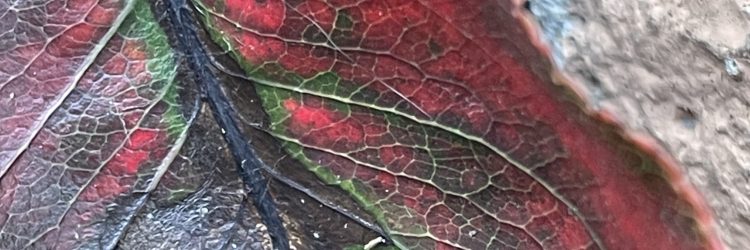
    • Bill 5141 In the News: Press Coverage and Media Coverage
    • Share this page to gather additional support 


    Uncategorized Leave a comment

    Bill 5141 In the News: Press Coverage and Media Coverage

    May 5, 2015 by Henny Kupferstein, Ph.D.

    Legislation would help autistic adults secure employment
    Author(s): Rebecca Botta-Zalucki and Henny Kupferstein
    For The Sunday Gazette Date: June 14, 2015 Section: D

     cbs6CBS News 6 – Albany– Assemblyman Angelo Santabarbara joined advocates from the Schenectady ARC, GRASP and Autism Society of the Greater Capital Region to introduce legislation that will help people with developmental disabilities find a job and thrive in the workplace.

    NEWS10 ABC   ALBANY, N.Y. (NEWS10) – Assemblyman Santabarbara will be unveiling his proposal to help those with autism in the workplace. (Video Below)

    santabarbara_autism

    image
    Bill would aid disabled job seekers: The Legislative Gazette, April 27, 2015
    Assemblyman Angelo Santabarbara joins local disabilities activist Rebecca Botta-Zalucki to push legislation that will provide New Yorkers with developmental disabilities access to communication training. Photo by Richard Moody.


    PR-assemblyman Assemblyman Angelo Santabarbara Press Release: Assemblyman Santabarbara Joins Disabilities Advocates to Unveil Job Training Legislation April 27, 2015


    PR-Kate GRASP.org: Global and Regional Asperger Syndrome Partnership President Kate Palmer outlines her organization’s support for Assemblyman Angelo Santabarbara’s new jobs bill.

    PR-SteveAssemblyman Angelo Santabarbara @asmsantabarbara with Stephen Motto from CUSP Educational Services @CUSPservices, supporting autistic college students with communication and academics and employment success.

    pr-janineAutism Society of Albany, New York Executive Director Janine Kruiswijk outlines the importance of communication support in unlocking the potential of New Yorkers with Autism.

    PR-ARCSchenectady ARC Executive Director Kirk Lewis explains the benefits of communication support to people with developmental disabilities seeking a job.

    pr-chris Angelo Santabarbara @AsmSantabarbara  “Hearing from a speech pathologist about the importance of offering communication support provided in this bill.”


    Click to view Assemblyman Angelo Santabarbara’s Press Release.FOR IMMEDIATE RELEASE:  Press Conference, Monday April 27, 2015 (12:30 pm)

    Additional Links:

    • How To Support Bill A05141 – VR Communication Support for Autistic and other Consumer with language barriers

    • Senator David Carlucci Sponsors VR Communication Support for Autistic Consumers, Senate Bill No. S04256 / A05141

    • ASHA supports Bill No. A05141 on behalf of Speech Therapists

    • NYSACRA and NYSRA fully support A.5141 (Santabarbara) and S.4256 (Carlucci)
    • NYSILC and NYAIL endorse (A.5141 Santabarbara, S.4256 Carlucci) Communication support in Vocational Rehabilitation Communication Support services
    • NYSARC, Inc. Memorandum of Support for A.5141/ S.4256 Autism Communication Support Bill
    • Complete details about this bill

    • Bill 5141 In the News: Press Coverage and Media Coverage
    Uncategorized Leave a comment

    Press Conference, Monday April 27, 2015 (12:30 pm)

    April 24, 2015 by Henny Kupferstein, Ph.D.

    Monday, April 27th, 2015 at the New York State Legislative Office Building in Albany, press conference in support of Bill A05141/S04256, which is designed to transform the opportunities for adults with disabilities who transition into ACCES-VR for vocational training and require equal access through communication support.

    Click to view Assemblyman Angelo Santabarbara’s Press Release.

    Click to view Assemblyman Angelo Santabarbara’s Press Release.

    Additional Links:

    • How To Support Bill A05141 – VR Communication Support for Autistic and other Consumer with language barriers

    • Senator David Carlucci Sponsors VR Communication Support for Autistic Consumers, Senate Bill No. S04256 / A05141

    • ASHA supports Bill No. A05141 on behalf of Speech Therapists

    • Complete details about this bill

    • Bill 5141 In the News: Press Coverage and Media Coverage

    Which assemblymember did you ask to support autistic consumers with Bill A05141? http://tinyurl.com/lx9rxtx

    Uncategorized Leave a comment

    Senator David Carlucci Sponsors VR Communication Support for Autistic Consumers, Senate Bill No. S04256 / A05141

    March 16, 2015 by Henny Kupferstein, Ph.D.

    Senator David Carlucci

    Senator David Carlucci

    Senator David Carlucci, Chair of Mental Health and Developmental Disabilities Committee, sponsors VR Communication Support for Autistic Consumers. Senate Bill No. S04256 (A05141) directs the commissioner of education (John B. King Jr) to amend the education law in relation to vocational rehabilitation services to add a new section (1004-c) for communication support as a vocational rehabilitation service. The deputy Commissioner of Adult Career and Continuing Education Services (Kevin Smith) is to implement the service statewide effective January 1, 2016.

    • How To Support Bill A05141 – VR Communication Support for Autistic and other Consumer with language barriers
    • Complete details about this bill
    • ASHA supports Bill No. A05141 on behalf of Speech Therapists
    • Bill 5141 In the News: Press Coverage and Media Coverage

    First introduced to the New York State Assembly by Angelo Santabarbara as Bill No A05141, This bill is rapidly gaining the support of national organizations that are directly involved with servicing autistic adults.

    • The American Speech-Language-Hearing Association (ASHA) submitted their letter in support of Bill No. A05141.

    Details of This Bill

    Currently, VR spends 80% of their budget for  job coach specialists to train individuals in skill such as mopping floors and bagging groceries. These specialists only need a GED to contract with the state, for up to $42 per hour.  Instead, the bill asks VR counselors to refer to speech therapists or special education teachers to support communication in the workplace.

    This support would be consistent with the needs of the disability and appropriate use of the funding available in the budget. Currently, special education teachers and speech therapists are trained in social pragmatic language disorders, and the nuances of how these challenges interfere with the workplace.  With less spending and more appropriate services, autistic adults stand in an excellent position to redeem themselves of the 90% unemployment rates, depressing the community.

    How Can You Help?

    Contact the chairs of the overseeing committees and ask for them to put this bill on the agenda.

    1. Senate Bill No. S04256:
      Senator John J. Flanagan
      Chair, Education Committee
      Tel: 631-361-2154 or 518-455-2071
      flanagan@nysenate.gov
    2. Assembly Bill No. A05141:
      Assemblywoman Catherine Nolan
      Chair, Education Committee
      Tel: 718-784-3194 or 718-456-9492 or 518-455-4851
      NolanC@assembly.state.ny.us  and collinsj@assembly.state.ny.us

    Share this page [Help Pass Bill A05141 – VR Communication Support for Autistic Consumers], and make a difference.

    Additional Links:

    • How To Support Bill A05141 – VR Communication Support for Autistic and other Consumer with language barriers
    • Complete details about this bill
    • ASHA supports Bill No. A05141 on behalf of Speech Therapists
    Uncategorized 1 Comment

    ASHA supports Bill No. A05141 on behalf of Speech Therapists

    March 10, 2015 by Henny Kupferstein, Ph.D.

    FOR IMMEDIATE RELEASE

    ASHA supports Bill No. A05141 on behalf of Speech Therapists

    ASHA supports Bill No. A05141 on behalf of Speech Therapists

    The American Speech-Language-Hearing Association (ASHA) submitted their letter in support of Bill No. A05141. ASHA is the national professional, scientific, and credentialing association for 182,000 members and affiliates who are audiologists; speech-language pathologists; speech, language, and hearing scientists; audiology and speech language pathology support personnel; and students. Over 16,000+ ASHA members reside in New York.

    What does this mean for VR Consumers?

    Job Coach specialists with New York ACCES-VR are not of a regulated profession. They only need  GED to service consumers.  The new bill changes the mandate to include a regulated profession only to deliver the service of Communication Support. Furthermore, these professions must be of those which train their credentialed members in social pragmatic language disorders.  Currently, these practitioners are Speech Therapists and Special Education teachers, and some psychologists. At this time, Social Workers are not trained in the nuances of these language disorders unless they subscribe for added training. It is important that services be provided in an appropriate manner consistent with the needs of the disability.

    Additional Links:

    • How To Support Bill A05141 – VR Communication Support for Autistic and other Consumer with language barriers
    • Complete details about this bill
    • Bill 5141 In the News: Press Coverage and Media Coverage
    • hare this page to gather additional support 

    Click the screen capture below to read ASHA’s letter of support in PDF format.

    ASHA-support

    Uncategorized Leave a comment

    Complete Details for Bill A05141 – VR Communication Support for Autistic Consumers

    February 18, 2015 by Henny Kupferstein, Ph.D.

    Henny with Senator Charles Schumer

    Henny with Senator Charles Schumer

    Details about this bill, including history and original proposal by Rebecca and Henny

    New York BILL NO A05141

    • Direct link to the Bill
    • Direct link to the original proposal by Rebecca Botta-Zalucki and Henny Kupferstein, submitted to Assemblyman Santabarbara.
    • Bill 5141 In the News: Press Coverage and Media Coverage

    TITLE OF BILL: “An act to amend the education law, in relation to vocational rehabilitation services for enhancing communication support”

    Introduced to the New York State Assembly by Angelo Santabarbara.

    Short Description:

    This bill directs the commissioner of education (John B. King Jr) to amend the education law in relation to vocational rehabilitation services to add a new section (1004-c) for communication support as a vocational rehabilitation service. Deputy Commissioner of Adult Career and Continuing Education Services (Kevin Smith) to implement the service statewide effective January 1, 2016.

    Our Calculations (based on The State Fiscal Year annual reports):

    • 29, 200 Acces-VR annual consumers state-wide
    • 4% ASD = 1,168 individuals
    • 2.8% employed = 32 individuals statewide
    • 88.5% with significant disabilities

    History:

    In June 2013, Rebecca Botta-Zalucki and Henny Kupferstein met with Assemblyman Santabarbara and submitted a proposal (click here to read) for reforming Acces-VR’s failure to adequately support autistic consumers. The proposal outlines an intervention for system change where a radical reduction in the budget would also increase the employment rates significantly.  This change would thereby radically alter the efficacy of the program moving forward, shining a light on the abysmal statistics published by the agency to date. By adding communication support as a service, the agency will support consumers appropriately and dissolve the demoralizing, costly, and ineffective job coaching services that still leave autistic adults without sustainable employment.

    The federal government has given the jurisdiction to the state to interpret their own policies and consolidate funding. In July, 2014, we met with Debora Brown-Johnson, Assistant Deputy Commissioner of ACCES-VR and Michelle Barlow from ACCES-VR Quality Assurance and Monitoring Unit (QAMU) at the New York State Education Department. The proposal was then presented at the council’s open session, putting the matter on the record with State Ed. New York’s State Ed Deputy Commissioner reviewed the proposal in July 2014 but determined that no changes would be made to the policies at that time.

    Rebecca and Henny wish to thank the following agencies and professionals for signing the proposal and supporting this historic piece of legislation:


    (1) Janine Kruiswijk

    Executive Director

    Autism Society of the Greater Capital Region

    101 State Street

    Schenectady, New York 12305

    (518) 355-2191

    www.albanyautism.org


    (2)   Patricia Schissel, LMSW    

    Executive Director, AHA

    www.ahany.org

    888.918.9198, 646.505.6011


    (3) Stephen Motto, MSEd

    Director of Operations

    College & University Support Programs (CUSP)

    PO Box 66367

    Albany, NY 12206

    (518) 203-3913

    www.cuspservices.com


    (4) Lynda Geller, Ph.D.

    Founder

    Spectrum Services

    303 Fifth Avenue, Suite 1003

    New York, NY 10018


    (5) Pamela Chris Howard, CCC-SLP

    www.speech-1.com

    NYS LIC011978-1

    ASHA member 12026062

    member of the Autism Society of America

    member of the Capital Area Speech and Hearing Association

    518-728-4652

    chrishowardspeech@gmail.com


    (6) Mitch Nagler MA, LMHC

    Director, Bridges to Adelphi Program

    Assistant Director, Student Counseling Center

    Adelphi University

    University Center Room 302

    One South Avenue

    P.O. Box 701

    Garden City, NY  11530-0701

    (516) 877-3665

    mnagler@adelphi.edu


    (7) LDA of Western New York

    Mike Helman, Executive Director

    716-874-7200

    mhelman@ldaofwny.org


    (8) Sheila Steinhof, MS,

    -Vice President Programs, Learning Disabilities Association of NYC

    -Governor appointed council member as Student Advocate of the Advisory Council for Licensed Private Career Schools

    -Chair Subcommittee “Student Access” to above council

    http://www.ldanyc.org
    ssteinhof@ldanyc.org


    (9) Stephen Shore, Ed.D.

    Clinical Assistant Professor of Special Education

    Adelphi University

    115B Alumni Hall

    One South Avenue

    P.O. Box 701

    Garden City, NY  11530-0701

    sshore@adelphi.edu

    (857) 225-0304


    (10) Christine Gerber, M.S, CCC-SLP

    Clinical Supervisor/Instructor

    SUNY Fredonia

    280 Central Avenue

    Fredonia NY 14063

    gerberc@fredonia.edu


    (11) Valerie L. Gaus, Ph.D.

    Licensed Psychologist, Private Practice

    64 East Gate Drive

    Huntington, NY 11743

    (631) 692-9750

    www.drvaleriegaus.com

    gaus@optonline.net


    (12) Karen L Colaiacovo

    Disability Resource Coordinator

    Chautauqua Works

    407 Central Avenue

    Dunkirk, NY 14048

    716-487-5127

    kcolaiacovo@chautauquaworks.com

    Uncategorized 1 Comment
    Left to right: Rebecca Botta-Zalucki, Assemblyman Santabarbara, and Henny Kupferstein, holding the signed proposal.

    Help Pass Bill A05141 – VR Communication Support for Autistic Consumers

    February 18, 2015 by Henny Kupferstein, Ph.D.

    Left to right: Rebecca Botta-Zalucki, Assemblyman Santabarbara, and Henny Kupferstein, holding the signed proposal.

    Left to right: Rebecca Botta-Zalucki, Assemblyman Santabarbara, and Henny Kupferstein, holding the signed proposal.  Read the proposal

    URGENT ACTION: Contact your assembly members and help us get our VR communication support bill signed into law. We need more sponsors in the state senate who are interested in autism legislation.

    [Click to read more about this bill]
    [Follow this bill on HennyK / FaceBook]

    Here’s what you’ll need to do:

    1. Contact your state assembly person and ask them to support this bill (list here)
    2. Ask if they are willing to co-sponsor this bill.
    3. Share your personal anecdotes of what this bill means for you and/or your organization.
    4. Share this page on social media, with colleagues, friends, and family. We need the word to get out!

    Step Up Your Advocacy Skills!

    1. Contact NYS Education committee’s chairwoman Catherine Nolan and ask her to support this bill which is now in the hands of the committee.
    2. Contact the members of this committee (list here), and ask them to co-sponsor this bill.

    Remember:

    • Share personal reasons as to why this bill is critical.
    • Scroll down for sample letters and a list of talking points.

    Sample Letter in Support of NY Bill A05141

    Dear Assembly(man/woman),

    It’s time for New York to join the long and growing list of states that support autistic adults in sustaining meaningful employment.  I encourage you to support and move forward New York State Assembly Bill A05141. This piece of  legislation would require Acces-VR (Vocational Rehabilitation) to provide communication support services for consumers with social pragmatic language disorders related to Autism.

    This issue is extremely personal to me and many other voters who care deeply about our financial independence.  Many autistic consumers hold advanced college degrees and require assistance in sustaining a working relationship with a boss, supervisor, and colleagues. Autistic consumers have a medical necessity for communication support in lieu of task training.

    Appropriate support is affordable and available. We no longer need to permit job coaching to continue the often undignified and dated act of skills training. It’s unsettling that it remains perfectly legal to consolidate the VR budget for job coach specialists, some with GEDs, to teach consumers who have advanced degrees and experience. I urge you to support Bill A05141 and vote for it.

    Sincerely,

    Your name

    Sample Talking Points in Support of Bill A05141

    • Social pragmatic language disorders are now a part of the autism diagnosis in the DSM-5.  This also affects individuals who are verbal and highly articulate.
    • 29,000 individuals serviced by Acces-VR in New York, only 4% (1,168 individuals) were autistic consumers. Only 2.8% achieved employment in 2012 or 32 individuals statewide. (Source)
    • Medicaid is now required to pay for speech therapy if there is an autism diagnosis, but only up to age 21. This oversight leaves adults without services and ultimately destitute.
    • Under current federal law, people who receive their autism diagnosis in adulthood are not eligible for OPWDD and cannot receive speech and language services through medicaid or HMO.
    • Intellectual disability is not part of the diagnostic criterion for autism spectrum disorders in the DSM-V. In fact, above-average IQ is expected.
    • The diagnostic criteria for Language Disorder (315.39) is for difficulties which are not attributable to hearing, sensory, motor dysfunction, or another medical condition and are not better explained by intellectual disability.

     [More about this bill] [ Read the proposal ]

    Additional Links:

    • Bill 5141 In the News: Press Coverage and Media Coverage
    • How To Support Bill A05141 – VR Communication Support for Autistic and other Consumer with language barriers
    • Senator David Carlucci Sponsors VR Communication Support for Autistic Consumers, Senate Bill No. S04256 / A05141
    • ASHA supports Bill No. A05141 on behalf of Speech Therapists
    • NYSACRA and NYSRA fully support A.5141 (Santabarbara) and S.4256 (Carlucci) 
    • NYSILC and NYAIL endorse (A.5141 Santabarbara, S.4256 Carlucci) Communication support in Vocational Rehabilitation Communication Support services
    • NYSARC, Inc. Memorandum of Support for A.5141/ S.4256 Autism Communication Support Bill
    • omplete details about this bill
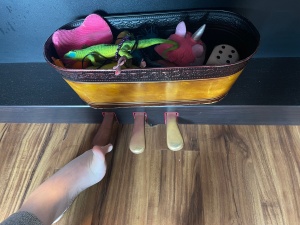
    Uncategorized Leave a comment

    “I am autistic”, not a “person with autism”

    February 2, 2015 by Henny Kupferstein, Ph.D.

    kateandandrewKate and Andrew are autistic. By their own words, they are not “living with Autism” or “suffering from Autism”. Kate is a small business owner and Andrew is a retired attorney that served for thirty years in the New York State Department of Finance. In this video, Kate and Andrew share their thoughts about the politically correct trend of “Person First” language and what they say about a dehumanizing requirement to use disability etiquette amongst professionals.

    Autism is genetic. It is not caused by vaccines, parenting deficits, or birth trauma. Autism is neither an epidemic nor a disease.

    Transcript:

    My name is Kate.
    My name is Andy.
    I am a handwriting instructor, calligrapher, and married woman.
    I am a retired lawyer, and am married to Kate.
    I am autistic.
    I am autistic.
    I am not an individual with autism.
    I am not an individual with autism.
    You are not an individual with youthfulness.
    You are not an individual with Americanism.
    You are not an individual with partial Spanish bilingualism.
    You are not an individual with left handedness.
    You are not an individual with Americanism.
    You are not an individual with Democratic.
    You are not an individual with Judaism.
    You are not an individual with Christianity.
    You matter!
    You matter!
    You are important!
    You are important!

    Uncategorized 3 Comments

    Autism Society Youth Chorus

    October 12, 2014 by Henny Kupferstein, Ph.D.

    The Autism Society’s Youth Chorus pilot program was started in Winter 2013 under the direction of Henny Kupferstein.   The following videos can give you some insight into our work together.

    “What We Learned” – ASA Youth Chorus – 2013-2014
    The Autism Society’s Youth Chorus in a video scrapbook of lessons learned in the weekly rehearsals.

    “Let It Go” with Mikey and Olivia
    Interactive music-making is a piece of cake when collaborating with perfect pitch possessors.

    Autism Society Youth Chorus Thursday night rehearsal

    Uncategorized asaautism societychorusperfect pitchrehearsalyouth Leave a comment

    REALIZED – Album by Henny Kupferstein

    May 21, 2014 by Henny Kupferstein, Ph.D.

    CLICK TO BUY

    Realized is my first album of original music symbolizing the sudden realization of my musical abilities in my early thirties. My Klezmer roots and classical influence weave an uncanny fusion of raw sophistication and poignant lyricism.

     Now Available for instant download:

    • Apple Music / iTunes
    • Spotify
    • YouTube Music 

    Reviews

    Henny Kupferstein, the composer, adventurer, innovator of musical discovery through the prism of perfect pitch and sensory integration, has made a giant leap on her new CD “Realized”. This exquisite and intriguing new music with irregular meter, recurring figures of melodic development and rhythmic vibrancy is perfect for choreographers who yearn for beautiful, interesting and innovative movements with melodic distinctiveness. From the high octane of warmth and hope in “Dealing With It: Five Stages of Grief” and reflective passion of “Laminade” to the improvisational avaunt guard, “Music For People” (which is totally accessible to any taste and my favorite on the CD), Henny Kupferstein is someone to look out for as an up and coming great virtuosity of composition. Listening to the new compositions lets the mind soar and opens closed doors of artistic vision. A must for any theatre artist who uses music in the studio or on stage.

    Clay David, Theatre Director, Choreographer
    Berkeley Playhouse, Circle of Light Theatre, Aurora Theatre
    The Autism Channel

    Support starving artists, they make you feel. 

    Complete List of Tracks:

    1. Sonata No 3 in G for Piano and Cello [length: 6:28]
    2. Al Yis’hallel (Piano Trio)  [length: 3:10 ]
    3. Blouse (Brass Trio)  [length: 2:18 ]
    4. Sonata No 2 in F for Piano  [length: 7:27 ]
    5. Music for People (Unplanned Improvisation)  [length: 2:59 ]
    6. Sonata No 1 in E-Flat for Piano and Violin  [length: 3:30 ]
    7. Cantabile in D (Duet for 2 Clarinets)  [length: 3:56 ]
    8. Dance for Strings, Sonata No 4 in A  [length: 6:32 ]
    9. Laminade (String Quartet)  [length: 4:03 ]
    10. Dealing With It: Five Stages of Grief (Quintet)  [length: 2:52]

    Album Notes

    Sonata No 3 in G for Piano and Cello

    Deep tones open up this piece without the intention of darkening the mood. Instead, the upbeat and steady pulse leads the listener into a journey of cushioned stability. Composed in Winter 2013, This composition is the first and only piece that I have ever written while another person was watching it unfold. This was a unique experiment which grew to incorporate my ideas with the observer’s likes and emotions and into a blended thought. This piece is easy to listen to as the sound progresses meticulously through its start and end points without dragging the listener into its transitions.

    Al Yis’hallel (Piano Trio)

    Al Yis’Hallel is a piano trio composed in Winter 2012 for easy listening. This composition is to be played in a mellow and steady lilting sound, the sound of gentle loving rebuke and to be performed with classical instrumentation for piano, cello, and violin. This piece sings to you all the way through the key change and the gentle end. Inspired by Jeremiah 9:22-23 – “Al yis’hallel chacham b’chachmaso… hagibor b’gvuraso…ashir b’ashro; ki im b’zos yis’hallel hamis’hallel – haskel v’ydoa Osi! – Let not the wise praise himself for his wisdom, nor the strong for his strength/health, nor even the wealthy for his wealth; only for the following can one praise himself: when showing insight, and for that you know/understand Me [God]!”.

    Blouse (Brass Trio)

    After graduating with my music degree, I had to trade my hooded sweatshirts for professional dress. “Blouse” reflects my resentment at having to be all proper while missing my friends from college. Writing for wind instruments was my idea for paying tribute to my favorite musician-friends into one performance experience. When writing for performers, a composer must also take the extra measures to keep the tones within their comfort zone. This piece was a musical expression of my admiration of musicians who have gained exceptional mastery of their instruments. As a thanks to their skill, this piece fits their instrumental ranges comfortably for their utmost enjoyment.

    Sonata No 2 in F for Piano

    The key of F is the most repulsive to my synesthetic ear, a reaction I cannot suppress. I challenged myself to write a solo piece for piano, my most precious instrument of choice. To survive the ordeal, I fought to remain true to the key signature. The listener can hear the desperate attempts to veer into the comfortable relative keys. In the end, I did come home to the key of F to symbolize my discipline as a composer.

    Music for People (Unplanned Improvisation)

    Music for People (MfP) is a non-profit organization dedicated to music-making and music improvisation as a means of self-expression. In the Spring of 2012, I entered the world of making music with others with intentional sharing of sound. The joys of this intimate process is revealing to self and others. This precious moment was captured in a spontaneous recording. There were no discussions before any playing has commenced other than an shared moment to take a deep breath together. Joined by Grammy® Award-winning cellist David Darling, this moment will never be forgotten.
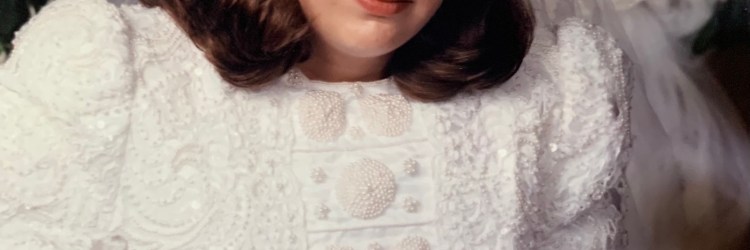
    Sonata No 1 in E-Flat for Piano and Violin

    The Sonata in Eb was a project designed to force me to reduce all the glorious sounds in my head and simplify it for a duet. In a way, choosing the piano felt like cheating since it gave me an opportunity to throw in ten possible notes with each linear moment of the piece. The painstaking effort to make each note carry more weight than a full chord resulted in a very light and fluffy piece for intelligent listening. The melody line is very singable and memorable. The pitch choices create a symphonic texture and pulse change to accommodate the rise and fall of the emotional peaks. This piece symbolizes a complex sound that prints deceptively simple on paper until analyzed.


    Cantabile in D (Duet for 2 Clarinets)

    The idea for this style came from the desire to use traditional notation to dictate a specific thought to the performers with guaranteed replication each time. Cantabile is an Italian term from Late Latin cantābilis, meaning worthy to be sung. In this composition, I wrote the notes with the perfect timing without room for interpretation. This way, my original idea of when to stretch a moment of the phrase can be notated in the passage exactly to be performed in this way each time. This perfect interplay between the two clarinets makes it seem like a lone singer out in the field, begging for an audience.

    Dance for Strings, Sonata No 4 in A

    Writing for strings is such a joy for me. In this string trio, I relied on the skill of my string-playing friends and give them something in their familiar repertoire to explore. This very traditional piece is written in classical instrumentation for cello, viola, and violin. Textures and ideas are explored one at a time so as not to overload the listener. The individual sections flow in a familiar sound of the The Classical period in music history. My personal favorite is the opening to the third movement—Trionfante, to be played with a triumphant and majestic assertion of one’s musical training.

    Laminade (String Quartet)

    This piece was born in the moment of inspiration when experiencing several challenging hurdles. I willed myself into writing something that would not drag the listener into that unforgiving space. The word “laminade” was uttered in conversation that day instead of the word “validate”. The frustrations of the moment leaked into my conversations which pushed me to seek solace in music composing. Written in 45 minutes, this piece helped tide me over that time. By writing for strings without any prior experience, I was able to explore my potential as a composer and self-validate without having to speak.

    Dealing With It: Five Stages of Grief

    “Dealing With It”, is a quintet with non-traditional instrumentation for piano, cello, flute, french horn, and violin. Composed in Winter 2013, the Kübler-Ross “five stages of grief” are represented in the score. Denial, anger, bargaining and depression culminate into a final section of acceptance, sounding out how I deal with it. The number five also represents the my four children and I as a unit.

    Uncategorized Leave a comment

    Sponsor Henny’s workshop presentation at NewCaje 5 in L.A.

    April 28, 2014 by Henny Kupferstein, Ph.D.

    Help me raise $1,500 in 30 days, for airfare and conference fees.

    paypaldonate


    Please help me get to the NewCAJE 5: Jewish Educators Conference 2014, August 10-13 in Los Angeles as your personal investment towards the continuity of Jewish Music Education globally. Please take a moment to share my campaign with your networks so that your friends and colleagues can also have the opportunity to participate.

    My workshop is entitled A Chassid in Conservatory. I will teach Jewish Educators about my duplicable methodology for teaching sight-reading in the classical tradition as a means for teaching the trope Torah-reading tradition to non-verbal, autistic, and special needs students in time for their Bar/Bat-Mitzvah. Learn more about my work at http://www.hennyk.com.

    Background:

    In many special ed programs, a student with an IEP enrolled in an ensemble will be put in the corner to play the triangle. Yet, these individuals are often the most musically talented in the room. In Jewish private schools, music is understood as extracurricular and rarely included in the budget. The tradition of learning trope should not be passed up in lieu of mastering yet another scholastic skill. Students should begin their music education from the earliest age and gain foundational mastery of theory and aural skills. For students with learning differences, specialized music education goals should take precedence for sustaining this beautiful tradition. Empowering the youth of today strengthens their music leadership for tomorrow.

    Tiske L’mitzvot.

    paypaldonate

    Uncategorized Leave a comment

    “ASD Professional Network – teachers, clinicians, practitioners” FaceBook Group

    March 15, 2014 by Henny Kupferstein, Ph.D.

    “ASD Professional Network – teachers, clinicians, practitioners” is a FaceBook group connecting what you know with whom you know!   Administrator: Henny K.

    For: OT, PT, Speech Therapist, Special Education Teachers, Educators, Clinicians, Practitioners, consultants, etc.

    Description: This FaceBook group was created as a safe, private, and secured place for networking between professionals who work with autistic people. To join, send a message to the administrator containing the email address of your professional contacts who can benefit from this group. An email invitation will sent to them.

    <– Return to Resources Page

    Uncategorized Leave a comment

    Autism’s Musical Gift

    February 1, 2014 by Henny Kupferstein, Ph.D.

    Written by Henny Kupferstein, for:

    Autism Aspergers Network Magazine – Issue 3J2014
    http://www.aanmag.com.au

    Autism’s Musical Gift

    AAN Magazine Issue Cover

    AAN Magazine Issue Cover

    In the language of music, communication becomes possible through the give-and-take of tonality, rhythm, timbre, and phrasing.  People who study an instrument for many years can participate in such musical exchanges at improvisation groups, open mic, and jam sessions. For parents who shuttle their children to speech and occupational therapy every other day, music lessons falls to the bottom of the priority list.  In an effort to improve on skills that are presumed to be necessary for daily living, inner expressions become categorized as recreational.  This can be counterproductive, since the autistic brain is specifically wired to have extraordinary musical abilities.

    Autistic people benefit from the neural differences in their auditory perception. This type of detail-oriented information-processing lends itself to preeminence for fine arts (music) over whole-words (language), often resulting in the phenomenon of perfect pitch (“Absolute Pitch”), and synaesthesia.  With non-verbal students, methods for teaching to their gift must be applied, to enhance their educability in all areas of life.  This way, the gift allows them to blaze through their journey towards impressive achievements in music, reading comprehension, mathematics, and social behavior.

    Numerous researchers have studied autistic individuals and their musicality, after they have reportedly demonstrated high intelligence through musical communication. Absolute Pitch has been a captivating phenomenon for researchers, though there are many discrepancies on the correlations between autism and absolute pitch.  Absolute pitch has historically been estimated to exist in 1 in 10,000 of the population. However, current studies mostly tested individuals through note-naming. This language component in the testing is inherently biased against a population with communication differences.  To prove intelligence and musicality, different assessment methods are key.

    Susan Rancer is a music therapist who gets it. Herself a perfect pitcher, Susan maintains a private practice in the San Francisco Bay Area. Her work is devoted to one-on-one teaching in a highly specialized manner. Almost all her autistic students have absolute pitch, and three of her students have transitioned into college.  Susan explains how people with absolute pitch are addicted to sound. They will imitate voices from TV shows, mimic household sounds and car alarms, and learn languages with authentic accents instantly. AP possessors also have a tendency to set impossibly high standards for themselves, and the explode when they do not master a skill instantly. With the ability to instantly match and recall pitch, the possessor believes that everything in life should be mastered with the same instantaneity.   This is the cause of many life frustrations and deflated self-esteem.  The individual begins to think that they are simply stupid, when other things in life do not come to them just as easily.

    Their lessons need to be taught in way so that the student begins creating sound right away.  Teaching scales, fingering, and other foundational techniques will break down the student’s motivation to learn.  Modifying the lesson by using colored stickers to match color-coded notes to keys, is the antithesis to this process. The student does begin to create sound easily, however they learn no new skill which carries over to the functional musical world.  Amongst seasoned musicians, this individual then falls through by the failures of their training.  Alternately, teaching music theory and note-reading is a skill that opens up infinite possibilities, such as college music programs, and music composition.

    Society values a person who plays Mozart on the piano, because reading and making music in the classical tradition is understood as a sign of intelligence. In a speech-oriented world, those who speak, have their thoughts known. All others have to find a way to make their inner thoughts and desires be heard through other means.  My daughter has learned through music therapy that she had the ability to sing, “more ketchup, more ketchup”, by tapping a rhythm to pace herself into a song. Offering the gift of communication to an individual should be a primary goal.  Finding the appropriate method for teaching is critical.

    Parents should fire up their dream of providing piano lessons to their child. Clinicians who specialize in teaching autistic students, have arrived to their understanding by reorganizing piano pedagogy for their practice.  It is critical not to train their students to becoming a Mozart-playing concert pianist.   Music is not the goal; training in the discipline is.  The process of learning is where the magic begins to happen.  For students who possess absolute pitch, the intensity of their gift must be realized, and used to feed the other learning processes.  The professional piano teacher in your neighborhood is not trained to adapt her lesson to teach from the top down. Unable to gauge the educability of the student, the teacher would give up.  On the flipside, music therapists are trained to incorporate ‘increase eye contact’ and ‘improve social interaction’ as a goal for treatment. In between these two professions are the highly gifted individuals who have vast abilities waiting to be accessed.

    Students who have absolute pitch will be able to play anything they have just heard. This prodigious ability gets in the way of the teacher-student relationship, and boggles the mind of traditional musicians.  This is because the autistic brain masters the complex instantly, and then struggles to break it down into the simpler tasks.   When a person can solve an algebra problem in their head, the fundamental math lessons on addition and subtraction can elude such a learner.  For gifted absolute pitch possessors, learning how to read music can be a tedious and even torturous process for both the teacher and the student.  Yet, developing musical knowledge and skills should be understood as an integral part of functional living and social adaptation.

    Nate is a 7-year-old boy that I am currently teaching piano. Nate has a diagnosis of autism, and is functionally non-verbal. During one of our lessons, he entered in a completely overwhelmed state. He immediately began singing our good-bye song. For the parent and for me, this was indicative of the potency of the communication skills that he now developed, as a result of the music training in the previous sessions.  Thanks to the movie, “The King’s Speech”, more people are now aware that individuals with a speech impediment do not stutter while singing. So too, Nate had no difficulty communicating his needs while singing.

    Our auditory perceptions occur alongside the brain functions utilized for gestalt thinking. This whole-word way of thinking incorporates color and texture in its greater picture.  Computational functions such as mathematics are processed in the left brain areas, and are also responsible for speech.  Additionally, this is the area which must be engaged for an individual to be able to follow directions, vocalize thoughts, and recall finer details in their memory. The figure-ground functions in this area are responsible for picking out words from a page, and associating it to a given meaning.   When science is combined with the arts, all areas of the brain are utilized, encapsulating dormant possibilities.

    In many schools, a student with a diagnosis will be enrolled in an ensemble just like all other students. However, if there are behavior issues, the teacher might put them in the corner to play the triangle. Thus, the gift is marginalized, even while this individuals might very well be the the most musically talented in the room.   Instead, the teacher’s goals should include attendance, eye-tracking, fine and gross motor skills, executive function, and motor planning, to name a few. This specific method affords the individual the gift of demonstrating their intellect to family, friends, and teachers. A school district can easily recognize such competence as indicative of higher levels of sophistication.  At this point, the parent can expect the educational team to use this demonstration of student competence to justify taking steps toward mainstreaming.

    A highly specialized teaching method must bridge the arts and sciences to form a multidimensional sum of practice that is greater than its parts.  Art and science are often diametric opposites, however when conjoined, also connect the right and left brain pathways measurable through modern medicine.  The teacher must be a malleator of sound to invoke student perception, thereby creating biopsychosocial change to alter processing of the subject matter.  This methodology relies on the neurological strengths of the absolute pitch possessor to begin forming connections in underutilized areas of the brain.  When quality music is easily created by the absolute pitch student in the session, the intrigue of the multisensory experience from tactile playing and auditory perceptions combined, becomes the motivator for plowing through the lesson.

    Music isn’t what makes us smarter; it is the process of learning it that does.  Working on these goals each week through harmony and rhythm stimulates pattern recognition as translated from symbols. These associations of the musical notes opens the brain up to quantitative reasoning abilities which carry over to every area of life. This is how music can help bring about both dignity for the student with exceptionalities, and a change in social awareness in peer settings for what that student with special gifts can contribute. In the broadest sense, social change can be brought about through equal access and inclusion for arts and education. Acknowledging neurodiversity in music is a step toward inclusive education for all.

    Uncategorized Leave a comment

    Older Adults

    January 14, 2014 by Henny Kupferstein, Ph.D.

    Older adults in assisted living and residents of skilled nursing facilities have so much to offer to society.

    Cantor Dan, a former chazzan has allowed me to capture some magical moments on video.  Please enjoy every moving moment of this 3-minute video:

    Helen (103) benefiting from guided music in a therapeutic session Helen. See her giggle!

    Uncategorized 1 Comment

    Music Improvisation

    December 31, 2013 by Henny Kupferstein, Ph.D.

    rubberduckie2All humans are capable of creating sound to freely express themselves without the barriers of societal judgement. Music is a global language of unity and connection.  Below are some examples of free improvisation sessions, which always occurred without any prior planning. There is no “what key are we in”, no organization, no sheet music, and best of all, no talking!

    • Contact me about hosting a free improvisation experience in your community. All ages and levels of experience are welcome.
    • Search my YouTube channel for more Improv or Improvisation videos.  Samples below:

    Free improvisation, piano and viola:

    Six pianos, 35 pianists

    Free improvisation, piano and  trumpet

    Alphorn, Trombone, Violin, and Piano Improvisation

    Free improvisation, piano and violin

    On the strings of a Steinway grand piano

    Uncategorized Leave a comment

    College Readiness

    November 21, 2013 by Henny Kupferstein, Ph.D.

    “Why are autistic college students getting straight A's but failing their internships?” Presentation at NADD 32nd Annual Conference & Exhibit Show, The Fairmont, San Francisco, CA. November 20, 2015. Video available for staff training.

    “Why are autistic college students getting straight A’s but failing their internships?” Presentation at NADD 32nd Annual Conference & Exhibit Show, The Fairmont, San Francisco, CA. November 20, 2015. Video available for staff training.

    The traditional college journey does not quite happen for autistic people. The dream is achievable, but requires a strategy that is outside the expected norms. Thankfully, there are resources available for guidance and inspiration. For example, did you know that Temple Grandin enrolled in courses that helped her become an expert in Animal Husbandry, by piecing together a degree from online and campus lectures, some of them oversees? Guess what: Nobody cares about those details. All that matters is that she has a degree, and is valued for that achievement. So let’s get together and talk about this for yourself.

    Contact me about my consulting work.

    Uncategorized Leave a comment

    Piano Lessons, Zoom Remote 1:1 Private 

    October 24, 2013 by Henny Kupferstein, Ph.D.

    I teach non-verbal and autistic students to develop their musical gift in a permanent and dignified way. Through evidence-based piano pedagogy for perfect pitch students, there is no fear of rejection because of “behavior problems”.

    • Why Piano Lessons for My Autistic Child? Top 10 Questions Answered by Autistic Piano Teacher.
    • Ready for a consult? Click here to book an appointment
    Strength-based abilities system: What comes before “D”?  If you answered “C”, then you are ready to learn sight-reading for piano.  Beginners and all level of abilities and special needs are welcome.  My specialized method is designed to empower all individuals through piano mastery. Non-verbal and autistic homeschooled students with special needs and/or perfect pitch thrive from piano lessons.

    Scientific-based methodology – The neurobiology of auditory learning accessed during music instruction stimulates language-based skills necessary for educability. All humans are capable of benefiting from this specific methodology, especially non-verbal and autistic clients with enhanced musicality.

    Why Piano? Teaching sight-reading for piano in the classical tradition empowers non-verbal autistic individuals to demonstrate intellect through music.  Because most autistic people have perfect pitch, this process rapidly enriches their daily lives, and carries over to all areas of academia. The moment this can be observed by others, such individuals are recognized as worthy of regular education.

    Can I get smarter by listening to Mozart music every day?  “Nobody ever got fit watching spectator sports.” Making the music, rather than listening to recordings, “transforms your nervous system” and makes you a better learner” (DR. NINA KRAUS (2013) Neurobiologist , Northwestern University, California).

    In my music sessions, I address the following goals:

      1. Cognitive Development:

        1. Increase attention span.

        2. Develop orientation to the environment.

        3. Executive Function Skills 1
      2. Motor Development:

        1. Increase physical coordination.

        2. Improve dexterity and flexibility.

        3. Increase gross and fine motor skills.

        4. Develop hand-eye coordination.

        5. Develop motor-planning skills.

    1. Perceptual Development:

      1. Increase auditory discrimination skills

      2. Develop auditory concepts.

      3. Improve convergence insufficiency
    2. Social Development:

      1. Enriched communication skills.

      2. Enriched group skills

    3. Affective development

      1. Increase self-esteem and self-confidence.

      2. Bring about creative self-expression through music.

    CLICK TO SEE MORE VIDEOS

    Tobi (5), Non-Verbal Autistic, vocalizing for the first time with the help of the music

    Tobi (5), Non-Verbal Autistic, vocalizing for the first time with the help of the music

    oliver

    SEE VIDEO “There is so much to tell you, really. How I found this awesome, incredible teacher. How she recognizes his strengths and teaches to them. How she effortlessly assumes his competency even when I’m still not sure! How she totally gets how he processes information. How I always leave a lesson thinking: Well, this next step is going to be hard! And then how it totally isn’t even a fraction as hard as I imagined! Just thinking about it makes me want to explode with happiness. Happiness for Oliver in his achievement and happiness that I could finally help him do something he has wanted for so long.” ~ Oliver’s Mom, on All About the Music blog

    molly

    “By the third week of her lessons, Molly was a changed person. Empowered by recognition of her creativity, she was able to deal with the bullying at school”.


    One autistic boy’s progress: From screaming, to playing, to note-reading in 3 weeks

    Get Started:

    Click here to contact me for more information.

    Uncategorized autismautisticperfect pitchpiano lessonsspecial needs 1 Comment

    Consulting

    August 20, 2013 by Henny Kupferstein, Ph.D.

    Onsite and remote (Skype, Facetime) consulting services are available for social, emotional, educational, music learning, and sensory issues. Contact me for more information.

    Feedback and Testimonials:

    sensory mat

    Sensory Bath Mat for use on piano bench and on floor near piano peddles.  Click photo for details.

    Nov 8, 2013

    Hi Henny,

    Using the mat worked like magic for my ADD and autistic clients yesterday. One kid, who used to attack the piano, didn’t do that.  He also stayed in his chair for the most part.  All my students improved in ability to concentrate and attend to tasks.

    Best,

    Shauna Joseph RMT
    Registered Music Therapist
    Magically Musical, California

    ——–

    RE: Henny Kupferstein’s consultation services

    To Whom It May Concern:

    With Susan Rancer, RMT - Piedmont, California, April 2013

    With Susan Rancer, RMT – and Brandon, Piedmont, California, April 2013

    On June 24, 2013 Henny Kupferstein spent the day with my five year old daughter, Ruby, to consult with her ABA therapist, my husband and me.  Henny brings a unique perspective to handling issues that surface when raising a child on the autism spectrum. The best therapist in the world cannot know what goes on in an autistic child’s head, but Henny does. Her ability to troubleshoot sensory issues is uncanny. I understood my own child’s challenges better than ever after one day with Henny.

    I look forward to Henny’s next visit so we will all learn more. Without hesitation I recommend Henny’s services to families and therapists. There is no doubt Ruby’s growth and happiness benefited from Henny’s insight.

    Sincerely,

    Lisa

    ————–

    With Susan Rancer, RMT - Piedmont, California, April 2013


    See Patrick Jamming on guitar

    Oct 23, 2013

    Hi Henny,

    Patrick is doing amazing in school this year. His teacher totally believes in inclusion. He started out day 1 with a desk in the general ed 2nd grade class 3 doors down from his special ed class. He is in the gen ed class for math, science and reading plus lunch. All the things you recommended. We are so pleased that they put him there, plus he is doing very well.

    Thanks,
    Jamie

    Uncategorized Leave a comment

    Playing 4 Chords on Piano

    August 15, 2013 by Henny Kupferstein, Ph.D.

    Do you want to play any popular tune on piano in one minute or less?

    IMG_0658

    Tech Talk: In music theory, I-ii-IV-V never let’s you down. In the key of E major, if you play the same four chords over and over again, (E major, F# minor, A major, B major) with inverted chords, you can accompany yourself on the piano in a minute.  Concept by ear:  Left hand typically plays a bassline of Do-Ti-La-Sol in any key = E, D#, C#, B

    Plain English: Try playing these simple notes simultaneously (left -and- right):

    E -and- E, G#
    E -and- F#, A
    C# -and- E, A
    B -and- D#, A

    Instant music!

    Although in this clip, I-V-vi-IV is used, the minor second ii sounds way more exotic. Here’s how the pro’s do it:

    Uncategorized Leave a comment

    Ethan’s Song

    July 23, 2013 by Henny Kupferstein, Ph.D.

    Ethan is ten years old and lives in California.  Ethan agreed to compose a song together with me, and then record it. This video highlights his strengths, especially his Perfect Pitch, and his Autism, his overall wit, and wisdom.  Ethan only heard a single chord played before this song came pouring out from inside of him.  Please help Ethan go viral, since he checks his views and likes each day.  Celebrate awesomeness and share today:

    Uncategorized 4 Comments

    Post navigation

    Search Site:

    Services:

    • Legislative Activism and Agenda
    • Piano Pedagogy Videos: How to Teach to the Gift
    • Piano Lessons (Zoom)
    • Older Adults – Palliative, Dementia, Passing
    • College Readiness
    • Music Improvisation
    • Composing
    • Buy Sheet Music
    • Become a Licensed Developmental Music Educator
    • Consulting
    Follow Henny Kupferstein on WordPress.com

    FaceBook Public Figure page

    FaceBook Public Figure page

    Archives

    Popular Posts

    • Book – Perfect Pitch in the Key of Autism
    • ONLINE SURVEY: Study on Autism Childhood Interventions
    • Before You Pay for Piano Lessons: Little Johnny’s Bill of Rights

    • Reframing Autistic Behavior Problems as Self Preservation: A Freudian View
    • Autistic ABA Survivors Grow into Soul-Crushed Teenagers: Tracing the Roots of the Damage
    • Undoing operant conditioning trauma with autistic piano students
    • A Dog’s Life: Pedagogical Flaws in Repetitive Piano Practice for Autistic Students
    • Tabloid Sensationalism as Barrier to Autism Acceptance
    • Video of 20-Second Sensory Overload Simulation Exercise
    • Putting on the Bar-Mitzvah Tallit: Autism and Motor Skills (VIDEO)
    • “I am autistic”, not a “person with autism”
    • Autism Action NY 2016
    • Help Pass Bill A05141 – VR Communication Support for Autistic Consumers
    • REALIZED – New CD by Henny Kupferstein
    • Legislative Activism and Agenda
    • Don’t get Tricked: How to Spot Unethical Research Solicitations
    • Navigating the Role of an Independent Contractor in Special Education
    • The Scariest BCBA Costume that made us quit ABA
    • Understanding Professional Burnout vs. Autistic Overwhelm
    Parents: paste that IEP into the chatbot bot I made for you. It will find hidden behaviorism language and suggest affirming revisions. Go to msbehaviorism.com #banABA Chanukah story: they tried to kill us. We survived. Let’s commemorate that. #neverforget Day four working on a new painting. What do you see? Hung some art, lit the menorah, and ate some comfort food. Go to ms behaviorism .com to rewrite your IEP to affirming language #banABA Just in time for Chanukah, all the kosher feels #iyk #chassidim #yiddish (bbq flavored snack is now available in cribs for making shnitzel. I mean, come on!) Guava privilege feels so punk. 🌱 #banABA @lind.slaaay just sitting here minding my own ukulele @kaimanabeach

    Follow my work on FaceBook

    Follow my work on FaceBook
    Blog at WordPress.com.
    • Subscribe Subscribed
      • Henny Kupferstein
      • Join 127 other subscribers
      • Already have a WordPress.com account? Log in now.
      • Henny Kupferstein
      • Subscribe Subscribed
      • Sign up
      • Log in
      • Report this content
      • View site in Reader
      • Manage subscriptions
      • Collapse this bar
     

    Loading Comments...