Critique of Compassion as a “Dimension” of Applied Behavior Analysis (ABA)

Look out, behaviorism lovers. We the autistics are monitoring your insistence on rebranding ABA. No matter what you will call it (neurodiversity informed, trauma informed, compassion informed, etc.), we see you. We will continue to publicize our concerns, as clearly, those who practice ABA are not perfect enough, and rely on feedback from their patient group to correct their misbehaviors. 

There is no scientific method in place that considers ‘listening to the voices’ as primary source data. If they want to include our concerns in their research, they should survey us. Behaviorists who keep flagging my 2018 study are most likely to cite Leaf’s critique, while neglecting to cite Chown’s response to the editor

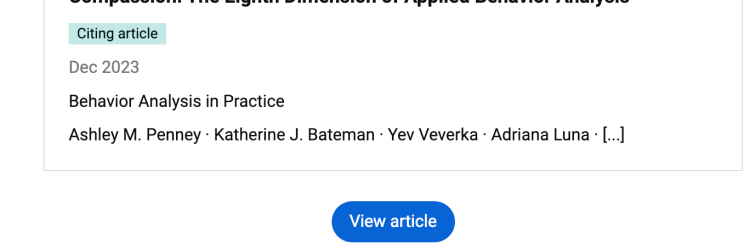
 Oxford Languages  defines Compassion as “sympathetic pity and concern for the sufferings or misfortunes of others” i.e. “the victims should be treated with compassion”. Yet, we have a growing body of behaviorist-led papers that propose adding “compassion” as the 8th principal in their standards of practice. Specifically, this month’s latest publication suggest: “Adding compassion as a definitional dimension of ABA will help behavior analysts find their way back to implementing interventions in a responsive, collaborative, and humble manner that includes working with our consumers and our critics, and listening to perspectives that can help us improve our practice.”

A google scholar search reveals a sublime trend of 17,000 results to the search of “compassion” in “ABA”. As behaviorists are not trained in conducting scientific research, their publications are typically proponents of change, directed at modifying their own. In the realm of adding “compassionate care or therapeutic relationship building” to their standards, we the consumers will be led to believe that we are a subject of their pity. 

Compassion is an engineered concern for our “suffering,” without extinguishing their agenda to modify us. With compassion in their work, we the autistics are the “consumers” of their services, and we are informed to be grateful for their consideration to help us, the ones with the “misfortunes” of being autistic. One compassion-suggesting behaviorist is cited as an early hero, where Wolf and others (1963) “taught a young boy to wear his glasses so that he would not lose his vision”, as an example of application of operant conditioning. If this makes you gag, please comment. 

Ban ABA Initiative

Autistic psychologist Henny Kupferstein, Ph.D. is taking names to push the #federal #banABA of #ABAtherapy in the United States.

Image may contain: 1 person, text

We are a 👨‍🔬👨‍💼👩‍🔧👩‍🎤🕵️‍♀️🧕👮‍♀️👩‍⚕️ rapidly growing movement ✌️ established after watching #cripcamp on #netflix.

💪 Join our private FB Group for ongoing discussion https://www.facebook.com/groups/federalbanaba

👂 Follow 👉Henny Kupferstein, Ph.D. for updates with the #BANaba hashtag 👈

If you have been cyberbullied by an autistic person, please join the Asking Dr. Henny 🏋🏻‍♀️ re: Cyberbullying Autistics facebook group.

To report inequality, please submit the Person or Entity information to our Single-Entry form. Your information must be obtained legally and from public domain.

click-here-to-get-started-logic-board-repair-service-new-york-computer-help  | New York Computer Help
Click to launch the single-entry database form

Who is a Token? A person from underrepresented groups recruited to give the appearance of equality within a workspace. Dr. Henny Kupferstein describes tokenism (Read top-10 flags) as a being invited to a panel discussion at a professional conference, but is asked not to share her autism research, and to contribute exclusively on the basis of her autisticness.

Who is an apologists? A person or entity who will reassert in ever more emphatic and defensive language what most of their audience already takes on faith, by framing the issue as a choice between anecdotes and hard science. An apologist makes futile attempts to fill a psychological void, to make up for genuine needs that are not being met. Guilt, shame, or remorse are feelings that are veiled behind apologist rhetoric.

Who is a Behaviorist? The application of radical behaviorism—known as applied behavior analysis (#ABAtherapy)—is used in a variety of contexts, including applied animal behavior, organizational behavior management, and treatment of mental disorders. Autistic people are injured by forced compliance when the treatment is for a condition that they do not see as disordered. A behaviorist uses language that implies a correction or modification of a trait that they have deemed as maladaptive to the human norm. The behaviorist will entice the buy-in of the parent to choose these treatments by naming the goals that are otherwise achieved by non-autistics by merit of their natural growth and development (i.e. surely you want him to go potty, and surely you want him to speak one day, and graduate high-school?).

Who is an autism hero? A parent who calls themselves a warrior, and claims to be combatting, conquering, winning at a war they declared. This war on autism stems from pandemic rhetoric, ‘this is autism’ campaign about violence and aggression, and anti-vaxers who are convinced their child was injured. Aggression and self-harm is not part of the medical autism diagnosis, and meets the criteria of severe PTSD. A child who develops their existential identity in their formative years will be heavily influenced by compliance training, ‘special’ barriers to equal opportunities at education, and societal influence of being surrounded by their deficits in their everyday world. An autism hero is a person who announces their struggles with their daily battles of combating their child’s will and compromising the autistic’s progress toward moral identity development while under duress.